
Markets
Flag of USA and China on a processor, CPU or GPU microchip on a motherboard. US companies have become the latest collateral damage in US - China tech war. US limits, restricts AI chips sales to China.
Getty Images

China’s DeepSeek turns AI on its head, with US tech stocks on track to lose $1 trillion in value

Nvidia could shed more than $350 billion today, as DeepSeek outscores OpenAI models on some measures.

Despite only being founded in 2023 and reportedly using inferior chips at a fraction of the cost of many of its competitors, Chinese AI lab DeepSeek released the R1 last week — a model that goes toe to toe with some of the biggest names in AI.

Its hardware efficiency, coupled with the fact that it’s free to use and open-source, is a potent cocktail that’s spooked the technology world over the weekend. DeepSeek’s output challenges the “spend billions to accelerate AI progress” narrative, and is sending stocks like Nvidia, Broadcom, and Microsoft plummeting in premarket trading — threatening to wipe as much as $1 trillion off America’s top tech names.

DeepTrouble

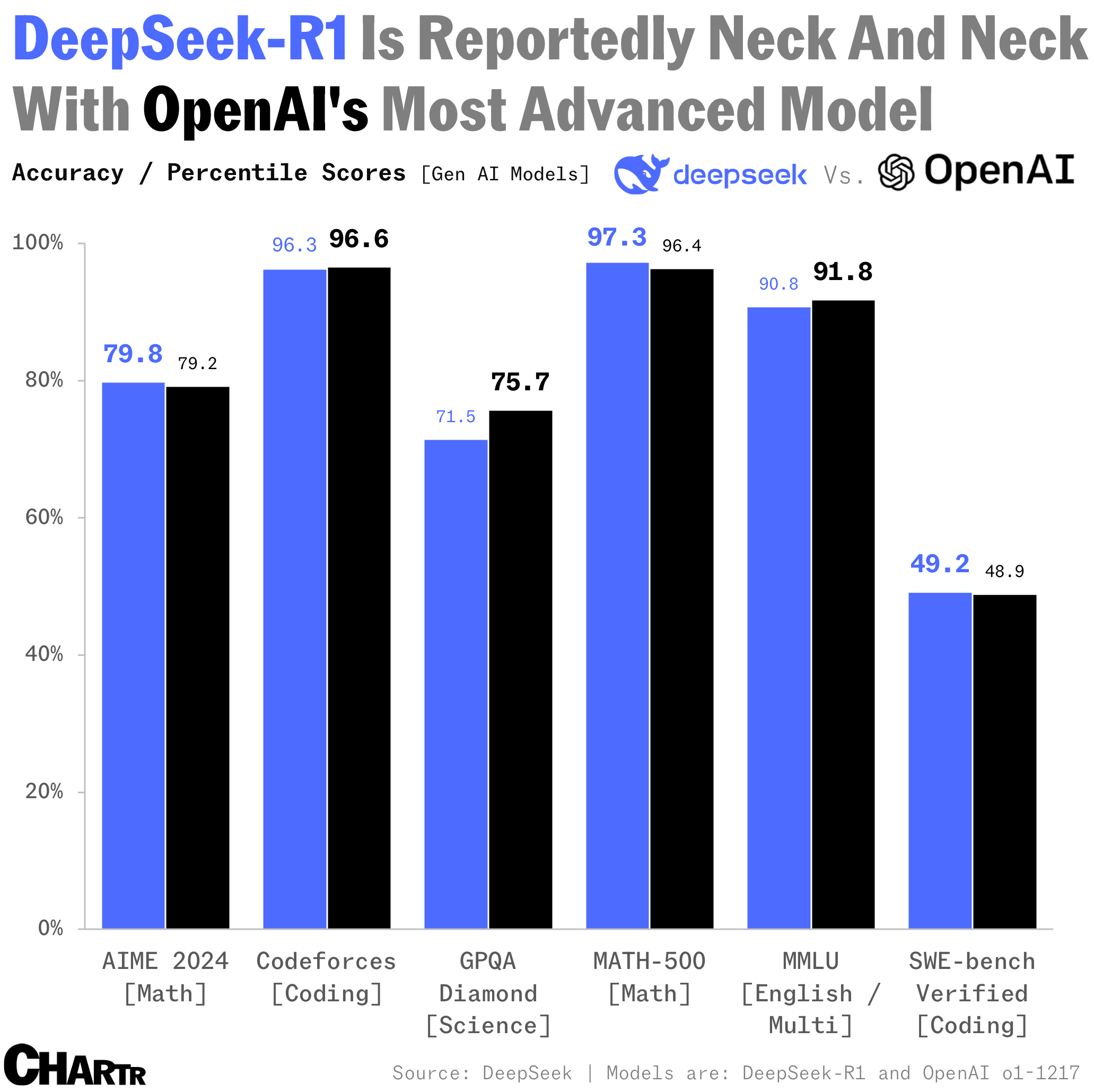
Indeed, the weekend buzz around the large language model — the fact that it “thinks” before it speaks, shows its workings, and matches OpenAI’s most powerful model, the o1, on a range of metrics — seems to have left much of Silicon Valley wowed and worried, in almost equal measure.
DeepSeek
Sherwood News

Per DeepSeek’s own figures, the R1 model outperforms the OpenAI o1 on a variety of key tests, shining particularly brightly in math, where it beats the latest model from Sam Altman’s company on three different tests. While it’s less consistent on coding and language tests — it fared particularly badly on the “SimpleQA” (not shown in chart above), a test evaluating the simple factual accuracy of the info that LLMs spit out — the differences are fairly slim, making the cost-effective R1 look impressive.

The Chinese company’s slimmed-down training costs, use of cheaper chips, API, and open-source model have hauled the endless drive for more chips and compute that’s driven much of the market for the last 18 months into question. Meta, for example, is planning to spend more than $60 billion on capital expenditures just this year.

At a time when people are wondering if we can trust TikTok due to Chinese government ties, many have similar questions about DeepSeek. Tech evangelist Marc Andreessen was among those singing R1’s praises over the last few days — though he may not have asked it about Tiananmen Square yet.

More Markets

See all Markets
markets

Seagate, Western Digital stumble amid reports of customer resistance to AI

Hard disk drive makers Seagate Technology Holdings and Western Digital slumped Wednesday following a report from The Information that Microsoft is facing pushback from software clients who don’t want to pay more for AI-optimized products.

Microsoft contested the report, issuing a statement saying it hadn’t lowered sales quotas or targets. But the story hit squarely on the core issue facing the market right now: whether AI will ever produce enough revenue to pay for the massive investments hyperscalers are making.

As the tumble for hard disk makers shows, this is a market-wide issue. Share prices of hard disk makers have boomed amid expectations that the soaring demand for data storage related to AI investment will juice sales of these cheap storage devices for the foreseeable future.

Seagate and Western Digital are still the second- and third-best-performing stocks in the S&P 500 this year, with gains of roughly 200% and 250%, respectively.

markets

Micron announces exit from consumer business to focus on AI demand

With a lot of AI mouths to feed amid a supply crunch for memory chips, Micron has made the decision to exit its consumer chip business (which goes by the brand name “Crucial”).

“The AI-driven growth in the data center has led to a surge in demand for memory and storage. Micron has made the difficult decision to exit the Crucial consumer business in order to improve supply and support for our larger, strategic customers in faster-growing segments,” said Sumit Sadana, EVP and chief business officer.

Memory chip prices have been surging thanks to demand from the AI boom, with South Korean memory giant SK Hynix saying that it’s already sold out all of next year’s production.

Per the press release, Micron will cease shipments of Crucial-branded items at the end of February 2026.

The product line has been a bit of a misnomer for the memory chip specialist as of late. Sales of Crucial-branded products fall under its mobile and client business unit, and the brand enjoyed a 25% jump in revenues year on year as of its most recent quarter. While impressive growth, that pales in comparison to the more than 200% surge in revenues for its cloud memory business unit, which focuses on high-bandwidth memory chip sales to hyperscalers.

Operating margins in the mobile and client business unit were 29% in its most recent quarter, compared to 48% for the cloud-centric division.

markets

Boeing falls as FTC requires it to divest Spirit AeroSystems assets to complete its $8.3 billion merger

The FTC said on Wednesday that the $8.3 billion merger between Boeing and its key supplier, Spirit AeroSystems, cannot proceed unless Boeing significantly divests Spirit assets.

Boeing shares fell more than 2% on the FTC’s proposed order, which said that Boeing should divest Spirit businesses that supply aerostructures (wings, doors, etc.) to rival Airbus. The assets, including personnel, will be divested to Airbus, the FTC statement said.

The moves would resolve antitrust allegations that Boeing’s acquisition of Spirit — which was spun out of Boeing in 2005 — would allow the plane maker to raise costs on Airbus or degrade its access to certain necessary parts. Boeing, the FTC alleged, could also have the ability to see sensitive information about its competitors.

The public now has 30 days to submit comments on the proposed order.

The moves would resolve antitrust allegations that Boeing’s acquisition of Spirit — which was spun out of Boeing in 2005 — would allow the plane maker to raise costs on Airbus or degrade its access to certain necessary parts. Boeing, the FTC alleged, could also have the ability to see sensitive information about its competitors.

The public now has 30 days to submit comments on the proposed order.

markets

D-Wave Quantum rises as Evercore ISI initiates with “outperform” rating, calling it a “leading play” in industry


D-Wave Quantum is up big on Wednesday after Evercore ISI initiated coverage on the annealing quantum specialist with an “outperform” rating and price target of $44, implying upside of nearly 96% from where the stock closed on Tuesday.

Analyst Mark Lipacis called it a “leading play as the computing industry sees its next Tectonic Shift to a Quantum Computing Era,” highlighting three key things the firm offers to investors:

  1. First quantum company with commercial revenues;

  2. It’s a full-stack play, with services, software, and hardware;

  3. And the ample cash hoard to develop its technology and potentially pursue M&A opportunities.

After its Q3 earnings report, CEO Dr. Alan Baratz told us that bolstering the firm’s gate model system (as opposed to its annealing system, which is its strength) was a priority.

“With the roughly $830 million in the bank, we have the resources to be able to invest more in that program, both internal investment and through acquisition,” he said. “We have one customer who has said, when you have a gate model system, I want it. So it expands our TAM [total addressable market], and it allows us to further grow our revenue.”

While commercial opportunities for publicly traded quantum computing companies have been relatively limited to date, particularly outside of D-Wave, Evercore’s Lipacis argues it’s not too early to invest in the industry.

“Each successive Tectonic Shift in Computing surprised investors with new workloads, and created stock performance of 100x-to-1,000x for full-stack ecosystem leaders,” he wrote. “To be clear, with over 40 quantum companies competing and no clear-cut leaders, we expect a shakeout, but to capture full-alpha, history shows you need to get in 10-years before the Tectonic Shift actually happens.”

He thinks that D-Wave will capture 12% of a quantum computing market that BCG estimates will be between $15 billion to $30 billion by 2035.

Latest Stories

Sherwood Media, LLC produces fresh and unique perspectives on topical financial news and is a fully owned subsidiary of Robinhood Markets, Inc., and any views expressed here do not necessarily reflect the views of any other Robinhood affiliate, including Robinhood Markets, Inc., Robinhood Financial LLC, Robinhood Securities, LLC, Robinhood Crypto, LLC, or Robinhood Money, LLC.