
Markets
TOPSHOT-US-ECONOMY-BANKING-YELLEN
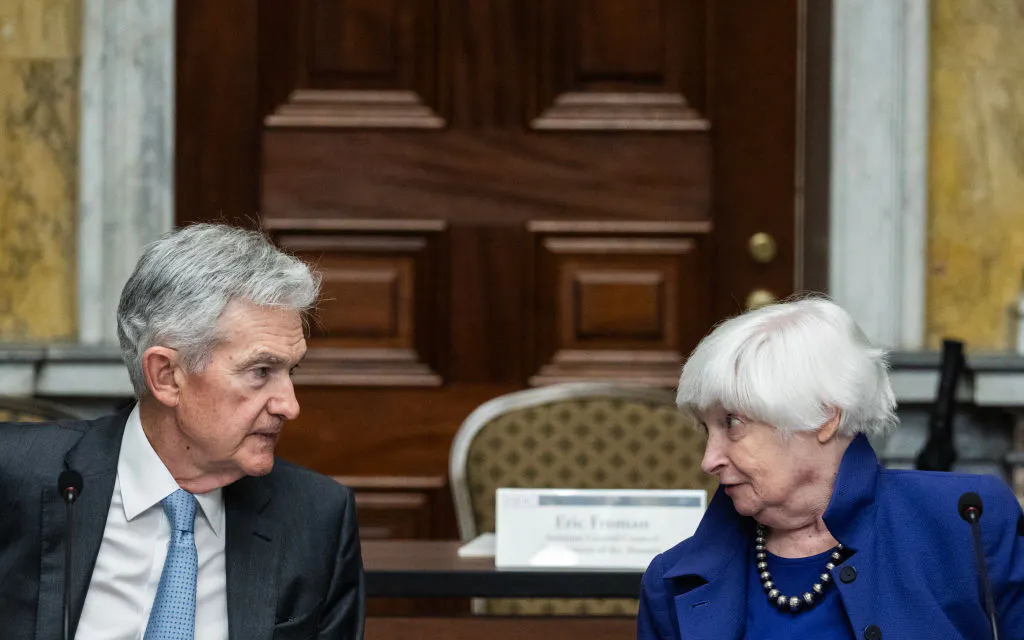
Jerome Powell and Janet Yellen (Photo by Andrew Cabellero-Reynolds/AFP via Getty Images)

The Federal Reserve always thinks we live in unusually uncertain times

One possible explanation for institutional inertia

Luke Kawa

With US monetary policymakers about to deliver an interest rate decision and updated economic forecasts, only one thing’s for certain: uncertainty.

Each quarter, every Fed official submits their own summary of economic projections, which includes their outlooks for how GDP growth as well as the inflation and unemployment rates will evolve over time.

Then monetary policymakers are asked, “Please indicate your judgment of the uncertainty attached to your projections relative to the levels of uncertainty over the past 20 years” — whether the outlook for that variable is more uncertain, less uncertain, or broadly similar versus the past two decades.

Only once since mid-2011 have more officials found the outlook for any one of these metrics to be less uncertain than usual — core PCE in September 2016.

But for GDP growth…

…and the unemployment rate, things are always allegedly a little more up in the air than normal.

Some of the key global economic milestones that have been in the rolling 20-year rear view mirror as the Fed’s been assessing how uncertain the world is:

The manifold emerging markets crises during the mid and late 1990s, Long-Term Capital Management’s implosion, the dot-com bubble, September 11th and ensuing wars, China’s accession to the WTO, the US housing bubble, global financial crisis, European debt crises, China’s devaluation of the yuan, Brexit... the list goes on.

Something’s always happening. But just as we are not all above-average drivers, not every period can have above-average uncertainty. (Perhaps monetary policymakers’ assessments are just convenient cover to avoid appearing overly confident, lest a tail risk tear their forecasts asunder.)

Otherwise, it’s a bit disconcerting that Fed officials consistently have such a skewed view about how uncertain economic conditions are. Especially because it seems like heightened uncertainty is not being used as an excuse to be more nimble in setting monetary policy. 

On the one hand, if you’re always very uncertain, it stands to reason that you should be more adaptive and willing to change your mind in response to new information — to take one step forward and two steps back to navigate a malleable world.

But monetary policymakers don’t operate by that code. A number of Fed officials have said (paraphrasing) that the worst thing they can do is take an action then reverse it — in this case, cut rates and then have to hike rates soon thereafter because they misjudged the persistence of inflationary pressures. In their eyes, this would be very detrimental to the credibility of the Federal Reserve as an institution. (Mary Daly, Raphael Bostic, and Christopher Waller immediately jump to mind as having made this argument, though I’m pretty sure there are others.)

The Federal Reserve is (rightly and wrongly) often accused of always behind behind the curve — too late to ease or raise rates. And one reason there’s a kernel of truth within these critiques is this inherent bias towards inaction coupled with what’s perceived to be never-ending regime of elevated uncertainty.

More Markets

See all Markets
markets

WSJ reports GameStop is preparing an offer for eBay and has quietly been building a stake in the company

GameStop is preparing an offer for eBay and has been quietly building a stake in the company, according to a report from The Wall Street Journal, a move it calls “part of CEO Ryan Cohen’s audacious plan to turn the trailer into a $100 billion-plus juggernaut.”

From WSJ:

GameStop, which has a market value of around $12 billion, has been quietly building a stake in eBay’s shares ahead of a potential offer, the people said. EBay is several times GameStop’s size, with a market value of around $46 billion. 

GameStop could submit an offer for eBay as soon as later this month, the people said. 

If eBay isn’t receptive, Cohen could decide to take the offer directly to eBay’s shareholders, one of the people added. Details of the potential offer for eBay couldn’t be learned. 

Shares of GameStop rose 7.4% after hours following the report, while eBay soared 12%. 

GameStop, which has a market value of around $12 billion, has been quietly building a stake in eBay’s shares ahead of a potential offer, the people said. EBay is several times GameStop’s size, with a market value of around $46 billion. 

GameStop could submit an offer for eBay as soon as later this month, the people said. 

If eBay isn’t receptive, Cohen could decide to take the offer directly to eBay’s shareholders, one of the people added. Details of the potential offer for eBay couldn’t be learned. 

Shares of GameStop rose 7.4% after hours following the report, while eBay soared 12%. 

US airlines pop on report Spirit preparing to shut down as government rescue deal fails to gain support

US airlines are spiking on Friday following a Wall Street Journal report that low-budget carrier Spirit Airlines is preparing to shut down. According to CBS News, the airline could cease operations as early as Saturday, barring an intervention.

In late April, President Trump said he would “love somebody to buy Spirit.” The administration weighed a $500 million rescue package, though it received significant blowback from members of Congress and ultimately didn’t receive support from Spirit’s creditors.

On Friday, Trump told reporters that the administration has given Spirit a “final proposal.”

Shares of Spirit’s rivals surged on the report, with budget carriers like Frontier Airlines and JetBlue climbing by double digits. The big four — Delta Air Lines, United Airlines, American Airlines, and Southwest Airlines — rose by low single digits. Alaska Air and Allegiant also saw a bump.

markets

Estée Lauder gets a glow-up after earnings beat, guidance hike

Estée Lauder shares are soaring after the beauty giant released Q3 earnings results that topped expectations and raised its full-year outlook, while also expanding its restructuring plan.

The key numbers:

  • Revenue of $3.71 billion (compared to analysts’ estimate of $3.69 billion).

  • Adjusted earnings per share of $0.91 (estimate: $0.65).

Estée Lauder also lifted its full-year earnings outlook to a range of $2.35 to $2.45 per share, up from $2.05 to $2.25 previously.

The bottom line is getting flattered by job cuts, with management increasing that target to as many as 10,000 roles, up from a prior range of 5,800 to 7,000, as part of a broader effort to streamline operations and shift toward faster-growing sales channels.

The rally comes after a tough stretch for the stock, which is down more than 20% year to date, with the results inspiring hope that its turnaround efforts will bear fruit.

CEO Stéphane de La Faverie said fiscal 2026 is “promising to be the pivotal year we intended,” with the company expecting to restore organic sales growth and expand margins for the first time in four years.

Amid these positive signals, Estée Lauder flagged risks from tariffs, geopolitical tensions, and potential disruptions tied to the Middle East.

Latest Stories

Sherwood Media, LLC produces fresh and unique perspectives on topical financial news and is a fully owned subsidiary of Robinhood Markets, Inc., and any views expressed here do not necessarily reflect the views of any other Robinhood affiliate, including Robinhood Markets, Inc., Robinhood Financial LLC, Robinhood Securities, LLC, Robinhood Crypto, LLC, Robinhood Derivatives, LLC, or Robinhood Money, LLC. Futures and event contracts are offered through Robinhood Derivatives, LLC.

