
Markets
St Louis Battlehawks v Memphis Showboats
The FedEx Cares relay (Wes Hale/Getty Images)
FedExpectations

FedEx’s quarterly report is exactly what you don’t want to see in the upcoming earnings season

FedEx’s results underscore that while tariffs are a solved problem in the eyes of the stock market, they are not for US executives.

Luke Kawa

FedEx’s quarterly report is every fear that could be realized during the second-quarter earnings season rolled into one.

The stock market is a game of “what have you done for me lately?” or, more accurately, “what are you going to do for me in the future?” So when the US shipping giant posted better-than-expected fourth-quarter earnings but an ugly outlook for the three months ending August, shares tumbled (though they’ve pared losses to about 2.6% as of 10:55 a.m. ET).

The FedEx conference call was dominated by one key line of questioning: how much is spending changing depending on the tariff outlook? Was there a drop-off in spending and then a big rush to buy after levies were scaled back? Or a massive spike in demand ahead of potential tariffs that then subsided? In other words: was your success a one-off, or is it repeatable?

Those are some queries that seeped into first-quarter earnings discussions, despite Liberation Day coming after the end of March. Most notably, look at Apple’s iPhone sales. Some other instances where management faced questions surrounding pulled-forward demand in the Q1 reporting period included Texas Instruments, Power Integrations, Intrepid Potash, and Mobileye, to name a few.

“Whether or not there is consumer pull forward is TBD,” Chief Customer Officer Brie Carere said, while adding that activity over the quarter was also quite lumpy. “Customs entries in May were double the January through April average.”

If FedEx is any indication, these questions are going to get asked more and more often during the upcoming reporting period.

While executives may not have all the answers, FedEx’s poor guidance for the current quarter, as well as how poorly the stock is doing relative to the overall market, speaks volumes. The stock, which has a reputation as something of an economic bellwether given its connections to global trade and consumer demand, is trading at its lowest level relative to the S&P 500 since 2001, when the US was in recession after the dot-com bubble burst. 

It’s dangerous to extrapolate from any one company’s results, and FedEx’s underperformance includes company-specific issues and is certainly not a pure signal of impending US economic doom. But its C-Suite is far from the only one that continues to fret about the potential impact of levies on US imports and retaliatory measures from other countries.

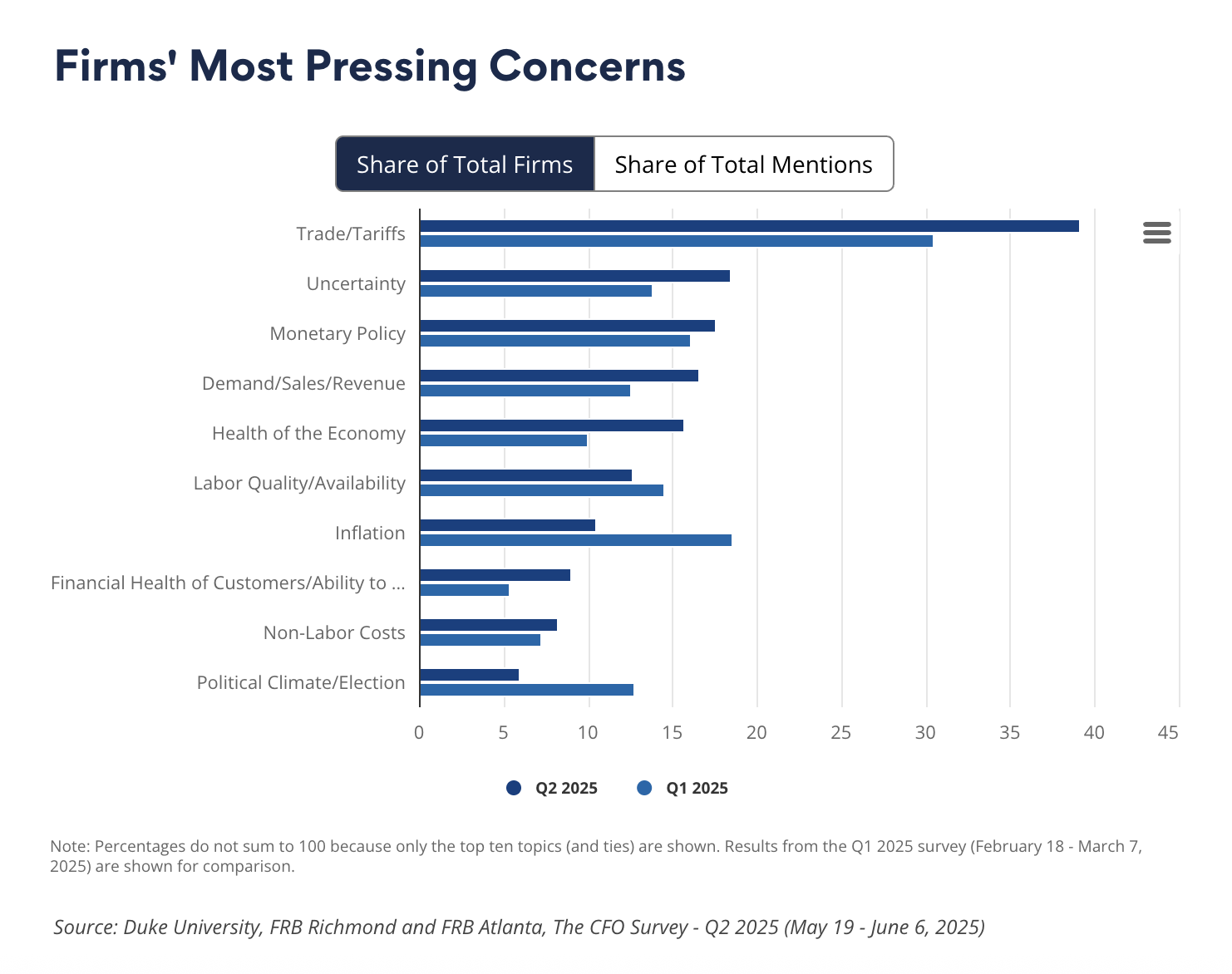
The recent release of the Q2 CFO Survey reveals an increased level of angst around tariffs in corporate boardrooms. The share of firms that cited trade or tariffs as their most pressing concern picked up from Q1 to Q2.

Of note: this survey was conducted between May 19 and June 6, a period when the S&P 500 was already about 20% above its early April lows, reciprocal tariffs had already been watered down, and a trade truce with China had been reached.

Tariffs, in the eyes of the stock market, are a solved problem. In the eyes of US executives, they are not. 

“We have a referendum on global supply chains every single day,” FedEx president and CEO Rajesh Subramaniam said, which is obviously not an ideal operating environment, to say the least.
CFOSurvey

In addition to “what have you done for me lately?” the stock market is also a game of “what’s in the price?”

And that’s where another tidbit from FedEx bears monitoring: its capex budget for the 12 months ending May 2026 came in about half a billion below expectations, at $4.5 billion.

One firm’s capex is another firm’s profits. Because investment outlays are depreciated over time by the spender but recognized immediately as revenues by the recipient, capex has an accretive effect on overall earnings.

Thanks in large part to increased confidence in the longevity of the AI boom, S&P 500 12-month forward capex estimates are at all-time highs. So are earnings-per-share forecasts.

The good news is that FedEx, a decidedly un-AI company, is not as representative of the market-cap-weighted S&P 500, which is dominated by megacap tech firms.

The bad news is that sufficiently negative macroeconomic dynamics come for every firm, as we saw quite clearly during March and early April.

And the OK news is that it’s not clear FedEx is an especially potent macro bellwether, or whether the US economy is in the midst of a drawn-out slowdown or suffering a more severe loss of momentum.

We’ll have to wait for the real start of earnings season in a few weeks to find out.

More Markets

See all Markets
markets

Boeing reports better-than-expected Q1 earnings, revenue

Plane maker Boeing reported its first-quarter earnings before the market opened on Wednesday. Its shares climbed more than 3% in premarket trading.

For Q1, Boeing reported:

  • Adjusted loss of $0.20 per share, compared to the loss of $0.68 per share expected by Wall Street analysts polled by FactSet.

  • Revenue of $22.22 billion, compared to estimates of $21.85 billion.

Boeing reported negative $1.45 billion in free cash flow in Q1, compared to the negative $2.34 billion expected by Wall Street. Prior to Wednesday, Boeing had reported two consecutive quarters of positive FCF following six straight quarters of negative results. The company is still guiding for full-year FCF of between $1 billion and $3 billion.

Earlier this month, Boeing announced it had delivered 143 commercial jets in Q1, up 10% from the same period last year and ahead of rivalAirbus, which delivered 114. This was Boeing’s first time out-delivering Airbus since 2018.

markets

GE Vernova, top AI energy play, rises after Q1 report

GE Vernova, a maker of power plant equipment that’s seen orders tied to data centers surge, rose early Wednesday after posting strong Q1 results and lifting full-year sales guidance. The GE spinoff reported:

  • Adjusted EBITDA of $896 million vs. the $772 million estimate from analysts polled by FactSet.

  • Total revenue of $9.34 billion vs. the $9.25 billion consensus expectation from analysts polled by FactSet.

  • Full-year 2026 sales guidance that was lifted to between $44.5 billion and $45.5 billion vs. prior guidance of between $44 billion and $45 billion, and consensus of $44.64 billion.

“In the quarter, our electrification segment booked $2.4 billion in equipment orders to support data centers, more than all of last year” said CEO Scott Strazik.

GE Vernova is up some 600% over the last two years through Tuesday’s close, but the majority of those gains were booked by August 2025. After being largely range-bound for months, the stock busted out following the company’s last earnings report, lifting the shares up nearly 50% in 2026.

markets

Vertiv drops after offering uninspiring Q2 guidance, overshadowing solid Q1 beat

Shares of Vertiv Holdings dropped as much as ~6% in early trading on Wednesday after the data center equipment’s better-than-expected Q1 numbers were overshadowed by uninspiring guidance.

For the quarter ended, March 31, 2026, Vertiv reported:  

  • Q1 adjusted earnings per share of $1.17 vs. the $1.00 consensus expectation from analysts surveyed by FactSet.

  • Sales of $2.65 billion vs. the $2.64 billion expectation (compiled by FactSet).

  • For Q2, Vertiv expects adjusted earnings of between $1.37 and $1.43, coming in below the $1.43 consensus estimate at its midpoint.

  • Q2 guidance for Vertiv net sales of $3.25 billion to $3.45 billion also vs. Wall Street’s call for $3.40 billion.

Vertiv, which listed in February 2020 as a result of GS Acquisition Holdings Corp., a so-called blank-check company, merging with private equity-owned Vertiv Holdings, has soared over 300% over the last year through Tuesday’s close, as investors have rushed to snap up shares of companies poised to collect some of the hundreds of billions of dollars in spending that the hyperscalers are pouring into the data center build-out. 

markets

Adobe rises on $25 billion stock buyback

Adobe was up as much as 3.5% in early trading on Wednesday after the company announced a share repurchase plan worth up to $25 billion, signaling to investors that company management sees retiring shares as a prudent use of capital at these levels. The stock has been down more than 60% since Feb 2024, largely on concerns that AI tools will disrupt the company’s business.

The new authorization, which Adobe detailed will extend through April 30, 2030, “is a direct expression of confidence in our robust cash flow and the long-term value we are delivering to investors,” said CFO Dan Durn in a press release.

Indeed, fears that new agentic models could affect demand compounded when Anthropic unveiled Claude Design last week, sending the company’s shares down on the announcement. Adobe released a series of AI-enabled customer service functions shortly after. Rival Figma, which Adobe was set to acquire before the deal was blocked by regulators, has also been under pressure.

Adobe is also not the only spooked software company proposing new buyback plans to bring investors back, joining Salesforce, which actually issued debt to buy back shares in a programme of the same size ($25 billion).

markets

United beats Q1 earnings and revenue estimates, lowers full-year profit guidance amid surging jet fuel prices

United Airlines reported its first-quarter earnings results after the bell on Tuesday. The carrier’s shares ticked down in after-hours trading.

For Q1, United reported:

  • Adjusted earnings of $1.19 per share, compared to the Wall Street estimate of $1.08 per share compiled by FactSet.

  • $14.6 billion in revenue, compared to the $14.39 billion consensus estimate.

In the first quarter, United’s fuel expense grew 12.6% from the same period last year to $3.04 billion.

For the second quarter, United expects adjusted earnings per share of between $1 and $2, shy of Wall Street expectations of $2.08. For the full year ahead, United said it expects earnings between $7 and $11 per share, compared to its prior guidance of between $12 and $14 per share.

“Guidance assumes United’s revenue recovers 40% to 50% of the fuel price increases in the second quarter, 70% to 80% of the fuel price increases in the third quarter and 85% to 100% of the fuel price increases in the fourth quarter 2026,” read the company’s investor update.

Earlier this month, United was among the first major US airlines to hike its bag fees amid higher fuel costs. Its shares have fallen more than 15% from a February high days before the war in Iran began.

United has also made waves this month following reports that CEO Scott Kirby had floated the idea of a merger with American Airlines to President Trump. A merger between two of the big four airlines would create a true US behemoth, controlling more than a third of the American market. American Air last week said it wasn’t interested in merging with United and hadn’t held talks on the idea. On Tuesday, Trump told CNBC that he doesn’t like the idea either.

Latest Stories

Sherwood Media, LLC produces fresh and unique perspectives on topical financial news and is a fully owned subsidiary of Robinhood Markets, Inc., and any views expressed here do not necessarily reflect the views of any other Robinhood affiliate, including Robinhood Markets, Inc., Robinhood Financial LLC, Robinhood Securities, LLC, Robinhood Crypto, LLC, Robinhood Derivatives, LLC, or Robinhood Money, LLC. Futures and event contracts are offered through Robinhood Derivatives, LLC.

