Tech
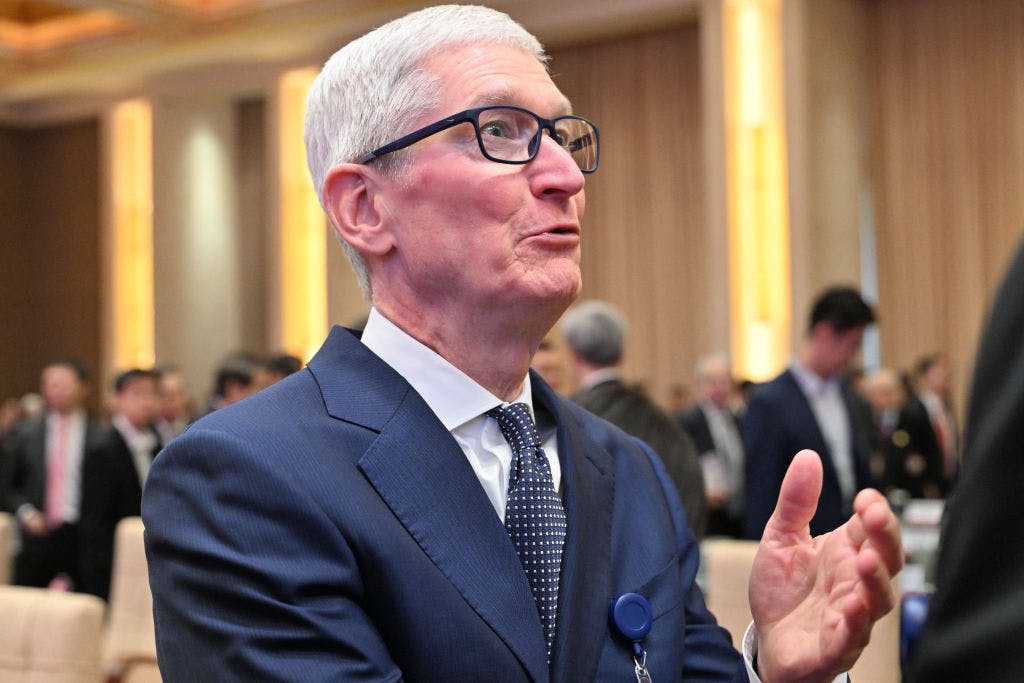
Apple CEO Tim Cook
Apple CEO Tim Cook attends the opening ceremony of the China Development Forum in Beijing on March 23, 2025 (Adek Berry/Getty Images)

Apple slumps as big iPhone sales that drove earnings and sales beat may be tariff-fueled one-off

Revenue and EPS beat analyst expectations.

Rani Molla

Apple beat analysts’ expectations, bringing in adjusted earnings per share of $1.65 (the FactSet consensus estimate was $1.62) and revenue of $95.4 billion (analysts forecast $94.5 billion). Its iPhone revenue was $46.8 billion, compared to the $45.97 billion analysts expected and up about 2% from the $45.96 billion it was in Q2 2024.

Apple is trading down after-hours.

While overall sales were strong, revenues from China declined and missed estimates, and its services sales were also a touch light.

Moreover, there’s concern that its iPhone sales, which notably exceeded expectations, represent a one-off pulling forward of demand from customers worried that tariffs will drive up its costs.

Investors will be focused on any color about how and where Apple is moving its supply chain and how these trade levies might affect the company.

The Trump administration’s tariffs on China stand to hurt Apple more than any other Big Tech company. Apple makes about 75% of its revenue from physical products, including iPhones and Macs that are mostly made in China, where tariffs are as high as 145%. Apple and other semiconductor-based electronics companies were recently granted an exemption from those tariffs only to learn they were simply being thrown into other buckets, whose levies have yet to be specified.

The Financial Times recently reported that Apple was trying to move all of its manufacturing for iPhones for the US market to India next year.

Apple had faced sluggish iPhone sales, with a year-over-year iPhone revenue decline last quarter. Additionally, it’s been lagging its peers in the AI space and has delayed a number of AI features from its iPhone 16 — something that culminated in a personnel shakeup and may be slowing new purchases of its flagship product even more.

Apple has also been beset by legal troubles recently.

Following its own antitrust trial back in 2021, Apple was told to enable third parties to direct customers off the App Store to make in app-purchases. Apple did so but charged a 27% commission on purchases that happened on those third-party websites — a work-around that a federal judge yesterday forbade it from doing in a ruling that could cost the company billions in revenue each year.

And as part of Google’s antitrust remediation, Apple also stands to lose the roughly $20 billion a year it gets from the search giant to be the default browser on iPhones.


More Tech

See all Tech
tech

Meta to lay off 8,000 employees, move 7,000 to new initiatives related to AI

On Wednesday, Reuters reported Meta plans to lay off about 8,000 employees in three batches and move another 7,000 employees to “new initiatives related to AI workflows.” The company also plans to “eliminate managerial roles,” though Reuters did not specify how many.

Reuters had previously reported the number and date of the layoffs, but details of the restructuring come from a new internal document from the company’s head of human resources. The cuts come as Meta tries to balance its enormous capex budget of $125 billion to $145 billion this year, as it builds out its AI infrastructure.

As of the company’s last earnings report, its headcount was 77,986.

Reuters had previously reported the number and date of the layoffs, but details of the restructuring come from a new internal document from the company’s head of human resources. The cuts come as Meta tries to balance its enormous capex budget of $125 billion to $145 billion this year, as it builds out its AI infrastructure.

As of the company’s last earnings report, its headcount was 77,986.

tech

Google employees are now competing with Anthropic and Meta for access to Google compute

Google built its reputation as a paradise for ambitious researchers: a place where smart people got massive resources and freedom to experiment.

But in the AI era, the physical infrastructure that powers those breakthroughs is maxed out, and even Google’s own employees are reportedly struggling to get enough computing power.

According to Bloomberg, the bottleneck comes down to hardware. Google’s custom-built AI chips — tensor processing units, or TPUs — are in such high demand that internal researchers say they’re effectively competing for rack space against massive, paying cloud customers like Anthropic and Meta. Frustrated by the bureaucracy of fighting for server time, top engineers are jumping ship to launch their own startups, arguing they can secure more reliable access to infrastructure on the open market than inside the company that actually builds it.

In other words: Google became so successful at selling AI infrastructure that its own researchers now have to justify experimental projects against revenue-generating workloads and a more than $460 billion backlog of paying tenants.

According to Bloomberg, the bottleneck comes down to hardware. Google’s custom-built AI chips — tensor processing units, or TPUs — are in such high demand that internal researchers say they’re effectively competing for rack space against massive, paying cloud customers like Anthropic and Meta. Frustrated by the bureaucracy of fighting for server time, top engineers are jumping ship to launch their own startups, arguing they can secure more reliable access to infrastructure on the open market than inside the company that actually builds it.

In other words: Google became so successful at selling AI infrastructure that its own researchers now have to justify experimental projects against revenue-generating workloads and a more than $460 billion backlog of paying tenants.

$420

Elon Musk once promised to take Tesla private at $420. More recently, he’s been offering xAI employees $420 to hand over their private tax returns as training data for Grok, Bloomberg reports, citing internal chats. In an effort to boost the chatbot’s tax-prep capabilities, the company asked employees — as well as friends and family — to submit completed tax returns in exchange for cash that, two months later, still hasn’t materialized. xAI is owned by the soon-to-be-public SpaceX.

tech

EY retracts report with apparent AI hallucinations

Consulting firm EY has retracted a report on travel loyalty points that an AI watchdog had found was full of hallucinations.

AI-detection firm GPTZero alleged that the report was “riddled with hallucinations,” including citing numerous sources that didn’t appear to exist. Sherwood News exclusively reported on GPTZero’s findings about the report on Thursday. EY didn’t respond to multiple requests for comment.

The firm later told the Financial Times that it had retracted the report, saying it was “reviewing the circumstances that led to this article’s publication.” It said the study wasn’t connected to work for any of its clients. 

“EY Canada takes the accuracy of all the content we publish seriously and we have an organization-wide commitment to the responsible use of AI,” EY said, according to the FT.

A link to the report on EY’s site now displays an error: “Oops! We couldn’t find the page you were looking for.” 

The firm later told the Financial Times that it had retracted the report, saying it was “reviewing the circumstances that led to this article’s publication.” It said the study wasn’t connected to work for any of its clients. 

“EY Canada takes the accuracy of all the content we publish seriously and we have an organization-wide commitment to the responsible use of AI,” EY said, according to the FT.

A link to the report on EY’s site now displays an error: “Oops! We couldn’t find the page you were looking for.” 

tech

Elon Musk expects Tesla Robotaxis to be “widespread” in the US by the end of the year

After an uncharacteristically clear-eyed earnings call where Elon Musk was cautious about the timing of the company’s many ambitious goals, the Tesla CEO is back to making his usual unlikely predictions:

“We already have some vehicles operating with no people inside and no safety monitors in three cities in Texas, and it probably will be widespread in the US by the end of this year,” Musk said by video at the Smart Mobility Summit in Tel Aviv on Monday. It’s a prediction Musk has made before, but that doesn’t mean it’s going to happen.

Tesla’s expansion of its Robotaxi service, which launched nearly a year ago, has been painstakingly slow. The vast majority of the Robotaxis — more than 500 in the Bay Area — have a person behind the wheel using a version of Supervised Full Self-Driving. In Austin, 12 of the 40 Robotaxis have been spotted driving unsupervised in the last week, according to Robotaxi Tracker. There are two more each in Dallas and Houston. Alphabet’s Waymo, by comparison, is already operating more than 3,000 of its driverless vehicles in cities across the country.

“Initially, were taking a very cautious approach to the rollout here,” Musk had said on the last earnings call, estimating the service would be in a dozen states by the end of the year. Today he was more bullish, estimating that in 5 or 10 years, “90% of all distance driven will be driven by the AI in a self-driving car.”

Latest Stories

Sherwood Media, LLC and Chartr Limited produce fresh and unique perspectives on topical financial news and are fully owned subsidiaries of Robinhood Markets, Inc., and any views expressed here do not necessarily reflect the views of any other Robinhood affiliate, including Robinhood Markets, Inc., Robinhood Financial LLC, Robinhood Securities, LLC, Robinhood Crypto, LLC, Robinhood Money, LLC, Robinhood U.K. Ltd, Robinhood Derivatives, LLC, Robinhood Gold, LLC, Robinhood Asset Management, LLC, Robinhood Credit, Inc., Robinhood Ventures DE, LLC and, where applicable, its managed investment vehicles.