Markets
NVIDIA CEO Jensen Huang Delivers Keynote At Developers Conference
Nvidia CEO Jensen Huang, metaphorically tangled up in export curbs (Justin Sullivan/Getty Images)

Fresh semiconductor export curbs on China show “Nvidia is a big chip on the table for Trump” in trade war

Shares of Nvidia are down more than 6% in premarket trading.

Luke Kawa

Nvidia is down 6.5% premarket after warning it will take a $5.5 billion charge in its upcoming earnings report in light of the US government cracking down on sales of its H20 chip to China. The VanEck Semiconductor ETF is likewise down 3.8% this morning.

This announcement comes following a host of chip restrictions on China enacted during the Biden administration and amid a trade war that’s become more narrowly focused on China, with the Trump administration slapping 145% tariffs on its imports and China putting a 125% tariff on US imports in response.

“The Trump Administration knows there is one chip and company fueling the AI Revolution and it’s Nvidia... and put a ‘Do Not Enter’ sign in front of China for Nvidia and Jensen with this restriction,” Wedbush Securities analyst Dan Ives wrote. “Nvidia is a big chip on the table for Trump in our view.”

Sales to China (based on the customer’s billing location) have been waning as a share of the company’s total revenues, to 13% in 2024 from 17% in 2023. Per Reuters, citing sources familiar, Nvidia had secured $18 billion in H20 orders since the start of the year, or a little less than 9% of expected revenues for its current fiscal year.
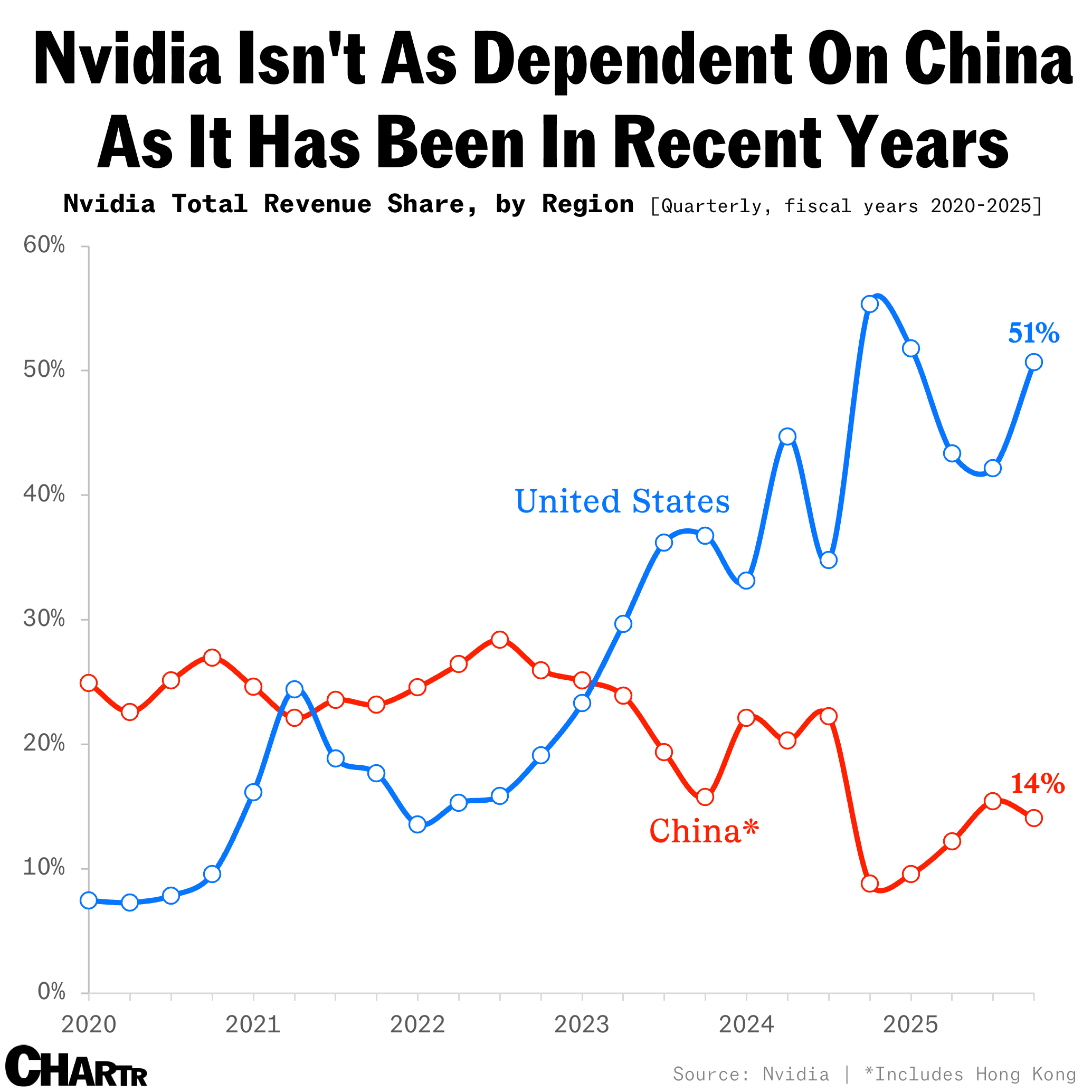
Nvidia revenue share chart
Sherwood News

But chip smuggling and disguising the final destination of Nvidia’s high-power chips have become an international concern, particularly following the emergence of DeepSeek. That’s led to investigations from the FBI, the White House, and the authorities in Singapore. From 2023 to 2024, Singapore’s share of sales increased from 11% to 18%.

“The Street will take this news with clear nervousness, worried these are the first shots fired in the tech battle between the US and China and Beijing/Xi are not just going to take this news and walk away,” Ives added.

Worries about additional export curbs have clearly been on management’s radar.

“Given the increasing strategic importance of AI and rising geopolitical tensions, the US government has changed and may again change the export control rules at any time and further subject a wider range of our products to export restrictions and licensing requirements, negatively impacting our business and financial results,” per the company’s annual report released in February. “In the event of such change, we may be unable to sell our inventory of such products and may be unable to develop replacement products not subject to the licensing requirements, effectively excluding us from all or part of the China market.”

Kind of seems like there are two bumpy paths for chip companies at the moment: if you make high-powered products outside the US that China wants, the US doesn’t want you to sell those to them. And if your fabs are in the US, you’re facing higher tariffs denting demand for anything China does want.


More Markets

See all Markets
markets

Nvidia strikes licensing agreement with AI inference specialist Groq

Nvidia reached an agreement to work with AI chip startup Groq to enhance its inference capabilities.

CNBC is calling this a $20-billion acquisition in cash, citing the top investor in Groq’s latest financing round (which valued it at roughly $6.9 billion in September). Groq’s press release on the matter, however, refers to this only as a “non-exclusive licensing agreement” and that “Groq will continue to operate as an independent company,” with no financial details provided. The lack of an official acquisition may be a bid to duck any potential antitrust concerns.

However, this is definitively an acqui-hire, as Groq founder Jonathan Ross and president Sunny Madra, as well as other members of their team, will be joining the chip designer “to help advance and scale the licensed technology.”

Inference is the “thinking” part of AI models (as opposed to training, which is more of the “learning”). Groq’s AI chips are LPUs (language processing units), distinct from GPUs (graphics processing units) or TPUs (tensor processing units). The company boasts that these chips “run Large Language Models (LLMs) and other leading models at substantially faster speeds and, on an architectural level, up to 10x more efficiently from an energy perspective compared to GPUs.” These products don’t need external high-bandwidth memory chips (which are facing a supply crunch), but rather use a different method of on-chip memory (SRAM, or static random-access memory).

Through this deal, Nvidia is likely looking to boost the efficiency of its AI solutions in a power-hungry (and scarce) world. It may also be viewed as a response to the success of Google’s Gemini 3 model, which utilizes TPUs that are also cheaper to operate than Nvidia’s GPUs. (In a fun twist, Ross, the Groq founder, was one of the architects of what would become Google’s first TPU during his time with the search giant).

“We plan to integrate Groq’s low-latency processors into the NVIDIA AI factory architecture, extending the platform to serve an even broader range of AI inference and real-time workloads,” wrote Nvidia CEO Jensen Huang in an email to employees, as reported by CNBC.

Good news for Groq is also good news for one of America’s most controversial and outspoken VCs: Chamath Palihapitiya, whose Social Capital fund was an early investor in the company. Chamath’s SPACs have generally tended to go over like a lead zeppelin, but this investment is already a massive winner.

markets
Luke Kawa

Micron jumps amid report of memory chip price hikes

Shares of Micron are catching a bid on Wednesday after South Korean media reported that its biggest competitors are raising selling prices for a line of high-bandwidth memory chips even though these will soon no longer be the most cutting-edge offerings available.

“According to industry sources on the 24th, memory semiconductor companies such as Samsung Electronics and SK Hynix have reportedly raised HBM3E supply prices by nearly 20%,” per the report from Chosun Biz. “This is unusual, considering that prices typically drop ahead of next-generation HBM launches. The prevailing view is that this is due to upward adjustments in HBM3E orders for next year from companies like Google and Amazon, which design their own AI accelerators, as well as NVIDIA, the largest HBM3E customer.”

Micron, along with those two companies, make up the triumvirate of high-bandwidth memory chip suppliers. These companies are all moving towards ramping their next-gen HBM4 production next year.

Meanwhile, appetite for HBM3E is being reinforced in part by President Trump’s move to allow Nvidia to sell its H200 chips to China.

markets
Luke Kawa

Opendoor acquires HomeBuyer.com in bid to boost home flipping and mortgage opportunities

Opendoor Technologies has acquired mortgage services platform HomeBuyer.com, according to a post on X from Chief Growth Officer Morgan Brown. Brown did not disclose financial terms of the deal in the post.

There’s an element of an acqui-hire here too, as HomeBuyer.com founder Dan Green will serve as Director of Mortgage Growth for Opendoor.

HomeBuyer.com offers tools for potential home buyers to assess their financing options, and mortgages are a logical avenue for Opendoor to pursue as the online real estate company looks transform the home buying and selling process in the US. At the very least, streamlining the financing process for potential buyers under its own roof should help Opendoor’s quest to pursue higher volumes of homes flipping.

Shares of Opendoor are little changed in premarket trading.

Many Opendoor bulls, including EMJ Capital’s Eric Jackson, have pointed to Opendoor’s potential to bolster its presence in mortgage, title, and other housing services as part of their optimistic view on the stock. In November along with the release of Q3 earnings, CEO Kaz Nejatian announced a new partnership with Roam pertaining to assumable mortgages.

Opendoor certainly hasn’t been idle during the holiday season. Earlier this week, the CEO touted an explosion in the company’s home-buying footprint to include all of the lower 48 US states, and management also announced that Coinbase Canada CEO Lucas Matheson was coming in to serve as its president.

markets
Luke Kawa

Intel drops on report that Nvidia stopped testing the 18A chip production process used by the chip manufacturer

Early on Christmas Eve, shares of Intel are tumbling like Santa off a rooftop after one too many spiked egg nogs.

Reuters reports that Nvidia “recently tested out whether it would manufacture its chips using Intel’s production process known as 18A but stopped moving forward, two people familiar with the matter said.”

Intel, for its part, told Reuters that its 18A processes are “progressing well” while it “continues to see strong interest” for its more advanced 14A production process. Previous reporting from the outlet indicated that in CEO Lip-Bu Tan’s early days leading Intel, he considered shelving the 18A manufacturing process entirely in favor of 14A in a bid to be more competitive with the likes of TSMC.

The $4 trillion chip designer announced a $5 billion investment in the chipmaker back in September as part of a collaboration that would see the two parties co-develop data center and PC products. That news sent shares of Intel up 23% in a single session, their biggest one-day gain since 1987.

Latest Stories

Sherwood Media, LLC produces fresh and unique perspectives on topical financial news and is a fully owned subsidiary of Robinhood Markets, Inc., and any views expressed here do not necessarily reflect the views of any other Robinhood affiliate, including Robinhood Markets, Inc., Robinhood Financial LLC, Robinhood Securities, LLC, Robinhood Crypto, LLC, or Robinhood Money, LLC.