

Markets
Money ring surrounding earth
(Getty Images)

Fund managers are worried about AI overinvestment. Bank of America is worried about fund managers overinvesting.

For the first time ever, fund managers surveyed by Bank of America think companies are investing too much.

Luke Kawa

For the first time ever, fund managers surveyed by Bank of America think companies are investing too much.

“Bad news…1st time in 20 years investors say companies ‘overinvesting’ (read ‘slow down, hyperscalers’),” Chief Investment Strategist Michael Hartnett wrote, commenting on the results of BofA’s monthly fund manager survey. “Asked about the biggest ‘tail risk’ for the economy and the markets, 45% of FMS investors said ‘AI bubble’ (up from 33% last month).”
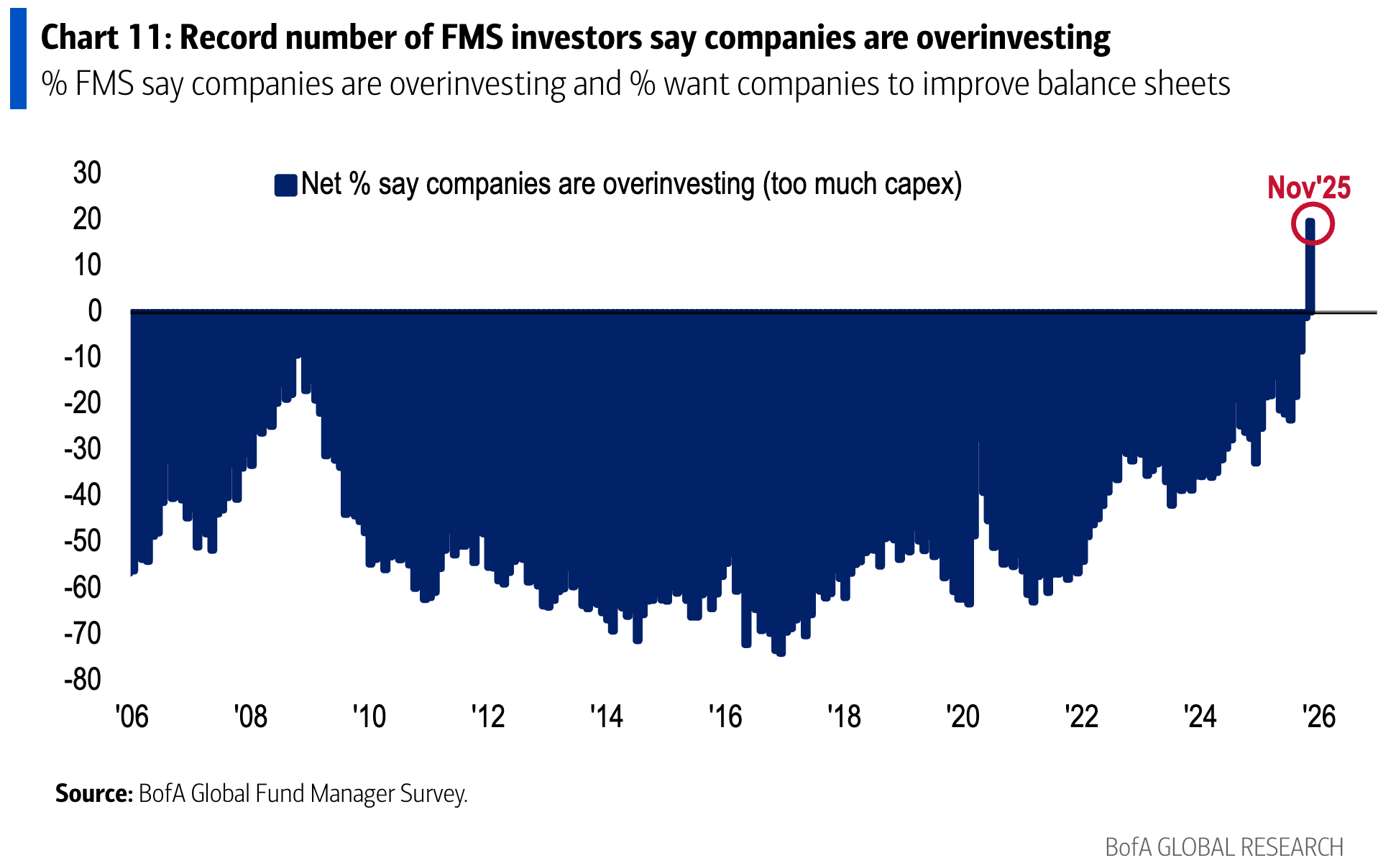
BofA capex overinvesting

Now, what this really shows, as Hartnett alludes to, is a very concentrated industry-specific concern around the aggressiveness of the AI build-out. Over on Bluesky, Bespoke analyst George Pearkes flagged that net private investment as a share of US GDP has effectively been a flat line for years.

“Just shows how tech-centric investors are. AI of course might be over-investing but the non-tech economy is stagnating or in recession and definitely isn’t overinvesting,” added Conor Sen, founder of Peachtree Creek Investments. “Office construction is weak, residential construction is weak, the freight industry is in recession, autos are pulling back on some EV spending.”

Fund managers would prefer that companies improve their balance sheets or return more cash to shareholders rather than boost business investment. That would certainly be a shift in what’s been rewarded in the stock market.

Year to date, a basket of the most capex-intensive stocks in the S&P 500 compiled by Goldman Sachs is up over 21%, outperforming baskets of companies with strong balance sheets and high shareholder returns by about 14 and 5 percentage points, respectively. Firms with high levels of investments have also bested these other cohorts over the past one and three months.

The irony about this survey is that while it says fund managers purport to be worried about overinvestment, if anything, BofA suggests that the overinvestment they should be worried about is their own: average cash levels among those surveyed dipped to 3.7% from 3.8%.

“Note cash levels of 3.7% or lower has occurred 20 times since 2002, and on every occasion stocks fell and Treasuries outperformed in the following 1-3 months,” says Hartnett, who called this low level of dry powder a “sell signal.”
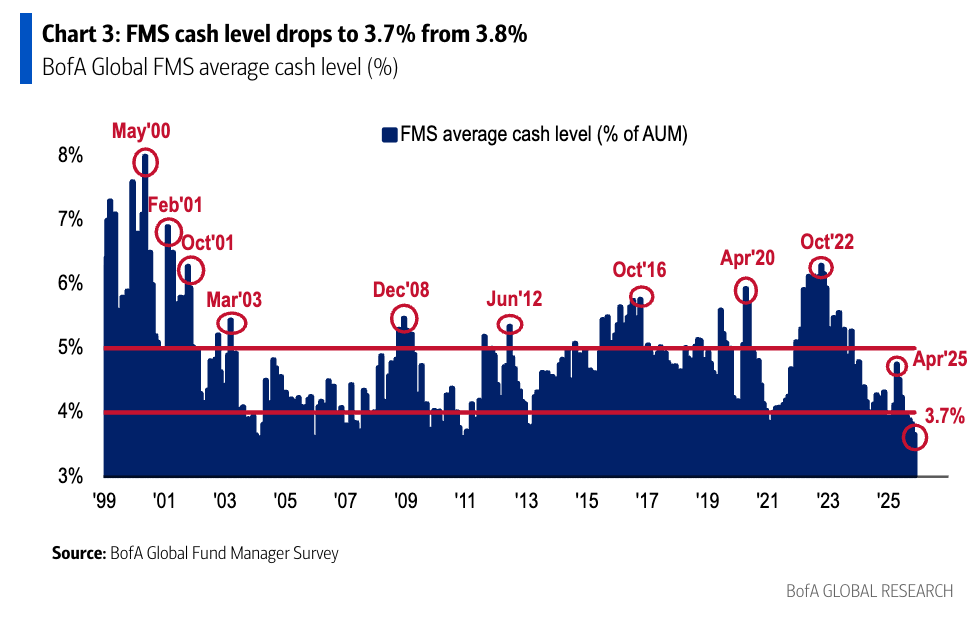
BofA cash levels

More Markets

See all Markets
markets

Opendoor surges on news that it’s being re-added to Russell indexes

Shares of Opendoor Technologies are spiking after the company announced it’s been selected for inclusion in the Russell 3000 Index.

Being added to indexes often brings along with it flows from funds that track those benchmarks.

“Inclusion in the Russell 3000 Index typically means membership in either the large-cap Russell 1000 Index or the small-cap Russell 2000 Index, as well as in relevant growth and value style indexes,” per the press release.

These additions will be effective after June 26.

What a difference a year makes: Opendoor was removed from the Russell 2000 at about this time last year because its share price had failed to hold $1. The flows associated with getting booted from the Russell 2000 was cited as a reason for elevated short interest on the stock, which one Redditor (u/gregw134) argued made Opendoor an attractive buy — months before its parabolic surge.

Since then, the company has picked up a horde of investors (the so-called “$OPEN ARMY”), overhauled its management ranks, and appears to be on the precipice of breaking even.

Eric Jackson, the architect of the explosion in retail attention on Opendoor, shouted out that Redditor’s research in an interview with Sherwood News:

“That was a great post. It was a really thoughtful post. Really, really detailed. I think I buy into probably 90% to 95% of what he’s saying. And I didn’t know about the whole ETF unloading, kicking it out of the Russell 2000, as a potential reason why it dipped down to $0.50 a couple of weeks ago.”

It’s also a strong session for stocks geared to the real estate market in general, with the fever in long-term bond yields seemingly well and truly broken.

Ferrari Luce EV

Ferrari’s EV push is testing what makes a Ferrari a Ferrari

Investors and pundits are hating on the electric Luce that Ferrari just unveiled.

markets

IREN rallies after securing GPUs to boost run-rate revenues to $4.4 billion

IREN jumped postmarket on Tuesday after management announced that they’d secured supply to make good on their recent deal with Nvidia.

The data company reached a $1.6 billion agreement with Dell for air-cooled Blackwell systems to service its AI cloud contract with the chip designer announced earlier this month.

The stock has pared much of its gains in early trading on Wednesday.

This previously revealed partnership will see IREN build out data centers designed by Nvidia to optimize for its hardware. Some of that compute will then be utilized by Nvidia, which also received warrants to invest up to $2.1 billion in IREN.

Once these systems are up and running in early 2027, IREN said that its annualized run rate would rise to $4.4 billion from $3.7 billion.

“Securing capacity and accelerating commissioning are our top priorities in a market where time-to-compute is everything,” IREN cofounder and CEO Daniel Roberts said in a statement. “Our relationship with Dell ensures access to hardware at the scale and speed the market demands.”

markets

Zscaler plummets after revenue guidance falls short of estimates

The market has deeply ingrained software-phobia right now, as traders are highly sensitive to anything software-related giving off any whiff of AI-related weakness. So, its not a huge surprise to see Zscaler down more than 20% in premarket trading on Wednesday after the cloud security company gave a softer customer growth outlook than expected, despite reporting solid results for its fiscal Q3.

Zscaler announced better-than-expected results across its key metrics for the quarter ended April 30, 2026, including revenue of $850 million (topping analyst estimates of $835 million, compiled by Bloomberg), annual recurring revenue (ARR) of $3.53 billion (vs. the $3.51 billion expected), and adjusted earnings per share of $1.08 (vs. expectations of $1.01).

But Zscalers ability to continue its winning streak is the main question — and as far as the company’s early guidance for new customer additions, its future looks bleaker than expected. The security firm now anticipates total ARR and revenue growth of 16% to 17% for fiscal 2027. In the nearer term, Zscaler also expects Q4 revenue to fall between $875 million and $878 million, with its upper limit below Wall Street estimates of $879 million.

Bloomberg Intelligence analysts noted that Zscaler’s fiscal 2027 ARR growth figure “suggests muted new customer additions are likely to weigh on the top line,” adding that the company “lacks identity security for AI agents in the suite, which may limit larger order closings.” Mizuho, RBC Capital Markets, and Evercore ISI analysts, similarly focusing on future guidance, also lowered their price targets for the stock following the call.

Separately, Citi analysts, who spoke to the companys management following the results, suggested that new customer growth could provide some upside, as new logo growth wasnt factored into the 2027 baseline. However, they also noted disruptions to the sales organization from two leadership changes, though the Zscalers CEO and CFO seem confident that those impacts will be absorbed, and dont expect disruptions at the quota-bearing level.

Peers CrowdStrike and Palo Alto Networks also sank around 2% before the bell on Wednesday.

Latest Stories

Sherwood Media, LLC and Chartr Limited produce fresh and unique perspectives on topical financial news and are fully owned subsidiaries of Robinhood Markets, Inc., and any views expressed here do not necessarily reflect the views of any other Robinhood affiliate, including Robinhood Markets, Inc., Robinhood Financial LLC, Robinhood Securities, LLC, Robinhood Crypto, LLC, Robinhood Money, LLC, Robinhood U.K. Ltd, Robinhood Derivatives, LLC, Robinhood Gold, LLC, Robinhood Asset Management, LLC, Robinhood Credit, Inc., Robinhood Ventures DE, LLC and, where applicable, its managed investment vehicles.

