
Markets
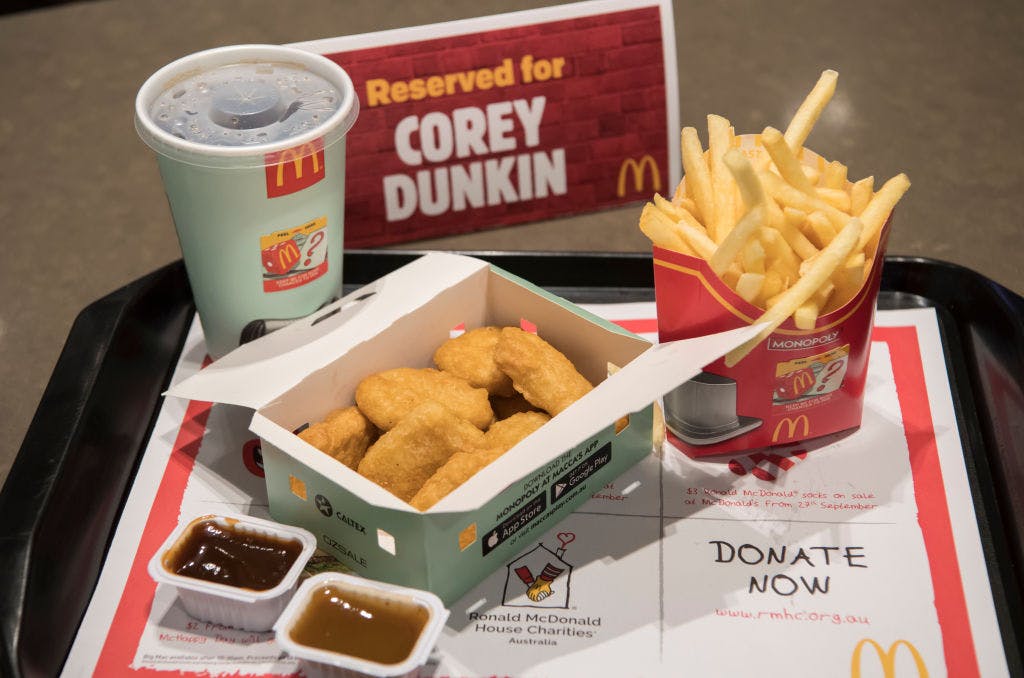
Dozens Gather To Watch McDonald's Fan Eat Chicken Nuggets
Thanks for the McNuggets, Ray (James D. Morgan/Getty Images)

We have the futures market — and Ray Dalio — to thank for the Chicken McNugget

Bridgewater founder Ray Dalio reimagined the chicken as an entity that consumes corn and soybeans on its way to being consumed by you.

Sherwood Staff

Welcome to Sherwood’s deep dive into futures markets, presented in partnership with CME Logo


Long before you could use a “buy now, pay later” option to DoorDash some McDonald’s, financial innovation played a key role in delivering the Chicken McNugget.

And what is a Chicken McNugget, anyway? 

If you ask McDonald’s, it will tell you it’s a scrumptious morsel of chicken, water, vegetable oil, enriched flour, and a host of other ingredients available quickly for relatively cheap.

Fresh takes on financial news

Subscribe and thrive

snacks logo

This site is protected by reCAPTCHA.

But if you ask Ray Dalio to zoom in on the main ingredient, he’d have a different answer.

In the same way that a Michelin chef might deconstruct a cheesecake into its constituent parts, reimagining the dish for an eager gourmet, Dalio viewed the chicken as an entity that consumes corn and soybeans on its way to being consumed by you.

This reconceptualization — and the futures market — is what allowed for bite-sized fried poultry to become a fast-food favorite.

Early in his career, the Bridgewater founder was hired as a consultant to work with McDonald’s on pricing this new menu item. McDonald’s wanted price security to be able to generate a solid return without frequently changing prices. So-called “menu costs” — the time and resources it takes to update pricing — are the deadweight costs of inflation, and can also turn off consumers.

There have been many attempts to introduce chicken (and egg) futures over time — oh, and by the way, the egg futures came first. But these were plagued by perishability and standardization concerns, and later, the magnitude of vertical integration among major poultry producers. Even now, you have to turn to China’s Dalian Commodity Exchange to access these futures. 

So Dalio couldn’t simply tell McDonald’s to use chicken futures to lock in supply at various points in time. That’s where his financial ingenuity came to the rescue, as he also happened to have Lane Processing, a leading chicken producer that would go on to be acquired by Tyson, as a client.

As Bridgewater recounts in its founding story (emphasis ours):

“The corn and soymeal prices were the volatile costs the chicken producer needed to worry about. Ray suggested combining the two into a synthetic future that would effectively hedge the producer’s exposure to price fluctuations, allowing them to quote a fixed price to McDonald’s. The poultry producer closed the deal and McDonald’s introduced the McNugget in 1983.”

Dalio, for his part, has said that it would be “overreaching” to call himself the creator of the Chicken McNugget. 

But without this display of financial engineering, the McNugget might have never gotten off the ground. Solving the financial equation was a prerequisite to overcoming the additional challenges of storage, distribution, deep-frying, and marketing.

It’s a throwback to the original conceit of futures in greasing the wheels of production and consumption, a practice that continues to this day for major sellers and buyers of everything from chocolate to jet fuel.

Since the early 1980s, the list of tradable agricultural commodity futures has swelled to include a variety of dairy products, pork cutout (the processed meat, rather than the live hog), and fertilizer, to name a few.

More Markets

See all Markets
markets

Akamai climbs to highest level since 2000 after reportedly securing Anthropic as a customer

Akamai’s billion-dollar AI infrastructure customer is Anthropic, Bloomberg reported on Friday. The cloud services company extended gains to trade up over 25% following the news.

On Thursday, the company announced a seven-year, $1.8 billion commitment from a “leading frontier model provider.”

Anthropic has been on a mad scramble to boost compute capacity after facing widespread complaints about Claude usage limits and seeing OpenAI position its accumulation of computing power as a competitive advantage.

In a little over a month, Anthropic has struck or expanded deals with CoreWeave, Amazon, Google, Broadcom, as well as xAI (through SpaceX).

As part of that xAI pact, Anthropic announced that it would be increasing usage limits for paying customers.

Anthropic has been on a mad scramble to boost compute capacity after facing widespread complaints about Claude usage limits and seeing OpenAI position its accumulation of computing power as a competitive advantage.

In a little over a month, Anthropic has struck or expanded deals with CoreWeave, Amazon, Google, Broadcom, as well as xAI (through SpaceX).

As part of that xAI pact, Anthropic announced that it would be increasing usage limits for paying customers.

markets

NuScale Power falls on disappointing drop in Q1 sales

NuScale shares are dropping in the early trading session after it released Q1 earnings yesterday after the bell that are failing to rejuvenate any excitement in the once high-flying, early-stage nuclear energy company.

The company announced Q1 revenue of just $560,000, well below the $10.5 million estimate, with sales down materially year over year thanks to old licensing and design deals that have since been completed.

The lack of financial progress has made NuScale Power more of a momentum-driven way to play the intersection of clean energy and AI infrastructure, particularly as hyperscalers and data center operators search for long-term power sources.

“The demand for reliable, carbon-free power has never been greater, and NuScale is the only SMR technology provider with a U.S. Nuclear Regulatory Commission approved design, an established supply chain and NPM components currently in production for commercial use to meet this essential need,” said John Hopkins, NuScale president and CEO. “We are building the infrastructure that this pivotal moment requires.”

Analysts at Goldman Sachs trimmed their price target to $9 from $10 in the wake of this report.

The company ended this quarter with cash, cash equivalents, and short- and long-term investments of $1.0 billion. The stock has dropped more than 25% year to date.

markets

Nintendo falls, will hike Switch 2 price amid memory crunch

Gaming giant Nintendo reported the results for its fourth quarter, which ended in March, on Friday morning. Its US-traded ADR fell nearly 4% in premarket trading.

Most notably, Nintendo announced it will raise the price of its Switch 2 console in the US by $50 to $499.99 in September. Investors have been waiting for Nintendo to join its rivals Sony and Microsoft in boosting the price of its flagship console, but the company had thus far been unwilling to do so this early in the Switch 2’s life cycle.

Nintendo shares have fallen about 45% over the past 12 months, as the company has been hit by tariffs and costs have increased due to AI’s memory demand and higher global shipping rates amid the war in Iran.

For its fiscal 2026, Nintendo reported:

  • 2.313 trillion yen ($14.8 billion) in total revenue, compared to estimates of 2.31 trillion yen ($14.78 billion) from Wall Street analysts polled by FactSet.

  • 19.86 million Switch 2 sales, compared to its 19 million forecast.

For the fiscal year ahead (which will end in March 2027), Nintendo forecast 16.5 million Switch 2 sales. The company is guiding for 2.050 trillion yen ($13.1 billion) in sales for the full year, compared to Wall Street estimates of 2.5 trillion yen ($16.1 billion).

Latest Stories

Sherwood Media, LLC produces fresh and unique perspectives on topical financial news and is a fully owned subsidiary of Robinhood Markets, Inc., and any views expressed here do not necessarily reflect the views of any other Robinhood affiliate, including Robinhood Markets, Inc., Robinhood Financial LLC, Robinhood Securities, LLC, Robinhood Crypto, LLC, Robinhood Derivatives, LLC, or Robinhood Money, LLC. Futures and event contracts are offered through Robinhood Derivatives, LLC.

