Markets
markets

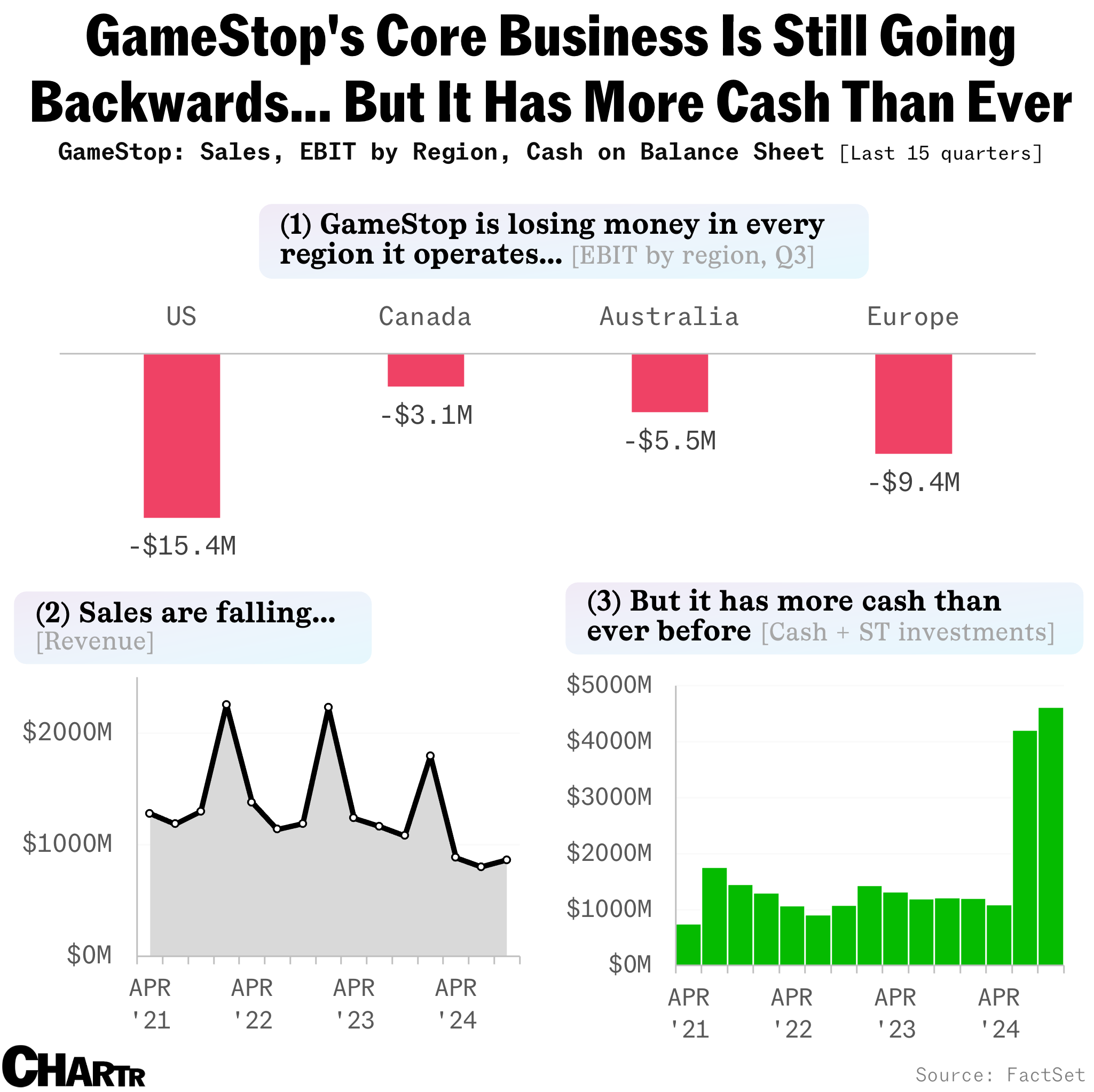
GameStop is still losing money in every region it operates in

It’s not very common for the following four things to all be true about a company:

(1) Sales are falling.
(2) The company is losing money in its primary business in every region where it operates.
(3) The company still generates a profit, overall.
(4) The company has billions of dollars more cash on its balance sheet than it did a year ago.

But then again, GameStop is not a very normal company.
GameStop chart
Sherwood News

Yesterday, GameStop reported its third-quarter earnings: while sales dropped 20% year over year, the video game retailer turned around to a $17.4 million profit — from the $3.1 million net loss in the same quarter last year — thanks to aggressive cost-cutting efforts and interest income from its growing cash pile. Following last week’s brief share spike fueled by meme-stock influencer Keith Gill’s post on X, GameStop’s shares are now up more than 75% year to date.

After hogging the meme-stock limelight for the last few years, GameStop management has done a very good job of cashing in on retail appetite for its shares, even as demand for its actual products — video game hardware and software — continues to ebb. As Luke Kawa puts it: “GameStop is still terrible at being a retailer. But it’s not bad at being a money-market fund.

But then again, GameStop is not a very normal company.

GameStop chart
Sherwood News

Yesterday, GameStop reported its third-quarter earnings: while sales dropped 20% year over year, the video game retailer turned around to a $17.4 million profit — from the $3.1 million net loss in the same quarter last year — thanks to aggressive cost-cutting efforts and interest income from its growing cash pile. Following last week’s brief share spike fueled by meme-stock influencer Keith Gill’s post on X, GameStop’s shares are now up more than 75% year to date.

After hogging the meme-stock limelight for the last few years, GameStop management has done a very good job of cashing in on retail appetite for its shares, even as demand for its actual products — video game hardware and software — continues to ebb. As Luke Kawa puts it: “GameStop is still terrible at being a retailer. But it’s not bad at being a money-market fund.

More Markets

See all Markets
Old electronic items tossed on ground for disposal, Hudson

Technology giants don’t look like they used to, as the asset-light era fades

Oracle and Meta are now some of the most capital-intensive businesses in the S&P 500, spending more than energy giants. I guess data really is the new oil?

markets

Space stocks rip amid speculation on Altman joining race

Space stocks AST SpaceMobile, Planet Labs, and Rocket Lab all soared Thursday amid a recovery in the high-beta momentum class of shares coveted by some retail traders.

(High-beta momo stocks are basically shares that have been on a winning streak for a while, and tend to go up a lot more than the overall market on positive days. Goldman Sachs includes all three of the aforementioned space stocks in its themed basket of such shares.)

There’s little other fundamental news out there on the companies themselves.

But a Wall Street Journal report that OpenAI impresario Sam Altman has been toying with the idea of entering the space industry, potentially standing up a rival to Tesla CEO Elon Musk’s Starlink satellite service, may also be contributing.

As we’ve mentioned elsewhere, sometimes these stocks seem to trade on a what’s-bad-for-the-Musk-empire-is-good-for-us-and-vice-versa vibe.

markets

Intel sinks on news it will hang on to networking unit

Intel dropped in early trading Thursday after it disclosed plans to retain ownership of its networking unit following a strategic review of operations.

The unit, known as NEX, makes products like infrastructure processors, which do needed “housekeeping” tasks like running security checks, thereby freeing core Intel CPUs to do the higher-value operations. It also produces switches and controllers that manage and direct the flow of data to CPUs.

markets

Quantum computing stocks soar on return of bullish options bets

The calendar says December, but the price action is starting to look a lot more like September to me:

Quantum computing companies IonQ, Rigetti Computing, and D-Wave Quantum are all up at least 7% as of 11:04 a.m. ET, buoyed by a wave of bullish options activity.

  • Nearly 50,000 calls in IonQ have already changed hands, well above the 20-day average for a full session, with activity concentrated in strikes from $50 to $55 in contracts that expire between Friday and mid-January. Its put/call ratio is near 0.2, versus an average of over 1 for the past 20 sessions.

  • More than 65,000 calls have traded in Rigetti, a hair shy of its full 20-day average. Like IonQ, options activity has a bullish tilt, with a put/call ratio of about 0.7 versus a 20-day average of roughly 1.2.

  • D-Wave, which received positive commentary from Evercore ISI on Wednesday, isn’t seeing call activity as elevated as its peers, but the options action is also very skewed toward the bull side, with a put/call ratio of less than 0.3 versus a 20-session average of 0.7.

Pure-play quantum computing stocks nearly doubled from late August to late September amid heavy options market activity thanks to reports on government support for the sector, M&A activity, tech breakthroughs, and a flurry of price target hikes by Wall Street.

Latest Stories

Sherwood Media, LLC produces fresh and unique perspectives on topical financial news and is a fully owned subsidiary of Robinhood Markets, Inc., and any views expressed here do not necessarily reflect the views of any other Robinhood affiliate, including Robinhood Markets, Inc., Robinhood Financial LLC, Robinhood Securities, LLC, Robinhood Crypto, LLC, or Robinhood Money, LLC.