

Markets
Daily Life In Dublin
People passing by a betting office advertising board (Artur Widak/Getty Images)
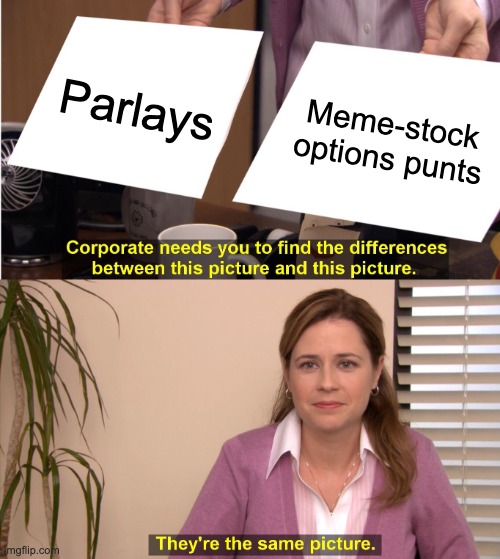
They’re the same picture

Gen Z trades stocks the same way it gambles

Young people have high risk tolerance. More news at 11.

Luke Kawa

A friend passed along a recent blog post from Drive by DraftKings, a venture capital firm whose founding partners include (wait for it) DraftKings, titled, “The Gen Z Effect: The Behavioral Shift Shaping Gaming, Fandom, and Human Performance.”

Here’s a passage that piqued my interest (emphasis added)

“Gen Z’s approach to gaming is clear. They gravitate toward formats that are fast, emotionally charged, and offer the chance at a meaningful payoff. Traditional, slow-paced gameplay is losing ground to experiences that deliver instant feedback and the possibility of an outsized win.

This is why crash games, meme stocks, and parlay bets have gained so much traction with this generation. These formats share a common formula: low-cost entry, high potential upside, and just enough unpredictability to keep things exciting. A recent Morgan Stanley survey found that 60% of bettors aged 21 to 34 have placed parlays, a rate nearly 30% higher than the overall population. Similarly, around 30% of US stock investors aged 18 to 24 have invested in meme stocks compared to 12% of investors ages 45-54.

It’s not just the payout that attracts Gen Z. It’s the emotional volatility, the rush of possibility, and the shareable nature of “just-missed” or jackpot moments. The appeal is simple: put down a small amount, take a swing, and hope to hit it big. Most of these bets won’t pay off, but the ones that do tend to go viral. Social media elevates these wins, creating a sense of FOMO that draws others in. It becomes a feedback loop of visibility, aspiration, and repeat behavior, which keeps Gen Z highly engaged and emotionally invested in the experience.”

To riff on this conception of a “common formula” between parlays and meme stock punts, which often take place through the options market to access embedded leverage:

Both parlays and short-term options punts are examples of things where you need multiple things to go right to win. In parlays, it’s discrete (usually sports-related) outcomes; in options, you need to get the direction and magnitude right by a certain point in time.
samepic

This is why I love the use of options as a storytelling device: they are always and everywhere a greed, fear, or complacency play built around a specific date by which something needs to either happen or not happen. There’s a subject, verb, and time.

“I think one thing that’s very clear about Gen Z is that they’ve repeatedly been told nobody is coming to save you,” Emily Sundberg, author of the Feed Me Substack, said at a live taping of Bloomberg’s Odd Lots podcast. “You hear this sense of ‘get the bag while the world is still here for you to make some money out of it.’”

Kind of ironic that the generation that thinks nothing in the world is going right for them seeks out betting and trading structures that require multiple things to go right to profit.

Is this really a Gen Z thing, though?

One can quibble about some of this line of thought. And I will. The 2021 meme stock boom was occurring when the average member of Gen Z was just in their early high school years. I doubt many of them were part of the Apes Together Strong crew.  

The “YOLO” catchphrase that serves as a shorthand for the kind of “eff it, we ball” approach to life was popularized by a somewhat seasoned millennial.

And to dodge any accusations of millennial-boosting, manias have existed well before we were a twinkle in our boomer parents’ eyes and will continue to persist long after we’re ashes. To this author, a person’s willingness to dive headfirst into booms is much more defined by their stage of life rather than the generation they belong to. Oh, to be young…

Gen Z likes structures with huge payoffs that often end in busts? How convenient for the VC firm, which concludes that the shifts in Gen Z behavior “reinforce why we focus where we do — on the edge of behavioral change, where category defining companies are born,” highlighting portfolio companies Triumph and Picklebet as great examples of firms whose products have been built for this generation.

More Markets

See all Markets
markets

Oracle, Microsoft power battered software stocks toward best 3-day stretch in almost a year

Software shares are rising again early Wednesday, putting the widely watched iShares Expanded Tech Software ETF on track for its best three-day stretch in almost a year.

So far this week, Oracle is up more than 20%, Microsoft is up over 9%, and both ServiceNow and Datadog have gained more than 12%.

Intuit, CrowdStrike, Autodesk, and Atlassian were also among the software shares rising Wednesday after taking lumps on worries about AI disruption earlier this year.

Why the rebound? Mean reversion is a powerful force in markets, and some of these shares could simply be enjoying an overdue snapback.

Bloomberg suggests there’s some “bottom fishing” going on, with investors finally deciding that the price for these still highly profitable, cash flow-positive companies has fallen low enough to make them a compelling bargain.

Pat Tschosik, chief thematic strategist at research firm Ned Davis, told Sherwood News that the market may have been too panicky about software stocks as a whole, slamming the shares of software companies that could survive and thrive in the AI era along with those doomed to disruption.

Determining the difference between the winners and the losers will take a look at the fundamentals of individual companies.

“Somebody who does the homework is going to make a lot of money in these stocks,” he said.

So far this week, Oracle is up more than 20%, Microsoft is up over 9%, and both ServiceNow and Datadog have gained more than 12%.

Intuit, CrowdStrike, Autodesk, and Atlassian were also among the software shares rising Wednesday after taking lumps on worries about AI disruption earlier this year.

Why the rebound? Mean reversion is a powerful force in markets, and some of these shares could simply be enjoying an overdue snapback.

Bloomberg suggests there’s some “bottom fishing” going on, with investors finally deciding that the price for these still highly profitable, cash flow-positive companies has fallen low enough to make them a compelling bargain.

Pat Tschosik, chief thematic strategist at research firm Ned Davis, told Sherwood News that the market may have been too panicky about software stocks as a whole, slamming the shares of software companies that could survive and thrive in the AI era along with those doomed to disruption.

Determining the difference between the winners and the losers will take a look at the fundamentals of individual companies.

“Somebody who does the homework is going to make a lot of money in these stocks,” he said.

markets

Robinhood, Webull gain as SEC approves removal of day trading limit for small investors

Shares of Robinhood Markets and Webull are surging in premarket trading after the US Securities and Exchange Commission gave the green light to removing a rule that had impeded small traders from day trading.

The pattern day trading rule will no longer bar traders from making more than four day trades over a five-day period if their margin account has less than $25,000. The changes were initially proposed by the Financial Industry Regulatory Authority. Under the SEC order published Tuesday after the close of regular trading, all traders, regardless of account size, will just need to have enough in their margin account to cover their exposure.

(Robinhood Markets Inc. is the parent company of Sherwood Media, an independently operated media company subject to certain legal and regulatory restrictions.)

Latest Stories

Sherwood Media, LLC produces fresh and unique perspectives on topical financial news and is a fully owned subsidiary of Robinhood Markets, Inc., and any views expressed here do not necessarily reflect the views of any other Robinhood affiliate, including Robinhood Markets, Inc., Robinhood Financial LLC, Robinhood Securities, LLC, Robinhood Crypto, LLC, Robinhood Derivatives, LLC, or Robinhood Money, LLC. Futures and event contracts are offered through Robinhood Derivatives, LLC.

