
Markets
Basketball - Paris 2024 Olympic Games: Day 15
LeBron James #6 of Team United States goes for a dunk (Zhao Wenyu/Getty Images)

“The best trading period” for US stocks starts today, says Goldman

The bank’s tactical-trading specialist thinks markets will rip higher from now through year-end.

“Today starts the best trading period of Q4 for US equities with data going back to 1928,” writes Scott Rubner, managing director for global markets at Goldman Sachs.

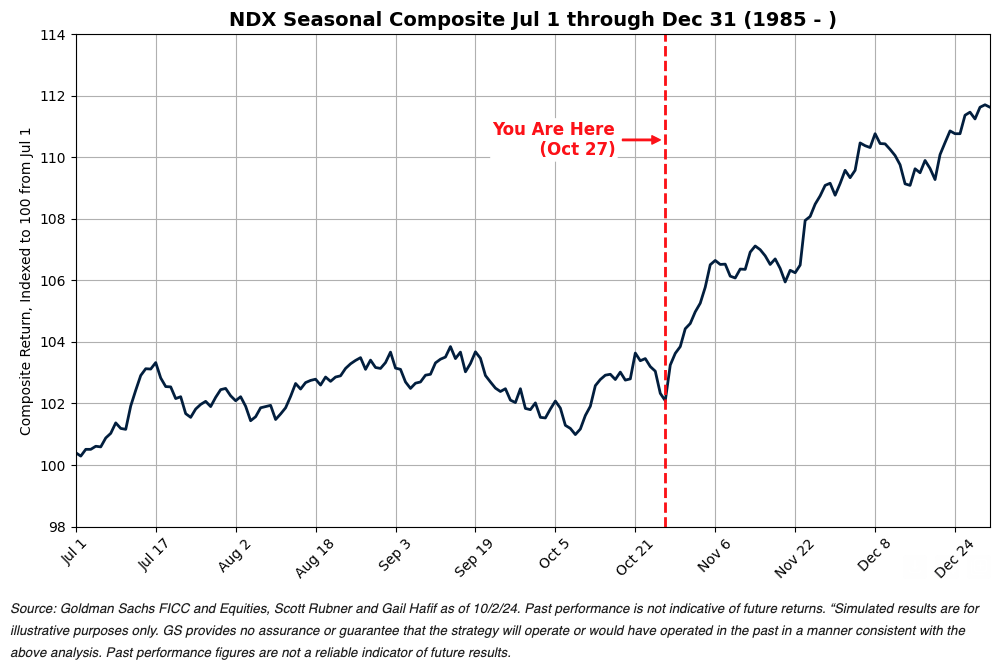
Since 1928, the median return from now through year-end is 5.2% for the S&P 500. Since 1985, the Nasdaq 100 has tended to be up double-digits over the same stretch.
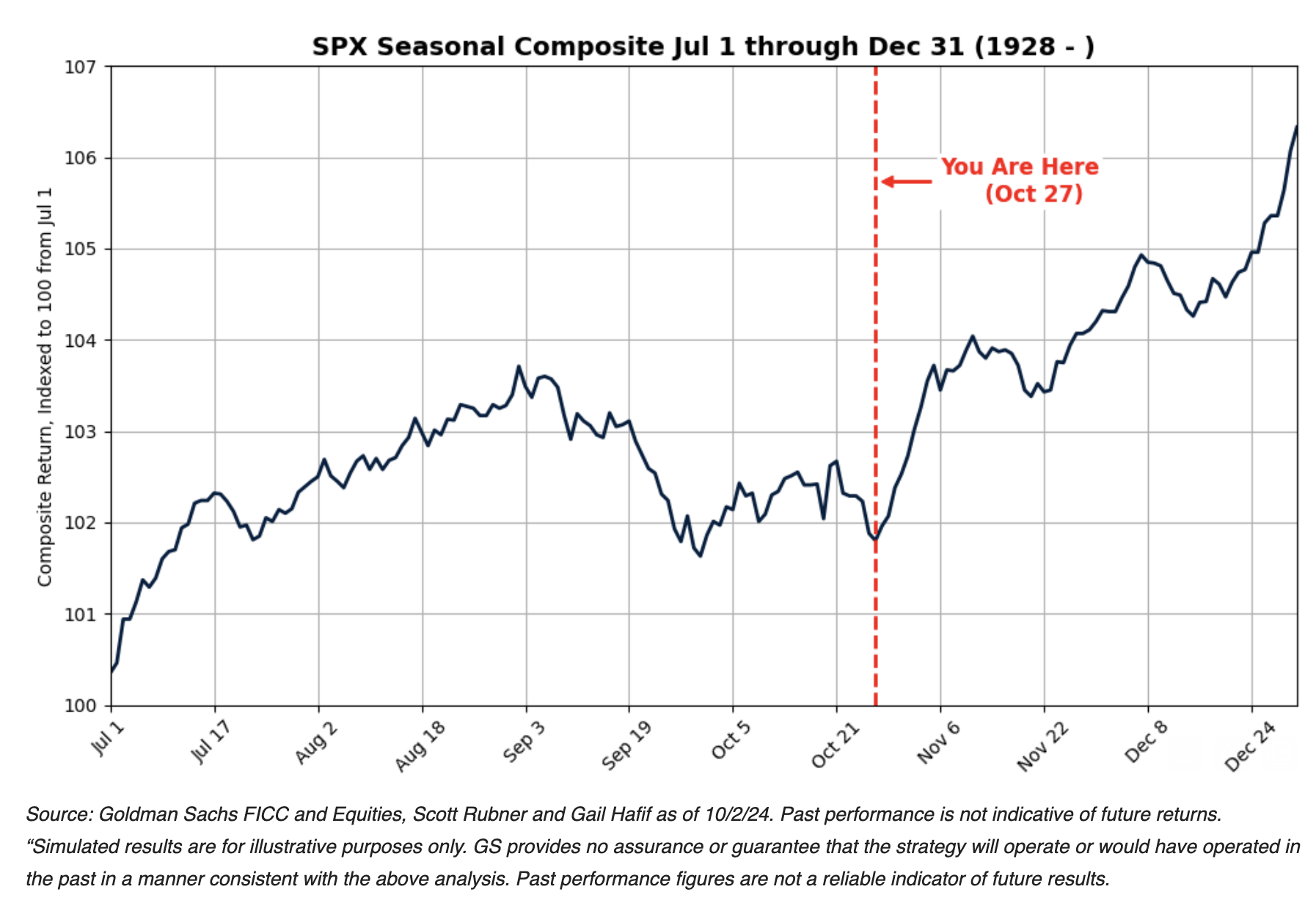
S&P 500 seasonals
Source: Goldman Sachs
Nasdaq seasonals
Source: Goldman Sachs

Conventional wisdom on Wall Street, per Rubner, is that stocks will retreat after next Tuesday’s election, but he’s more optimistic.

“I think that the US election will be a clearing event for risk assets, and re-risking may happen quickly (and out of favor sectors and themes that are under-owned),” he writes.

Starting now, activity of the bigger sellers of equities (mutual and pension funds) will die down, while a huge buyer — companies repurchasing their own shares — will begin to return in earnest as the heavy week of earnings announcements plays out.

Rubner previously flagged that Corporate America has already authorized a record $1 trillion in share buybacks so far in 2024, and November tends to be the busiest month for executing these repurchases.

Generally, there’s a lot of scope for money to rotate out of cash into stocks, he adds.
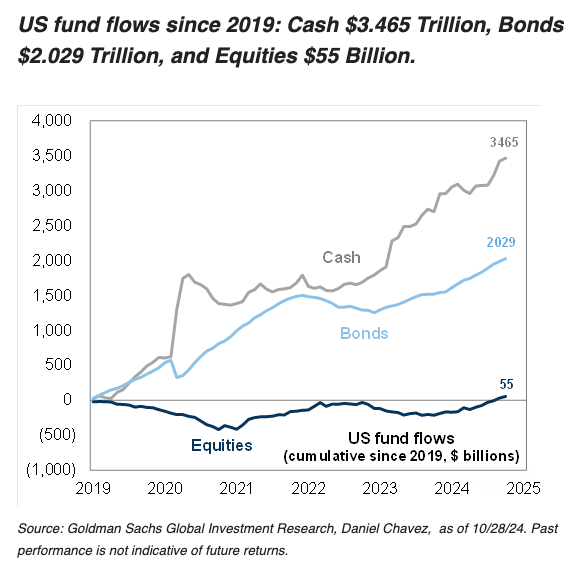
US fund flows since 2019
Source: Goldman Sachs

More Markets

See all Markets
markets

Quantinuum opens above IPO price and continues to rise as Wall Street remains hungry for quantum exposure

Wall Street is ready for even more quantum computing exposure. Shares of Quantinuum opened at $68, 13% above their initial public offering price, when the quantum company debuted on the Nasdaq Thursday.

The stock remained above the original pricing of $60 into Thursday afternoon. The Honeywell-backed company is pushing quantum technology further into the spotlight, raising $1.68 billion by selling 28 million shares, giving it a market cap of over $17 billion.

Investors have been piling into quantum computing stocks recently, with Rigetti Computing more than doubling over the past 12 months, while D-Wave Quantum is up almost 60%, and IonQ has gained more than 63% over the same period.

In its May S-1 filing, Quantinuum said it has "active customer engagements primarily focused across pharmaceuticals, materials science, financial services, government and industrial markets, including with market leaders, such as JPMorgan Chase."

markets

Applied Aerospace rises on second day of trading

Applied Aerospace & Defense shares are gaining on Thursday, though they’re still trading below their Wednesday IPO price of $20. Yesterday’s debut raised $650 million and put the company’s valuation at roughly $3.5 billion. Despite opening trading at $20.75, shares closed the day at just over $19.

Applied Aerospace manufactures components used in rockets, aircraft, and defense systems, including solid rocket motor cases, fuselage assemblies, and engine shafts. Its customers include companies such as Boeing and Anduril Industries. Separately, its IPO filing showed that its three largest customers accounted for roughly 59% of revenue in 2025.

Investors remain interested in defense-related listings as geopolitical tensions and military spending continue to drive interest in the sector.

Were right at the epicenter of doing really incredible mission work supporting next-gen interceptor development, which protects cities and countries, CEO Trip Ferguson said in an interview with NYSE.

markets

Ciena sinks despite crushing Q2 estimates and raising full-year outlook

Ciena Corp. shares are plunging Thursday despite the network technology company posting Q2 earnings results that beat Wall Street consensus estimates and raising its full-year outlook.

Ciena stock has surged so far this year, gaining over 150% year to date including todays drop.

Key numbers:

  • Revenue of $1.57 billion (compared to analyst estimates of $1.50 billion).

  • Earnings per share of $1.64 (estimate: $1.46).

  • 2026 full-year revenue guidance of $6.3 billion (estimate: $6.18 billion).

Revenue grew 40% year over year. That growth was anchored by the companys core Optical Networking segment, which brought in $1.1 billion, while its Routing and Switching division nearly doubled to $174.2 million.

Management also raised its full-year fiscal 2026 revenue guidance to $6.3 billion (plus or minus $100 million). This marks a notable upgrade from its previous full-year target range of $5.9 billion to $6.3 billion. For the upcoming fiscal third quarter, the company anticipates revenues of $1.625 billion, exceeding the Wall Streets expectations of $1.58 billion.

Todays results reflect the strength of our portfolio, the power of our business model, and disciplined execution in a dynamic supply environment, Gary Smith, president and CEO of Ciena, said in a statement.

markets

PVH shares plunge on lowered revenue outlook tied to geopolitical tensions

PVH is plunging in early trading following the release of its Q1 report, as a lowered full-year sales guidance overshadowed an otherwise solid earnings beat. The company, which owns iconic brands Calvin Klein and Tommy Hilfiger, warned investors that ongoing macroeconomic and geopolitical tensions would impact international revenues.

The primary driver behind the stock collapse is a revised fiscal 2026 forecast that caught Wall Street off guard. Revenue is now projected to be approximately flat compared to the flat to slight increase it had forecast previously, with the prolonged war with Iran and its widening economic impact on the EMEA region cited as the cause. Revenue in constant currency terms for the EMEA region fell 5% during the quarter as a result of these disruptions. The company continues to expect growth in its Americas and Asia-Pacific businesses.

PVH continues to expect full-year adjusted earnings between $11.80 and $12.10 per share, which includes a roughly $3.30 impact from tariff costs and around a $1.70 benefit from tariff refunds.

“As we look forward, we are balancing two opposing forces: on one side, the increasing brand and business momentum we are driving in both Calvin and TOMMY, and on the other, the prolonged effects of the Middle East conflict, which is putting pressure on the consumer in EMEA,” Stefan Larsson, the CEO of PVH, commented in a statement. “We are adjusting to the moment, while keeping our long-term approach to fueling our brand and business momentum.”

For Q1 itself, PVH posted total sales that rose 2% year over year to $2.03 billion. The retail brand bounced back to an $88 million profit, or $1.90 per share, reversing a net loss of $44.8 million from the same quarter last year. Growth was anchored by the companys direct-to-consumer sales, which grew by 6% on the back of strong performance in Calvin Klein denim and underwear, alongside Tommy Hilfiger outerwear.

Despite the sell-off, PVH stock has risen over 30% year to date.

Latest Stories

Sherwood Media, LLC and Chartr Limited produce fresh and unique perspectives on topical financial news and are fully owned subsidiaries of Robinhood Markets, Inc., and any views expressed here do not necessarily reflect the views of any other Robinhood affiliate, including Robinhood Markets, Inc., Robinhood Financial LLC, Robinhood Securities, LLC, Robinhood Crypto, LLC, Robinhood Money, LLC, Robinhood U.K. Ltd, Robinhood Derivatives, LLC, Robinhood Gold, LLC, Robinhood Asset Management, LLC, Robinhood Credit, Inc., Robinhood Ventures DE, LLC and, where applicable, its managed investment vehicles.

