
Markets
U.S.-WASHINGTON, D.C.-SENATE-HEARING-BANK-CEO
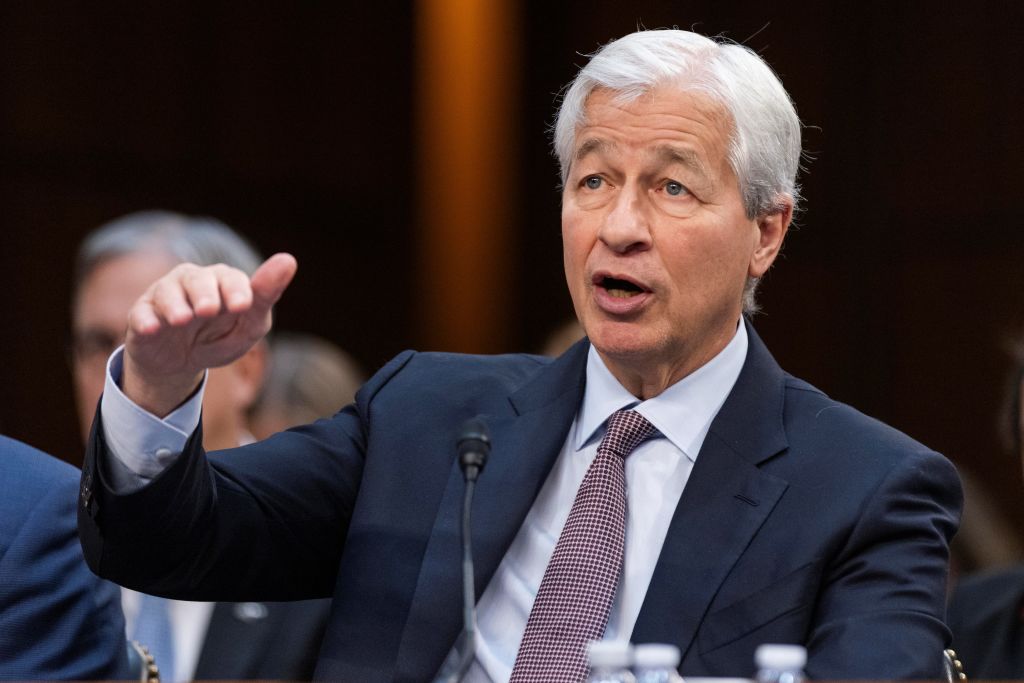
JPMorgan CEO Jamie Dimon (Photo by Aaron Schwartz/Getty Images)
Beta boom

Banks thrived with rising rates, but can't win with stable ones

Net interest income in focus for earnings season

Jack Raines

Last Friday, JPMorgan’s stock fell more than 6% after the bank failed to raise guidance on its net interest income (NII), or the difference between what the bank makes from loans, mortgages, and other interest-bearing assets and what it pays out to depositors. It mirrored a surprising trend seen in Citi and Well Fargo’s earnings calls.

Why are banks struggling to capitalize on higher interest rates? Because deposit rates are climbing, and loan issuances are slowing.

When the Federal Reserve cut rates to near-0% in 2020, banks reduced the rates they charged borrowers as well as the rates they paid depositors, lowering both the inflows and outflows that factor into NII.

However, as the Fed raised rates in 2022, banks were able increase rates on their loans again, improving their NIIs. Intuition would suggest that with the Fed now signaling that interest rates will likely be higher for longer, banks will benefit by continuing to flex their pricing power. But the opposite has been true.

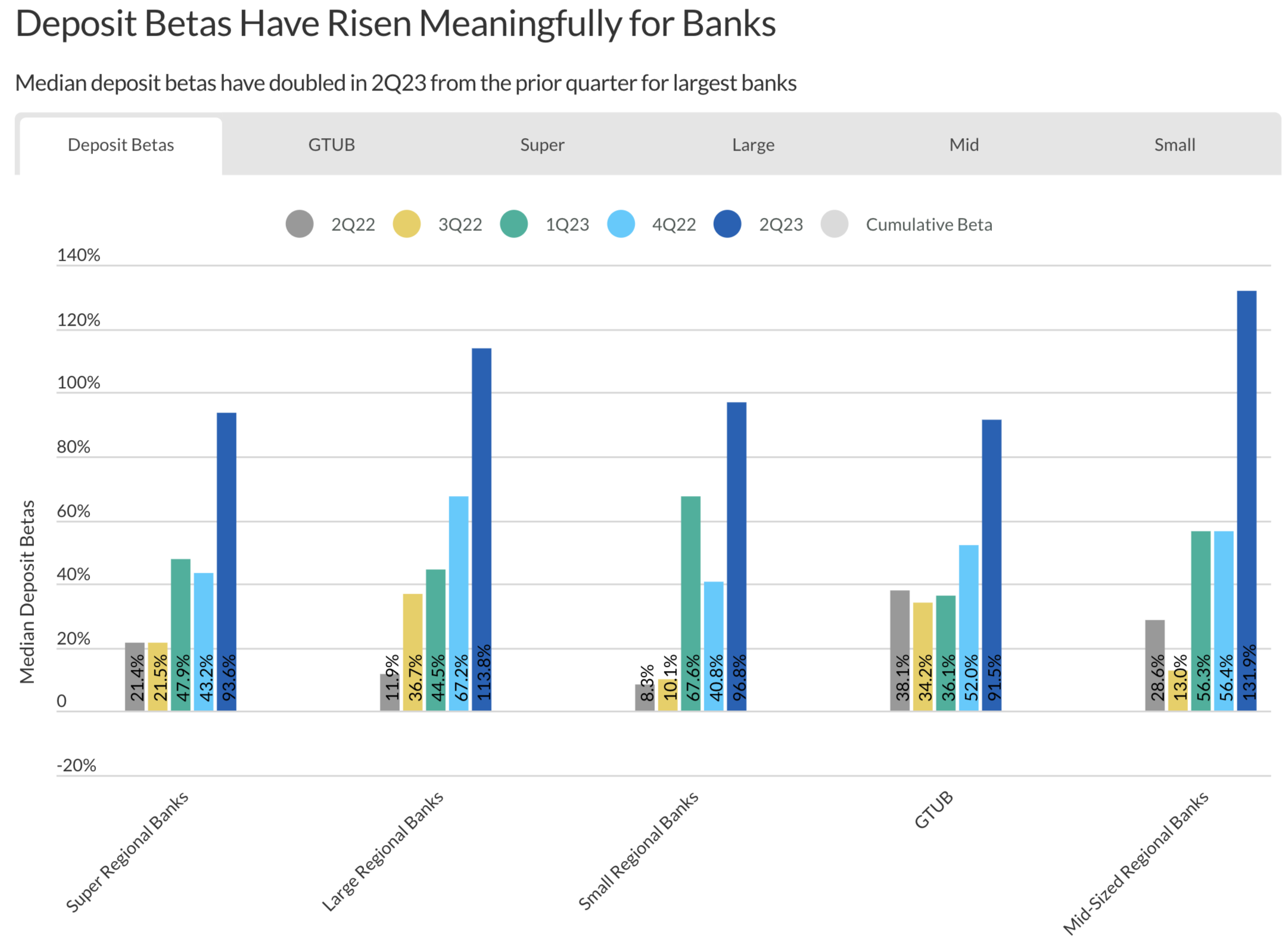
Banks use the term “deposit beta” to describe how much their deposit rates will change in response to changes in the fed funds rate, which is the Fed's target interest rate. If the Fed were to raise the fed funds rate by 50 basis points (bps), for example, and a bank were to increase how much they paid depositors by 25 bps, that bank’s deposit beta would be 50%.

As rates stabilized at higher levels, deposit betas have skyrocketed as banks have been forced to offer higher and higher yields on deposits to reduce outflows to money market funds, as well as to competing banks. According to ratings agency Fitch, deposit betas across all banks doubled in Q2 2023 from the prior quarter.
Deposit Betas
Source: Fitch

Debt issuance is also expected to decline in 2024, according to S&P Global. Banks charge higher interest rates on commercial loans, mortgages and other interest-bearing assets than they pay depositors, but loan demand has plateaued, further pressuring interest income.

Rising rates were a boon for banks, as they could raise rates on their loan products while deposit rates were low. However, stabilizing high interest rates have proved problematic, as competition is forcing banks to raise their deposit rates, and borrowers are more cautious about taking out new loans.

More Markets

See all Markets
markets

Broadcom jumps after locking down Google as a customer for future generations of TPUs

Shares of Broadcom rose more than 3% in postmarket trading on Monday after its most important customer doubled down on the custom chip specialist’s ability to produce its most valuable commodity.

In a filing, Broadcom said that it entered into a long-term agreement with Google to supply future generations of TPUs (custom AI accelerator chips) as well as a supply assurance agreement for networking and other equipment “through up to 2031.”

Bernstein analyst Stacy Rasgon indicated that Broadcom’s investor relations team told him that Google’s long-term agreement “has revenue commitments that go along with it through the timeline.”

Gemini 3 launched to rave reviews in November. The model was trained on TPUs co-developed by Broadcom and Google.

The same Monday filing showed that Broadcom, Google, and Anthropic expanded a partnership that will see the Claude developer access 3.5 gigawatts of AI compute capacity beginning in 2027, powered by the TPUs co-designed by the custom chip specialist and the search giant.

Bernstein’s Rasgon added that Broadcom’s team suggested these 3.5 gigawatts are “only part of a larger partnership over time.” He thinks Broadcom’s fiscal year 2027 guidance for AI revenues of $100 billion “is looking increasingly light” thanks to this news.

For what it’s worth, the enhanced pact with Anthropic hinges upon the firm’s ability to afford AI compute. But based on the insane trajectory of its run-rate revenue that may not be a big hurdle to clear.

“Broadcom’s expanded agreements with Google and Anthropic add rare multi-year visibility, reinforcing a $40-$50 billion AI revenue opportunity tied to Anthropic’s 3.5 gigawatt deployment starting in 2027, while building on the previously disclosed 1GW ($10 billion) starting in 2H,” wrote Bloomberg Intelligence analysts Kunjan Sobhani and Oscar Hernandez Tejada.

markets

Health insurers surge after Medicare agrees to pay 2.48% more in 2027, a bigger-than-expected boost

Health insurance stocks are surging after the Centers for Medicare & Medicaid Services said it plans to boost Medicare Advantage and Part D payments by 2.48% in calendar year 2027.

The likes of CVS, Humana, UnitedHealth, Molina Healthcare, Oscar Health, and Elevance Health are gaining in postmarket trading.

Wall Street analysts had anticipated that rates for 2027 would go up between roughly 1% and 1.5%.

These stocks had gotten crushed in late January when the Trump administration proposed relatively flat federal payment rates.

Insurance companies that provide government-sponsored plans, like Medicare Advantage, faced headwinds from higher-than-expected costs in 2025.

markets

Iran war winners Dow, LyondellBasell downgraded by Bank of America

Dow, Inc. and LyondellBasell — two petrochemicals stocks that surged as markets priced in shortages due to the closure of the Strait of Hormuz — should decline as investors focus on the long-term outlook for normalized petrochemical prices once the war resolves, Bank of America analysts wrote in a note downgrading the two stocks Monday.

BofA moved its rating on the shares from “neutral” to “underperform,” writing:

“Over time, as chemical markets normalize, we expect 1) investor focus to shiſt back to ‘normal’ or ‘sustainable’ earnings profiles and 2) the conflict to resolve without material asset rationalization, both of which likely bias shares lower over the next twelve months.”

Analysts also lowered their stance on another petrochemicals and building materials stock, Westlake, to “neutral” from “buy.”

While cutting those ratings, BofA actually raised its more near-term price targets for the shares. It upped LyondellBasell to $68 from $55, and Dow to $35 from $31.

But those price targets still imply declines of more than 10% compared to where both shares were trading late Monday morning. Both stocks are up roughly 30% since the start of the Iran war.

Latest Stories

Sherwood Media, LLC produces fresh and unique perspectives on topical financial news and is a fully owned subsidiary of Robinhood Markets, Inc., and any views expressed here do not necessarily reflect the views of any other Robinhood affiliate, including Robinhood Markets, Inc., Robinhood Financial LLC, Robinhood Securities, LLC, Robinhood Crypto, LLC, Robinhood Derivatives, LLC, or Robinhood Money, LLC. Futures and event contracts are offered through Robinhood Derivatives, LLC.

