
Markets
DRAM Micron
(Kiyoshi Ota/Getty Images)

Hot DRAM! Micron up on memory price spike

Micron is riding a year-end wave of price target hikes and ratings hikes, as prices for its core DRAM memory products spike.

Matt Phillips

Memory and storage chip maker Micron has had a healthy run, with shares doubling 85% over the last three months, thanks in part to spiking prices for its core DRAM product amid the AI investment boom.

In a note Wednesday, Citi analysts upped their target for the shares to $300 from $275, saying they predict good things from the company’s December 17 earnings report.

“We expect the company to post results/guidance significantly above consensus, driven by unprecedented increases in DRAM pricing, as DRAM pricing should increase 50% QoQ in 4Q25,” they wrote.
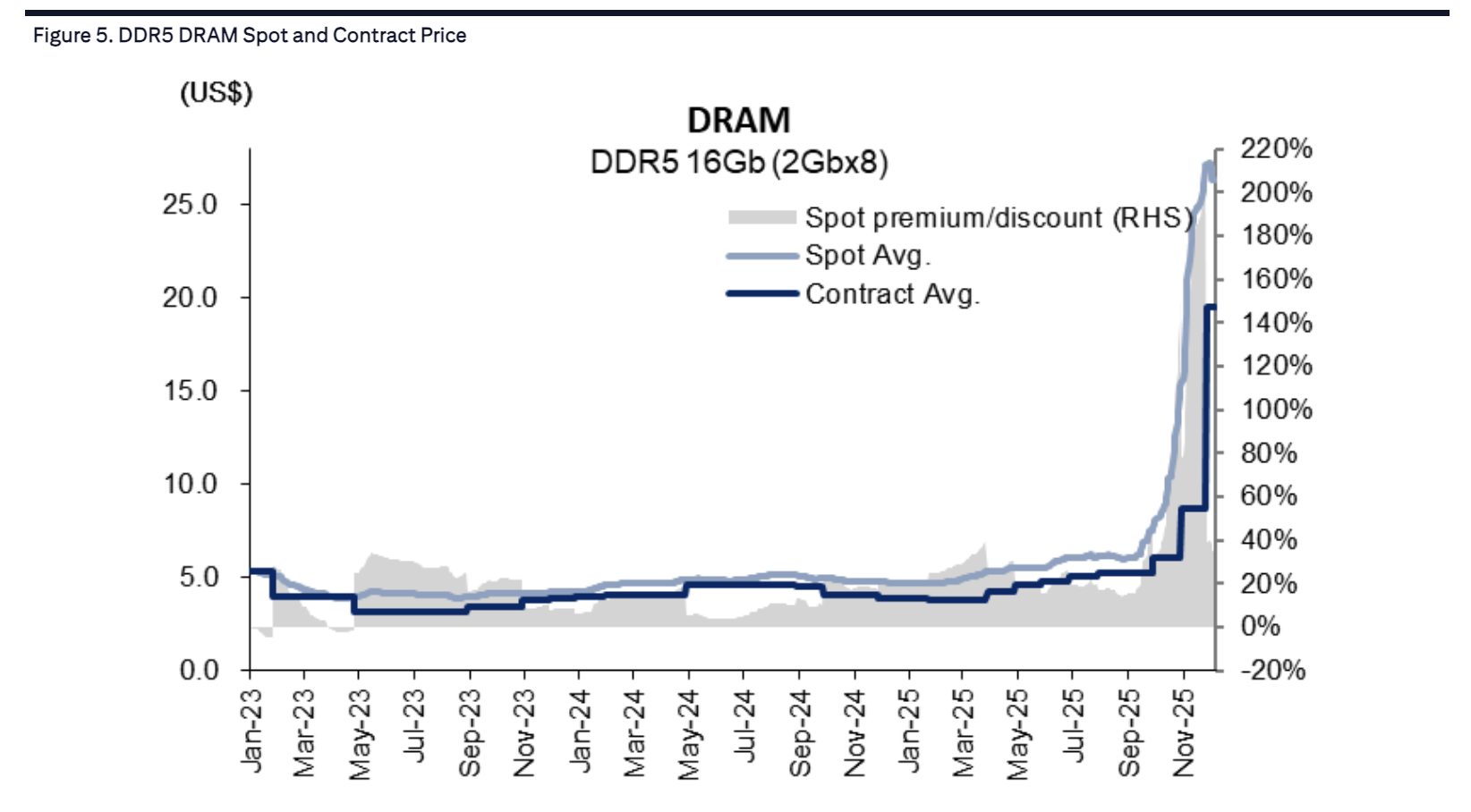
Dram Pricing Chart from Citi Research
(Source: Citi Research, DRAMeXchange)

As the chart above shows, this is a pretty remarkable move in prices for Dynamic Random Access Memory, or DRAM. Citi analysts estimate that DRAM sales account for roughly 79% of Micron revenues.

The ubiquitous short-term data storage chips used in computers and phones have long been considered something of a low-priced commodity product. (In fact, at times in the past, DRAM, which acts as a sort of high-speed, short-term memory for tasks computers are actively working on, has been called the “crude oil of the information age” because of its widespread use.)

Citi’s note is the latest in a number of favorable analyst missives on the stock this month, most lifting price targets. Yesterday, HSBC initiated coverage of Micron with a “buy” rating.

The shares have more than tripled this year, and are the fourth-best performers in the S&P 500.

More Markets

See all Markets
markets

CoreWeave reports modestly better than expected Q1 results, revenue backlog nearing $100 billion

CoreWeave is whipsawing in after-hours trading as investors digest whether its ho-hum earnings report can justify the 86% rally since late March.

In Q1, the neocloud firm reported:

  • Revenue: $2.1 billion (estimate: $2 billion)

  • Adjusted EBITDA: $1.2 billion (estimate: $1.1 billion)

As of March 31, its revenue backlog was $99.4 billion.

“We surpassed 1 GW of active power and believe we are well on our way to more than 8 GW by 2030, having positioned our capital structure to scale with the opportunity ahead," said CEO, co-founder, and Chairman Michael Intrator in a press release. “AI natives and enterprise customers are choosing CoreWeave because we sit between the models and the silicon, delivering the infrastructure, software, and expertise required to build and run AI at scale.”

At the end of the quarter, the company managed to close a unique debt deal backed by GPUs and what Meta is slated to pay for AI compute.

Since then, CoreWeave and its peers have been buoyed by a scramble for compute catalyzed by a seeming shortage for Anthropic, as the Claude developer aimed to beef up its footprint amid complaints around usage limits.

CoreWeave reached a multiyear deal with Anthropic to help power Claude, and also expanded its AI compute sales pact with Meta by $21 billion.

markets

Rocket Lab reports better-than-expected Q1 sales, stock rises

Retail favorite Rocket Lab rose late Thursday after reporting better-than-expected Q1 sales and offering up beat sales guidance for Q2.

Here’s how the company did:

  • Q1 revenue of $200.3 million vs. Wall Street’s expectation for $189.7 million, according to FactSet.

  • An adjusted loss per share of -$0.07 vs. the consensus estimate of a -$0.07 loss.

  • Adjusted EBITDA of -$11.8 million vs. analyst expectations of -$26.3 million.

  • Q2 sales guidance of between $225 million and $240 million ($232.5 million midpoint) vs. expectations for $205.3 million.

  • Q2 guidance for an EBITDA loss of between -$20 million and -$26 million (-$23 million midpoint) vs. the -$14.5 million analysts were penciling in.

Rocket Lab shares have surged roughly 2,000% over the last two years, as the company capitalized on investor enthusiasm for space.

Over the last year, Rocket Lab also rode growing excitement about companies that plan to use their ability to place clusters of satellites into low-earth orbit, and then sell data services to earthlings below — essentially the business model of Elon Musk’s Starlink.

Though it’s privately held for now, Musk’s space behemoth — SpaceX — remains the key source of excitement around the sector, enthusiasm which will likely grow as SpaceX moves forward with plans for what’s likely to be the largest public offering ever.

Rabid space enthusiasm aside, Rocket Lab remains a money-losing company that’s burning a lot of cash, though Wall Street analysts think it could break even in 2027.

We’ll see. That projection hangs on the company’s ability to get its larger Neutron rocket into its commercial launch cycle sooner rather than later. And given that Neutron’s maiden launch — originally slated for 2025 — has been delayed to the fourth quarter of 2026, that’s by no means assured.

markets

Opendoor Technologies reports better-than-expected Q1 results and touts key profitability milestone

Opendoor Technologies delivered a set of better-than-expected Q1 results while touting that it’s just achieved a key profitability milestone.

In Q1, the online real estate company reported:

  • Revenue: $720 million (estimate: $665.2 million)

  • Adjusted EBITDA: -$31 million (estimate: -$33.5 million)

In the press release, the company said it is adjusted EBITDA profitable on a 12-month go-forward basis as of April 1.

For Q2, management offered mixed guidance. The company expects sales of about $900 million (estimate: $1.13 billion) with adjusted EBITDA roughly flat (estimate: -$4.66 million).

Under its new leadership, the online real estate company has redoubled its efforts on aggressive home-flipping and adopted a “default to AI approach,” including using the technology for home assessments and in closings.

“Our 4Q25 and January 2026 cash acquisition cohorts have the best combination of margin, margin stability, and resale velocity of any corresponding cohort in company history (excluding the COVID-era cohorts),” said CEO Kaz Nejatian in a press release.

Opendoor’s share price, one of the most interesting things in the stock market for a couple months in 2025, has been decidedly boring in 2026. Since late January, it’s traded in a range of roughly $4.30 to $5.60.

markets
Saleah Blancaflor

US national average gas price rises 25 cents in a week once again to hit $4.55

Drivers have been seeing another increase at the pump, as the national average for a gallon of regular gas rose 25 cents for a second consecutive week.

Gas prices are currently $4.55 per gallon, which is $1.40 higher than it was about a year ago, according to the American Automobile Association. Gas prices have reached their highest level since 2022 when the national average peaked at $5.01 per gallon.

While crude oil prices dropped below $100 per barrel during ongoing negotiations to reopen the Strait of Hormuz, gas prices continue to face growing pressure from global supply concerns.

Loading...
 

(Event contracts are offered through Robinhood Derivatives, LLC — probabilities referenced or sourced from KalshiEx LLC or ForecastEx LLC.)

While crude oil prices dropped below $100 per barrel during ongoing negotiations to reopen the Strait of Hormuz, gas prices continue to face growing pressure from global supply concerns.

Loading...
 

(Event contracts are offered through Robinhood Derivatives, LLC — probabilities referenced or sourced from KalshiEx LLC or ForecastEx LLC.)

Latest Stories

Sherwood Media, LLC produces fresh and unique perspectives on topical financial news and is a fully owned subsidiary of Robinhood Markets, Inc., and any views expressed here do not necessarily reflect the views of any other Robinhood affiliate, including Robinhood Markets, Inc., Robinhood Financial LLC, Robinhood Securities, LLC, Robinhood Crypto, LLC, Robinhood Derivatives, LLC, or Robinhood Money, LLC. Futures and event contracts are offered through Robinhood Derivatives, LLC.

