Markets
Housing development in West Virginia
(Robert Knopes/UCG/Universal Images Group via Getty Images)

Blue skies for housing ahead

Markets seem to be pricing in a big response from residential real estate to the Fed’s rate cuts.

After spending nearly two years in a deep downturn, the US housing market is about to be jolted to life by a half-percentage point rate cut from the Federal Reserve later this week.

At least that’s the signal being sent by equity markets, as shares closely tied to the fortunes of home-buying activity continue to romp.

Over the last three months, the second-best performing stock in the S&P 500 has been flooring manufacturer Mohawk Industries — up about 40% — with other top-performing housing-related stocks such as credit check company Fair Isaac Corporation — keepers of the FICO scores required for mortgage applications — and home builder DR Horton hovering near the the top of blue chip list with gains of roughly 35%.

A similar dynamic is afoot in the world of small caps, where real estate site Redfin has posted again of more than 120% over the last three months. Home brokerage company ReMax is up nearly 60% in the same period.

Clearly, there’s a sense a Fed shift to fairly aggressive rate cuts — Luke tells us the market-implied odds that the Fed announces a half-point cut on Wednesday afternoon got as high as 70% — is just the tonic the housing market needs.


The logic is compelling. The shock of 30-year fixed mortgage rates leaping to nearly 8% late last year — after being less than 3% just a couple years earlier — flummoxed would be buyers and sellers alike. Those sitting on low rates, were loath to give them up even if they might like to move. Those hoping to buy a house found it tough to stomach paying hundreds of dollars more each month in interest costs than they would have just a couple years earlier. So nobody has been doing much buying or selling.

In July, pending home sales were within spitting distance of the record low posted during the worst moments of the Covid crisis in April 2020. It would seem there’s no where to go but up. On the other hand, given the scale of the moves of some of these stocks, that seems pretty well understood by the markets already.

More Markets

See all Markets
markets

Infleqtion targets revenue growth of 23% in 2026, up from 12% in 2025

Quantum computing firm Infleqtion said it’s aiming to book $40 million in sales this year as it released its 2025 results after the close on Wednesday.

That would be an increase of roughly 23% compared to the $32.5 million in revenues the company generated in 2025, and would mark an acceleration from growth of 12% last year.

The seller of quantum sensors and computers went public via a SPAC in February after carrying a pre-money valuation of $1.8 billion (well below other pure-play peers like Rigetti Computing, IonQ, and D-Wave Quantum).

“We did $29 million in revenue in 2024, and then we announced that we did $50 million of booked and awarded business in 2025. I think that sets a good foundation for significant revenue growth going forward,” CEO Matthew Kinsella told us in February. “I’ve always deeply believed that we need to develop that muscle of commercialization.”

markets

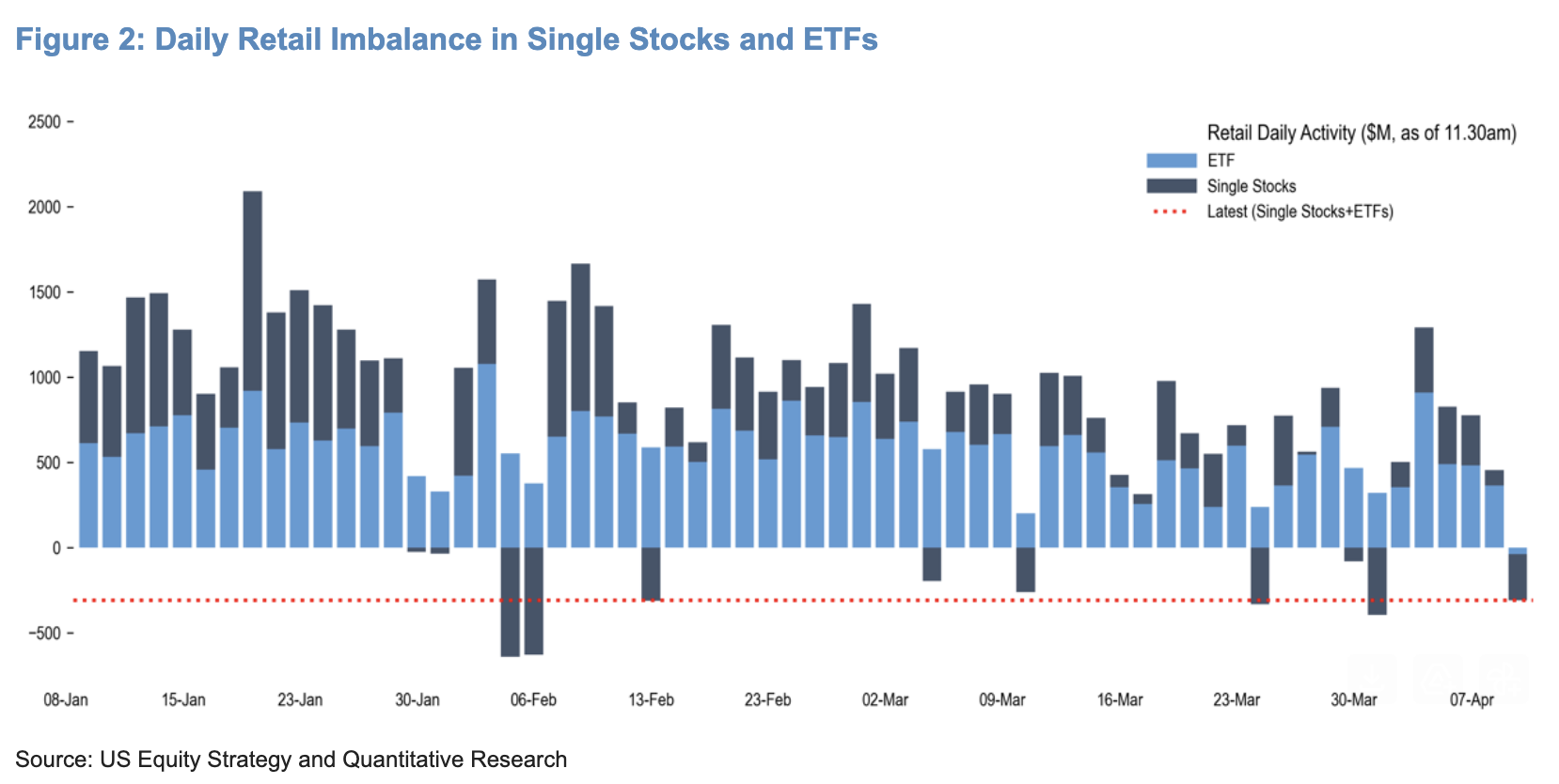
Retail traders are selling everything but the Magnificent 7, per JPMorgan

JPMorgan strategist Arun Jain with the skinny on retail trading activity through 11:30 a.m. ET today:

“Retail investors are selling into today’s strength in both ETFs and Single Stocks. In ETFs, they are trimming their broad-based exposure — a major departure from their typical pattern.”

The SPDR S&P 500 ETF and ProShares UltraPro QQQ suffered particularly large outflows, per Jain.

The exceptions to the selling pressure are the Magnificent 7 stocks, he wrote, with Nvidia, Tesla, Meta, and Microsoft enjoying “small net purchases,” while Micron, TSMC, Exxon, and Chevron were the most dumped names.

Retail trading 4/8

Last week, Jain noted that retail traders had been “skipping the dips, selling into rallies, and positioning more defensively” with markets jittery amid the ongoing Mideast war.

markets

Avis shorts facing $1.1 billion in losses as car rental company racks up 155% gains in its recent rally

Whatever traders are doing with Avis — buying, or just renting — it’s causing short sellers an immense amount of pain.

Shares of the car rental company have traded violently on Wednesday, from up nearly 7% at their highs to down almost 4% at their lows, after a face-ripping rally of 155% over the previous 11 sessions.

Per exchange data, roughly half the shares were sold short as of mid-March. S3 Partners, which tracks higher-frequency measures, said that short interest as a share of float had recently been trimmed to about 43%, down from as high as 53% at the start of the year.

Per Matthew Unterman, managing director at S3, Avis shorts are down $1.1 billion on paper over the past 30 days.

This isn’t Avis’ first rodeo: shares went parabolic in Q4 2021 as part of a meme stock moment in which it briefly became the most valuable company in the Russell 2000 small-cap index.

In any event, cheers to u/Bright_Leopard_4326, who admonished other members of the r/ShortSqueeze subreddit for not paying enough attention to the potential for a boom in the stock 10 days ago, when shares were trading below $150.

AVIS short squeeze
Source: r/ShortSqueeze

Latest Stories

Sherwood Media, LLC produces fresh and unique perspectives on topical financial news and is a fully owned subsidiary of Robinhood Markets, Inc., and any views expressed here do not necessarily reflect the views of any other Robinhood affiliate, including Robinhood Markets, Inc., Robinhood Financial LLC, Robinhood Securities, LLC, Robinhood Crypto, LLC, Robinhood Derivatives, LLC, or Robinhood Money, LLC. Futures and event contracts are offered through Robinhood Derivatives, LLC.