
Markets
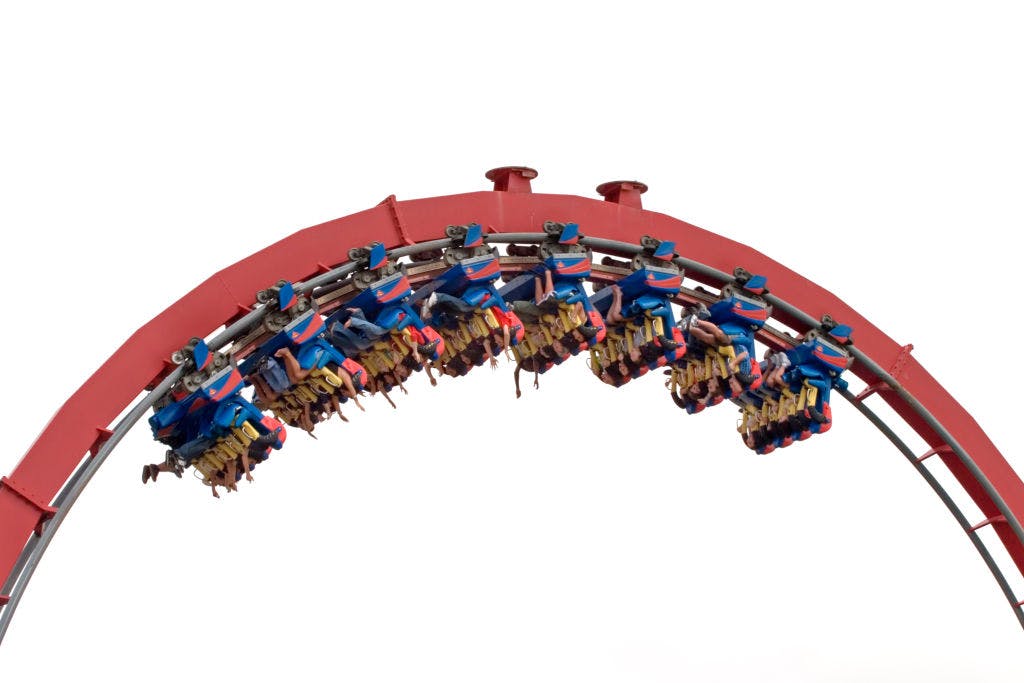
Roller coaster steel car full of riders
Roller coaster with a car full of screaming people (MyLoupe/Getty Images)

How bitcoin’s moves show that the stock market is actually fueled by vibes

Bitcoin has been strongly correlated with the S&P 500; the low-volatility stocks within the S&P 500 have not.

Luke Kawa

Bitcoin is behaving more like the S&P 500 than the boring, safer stocks within the S&P 500 are.

The 21-session correlation between the daily change in the iShares Bitcoin Trust and the SPDR S&P 500 ETF recently got above 0.75, a level not seen since early April, when both were cratering on the announcement of reciprocal tariffs. Meanwhile, the 21-session correlation between SPY and the Invesco S&P 500 Low Volatility ETF, which holds the stocks that tend not to move as much, has collapsed. It’s gone negative, but could reasonably just be described as simply uncorrelated.

These correlations hint at what’s been a key driver for the benchmark US index: the ebbs and flows of speculative appetite. (I’m operating under the assumption that changes in sentiment, willingness to take risk, and ride momentum are the proximate causes of why bitcoin goes up and down.)

I have received more than a bit of pushback across social media recently for suggesting that bitcoin is behaving like a leveraged, low-fundamentals tech stock. I’m happy to correct the record — but only to change the chain of causality here.

That is, stocks are behaving like a de-levered version of bitcoin.

It seems fairly clear at this juncture that rollovers in bitcoin and other speculative pockets of the market in October were the bleeding edge of the retreat from risk that’s gone on to infect even the AI megacap leaders as of late.

More Markets

See all Markets
markets

SpaceX gets a wave of bullish ratings from Wall Street analysts

SpaceX received more than a dozen positive analyst calls on Tuesday — including from major Wall Street banks — as they initiate coverage on Elon Musk’s space and AI company.

SpaceX went public on June 12 at a $2.2 trillion valuation, the largest debut in history. While the company hasn’t yet posted a profit, it seems to have convinced Wall Street that it will get there and grow its valuation on the way.

Of the at least 17 analysts that gave a rating on Tuesday, all but one gave it a “buy” or “outperform” rating. MoffettNathanson was "neutral."

The ratings come as SpaceX joined the Nasdaq 100 index, a benchmark tech-heavy basket of companies that underpins millions of portfolios. The inclusion adds built-in demand for the stock from index funds and ETFs.

Still, SpaceX fell more than 5% on Tuesday amid a broader sell-off, and is currently effectively flat from its opening price of $150 a share.

markets

Nike sinks to lowest level since 2014 after warning of “challenged” sales environment in Q4 report

Did Nike do it?

Investors had a mixed reaction after the global sports apparel company reported its fourth quarter earnings on Tuesday after the bell. Shares initially rose 5% as Nike beat out Wall Street expectations amid a hefty tariff refund bonus. However, the stock then sank to its lowest level since August 2014 in postmarket trading.

Here are the Q4 numbers:

  • Revenue of $11.0 billion (estimate: $10.8 billion).

  • Adjusted earnings per share of $0.20 (estimate: $0.12).

Ahead of this report, Nike warned that results would be flattered by a one-time tariff refund (now estimated at roughly $0.52 per share for the bottom line). That gave the company an extra cushion in snapping its streak of seven quarters of year-over-year profit declines.

Over the past year, the company had been punished by tariffs on imported goods, stagnant consumer spending, and increasing competition from other footwear brands like New Balance, Adidas, and Hoka.

Outgoing CFO Matthew Friend deemed it an “increasingly challenging operating environment, where sell-through remains challenged.”

Latest Stories

Sherwood Media, LLC and Chartr Limited produce fresh and unique perspectives on topical financial news and are fully owned subsidiaries of Robinhood Markets, Inc., and any views expressed here do not necessarily reflect the views of any other Robinhood affiliate, including Robinhood Markets, Inc., Robinhood Financial LLC, Robinhood Securities, LLC, Robinhood Crypto, LLC, Robinhood Money, LLC, Robinhood U.K. Ltd, Robinhood Derivatives, LLC, Robinhood Gold, LLC, Robinhood Asset Management, LLC, Robinhood Credit, Inc., Robinhood Ventures DE, LLC and, where applicable, its managed investment vehicles.

