
Markets
Canada and Mexico two flags together textile cloth fabric texture
Getty Images
Duties call

How will tariffs impact company profits?

Analysts from Goldman Sachs estimate a modest hit to S&P 500 profits.

On Saturday, President Trump announced that the United States will impose a 25% tariff on imports from Mexico and Canada, and an additional 10% tariff on imports from China. Since then, a deal has been reached with Mexico to delay tariffs by one month, although at the time of writing no such reprieve is in sight for the northern neighbor.

The original announcement would have seen tariffs go into effect on Tuesday for goods arriving from the three countries that America buys most from — a trio of nations that are collectively responsible for $1.25 trillion worth of imports last year (up to November).

That’s bad news if you spend a lot of cash on avocado on toast (about 90% of America’s avo supply comes from Mexico). It also likely means a direct impact on the profits of America’s largest companies.

Indeed, Goldman Sachs’ researchers, led by David Kostin, estimated in a new note published this morning that (emphasis ours):

“...every 5pp increase in the US tariff rate would reduce S&P 500 EPS by roughly 1-2%. As a result, if sustained, the tariffs announced this weekend would reduce our S&P 500 EPS forecasts by roughly 2-3%, not taking into account any additional impact from major financial conditions tightening or a larger-than-expected effect of policy uncertainty on corporate or consumer behavior.”

So, at face value, we’re potentially talking about profits mechanically falling 2% to 3% in aggregate, which is the simple part of the explanation as to why the SPDR S&P 500 ETF is down 1.6% in premarket trading, with automotive stocks like General Motors , Ford, and Volkswagen among the stocks getting hit the hardest. T

The harder stuff to foresee? Second-order impacts. Those could include, but are not limited to: the impact of tariffs on rising policy uncertainty, manufacturing relocation, the potential impact of retaliations, the downstream effect on inflation — and therefore interest rates — and the “release valve” effect of a stronger US dollar.
EPU Index
Sherwood News

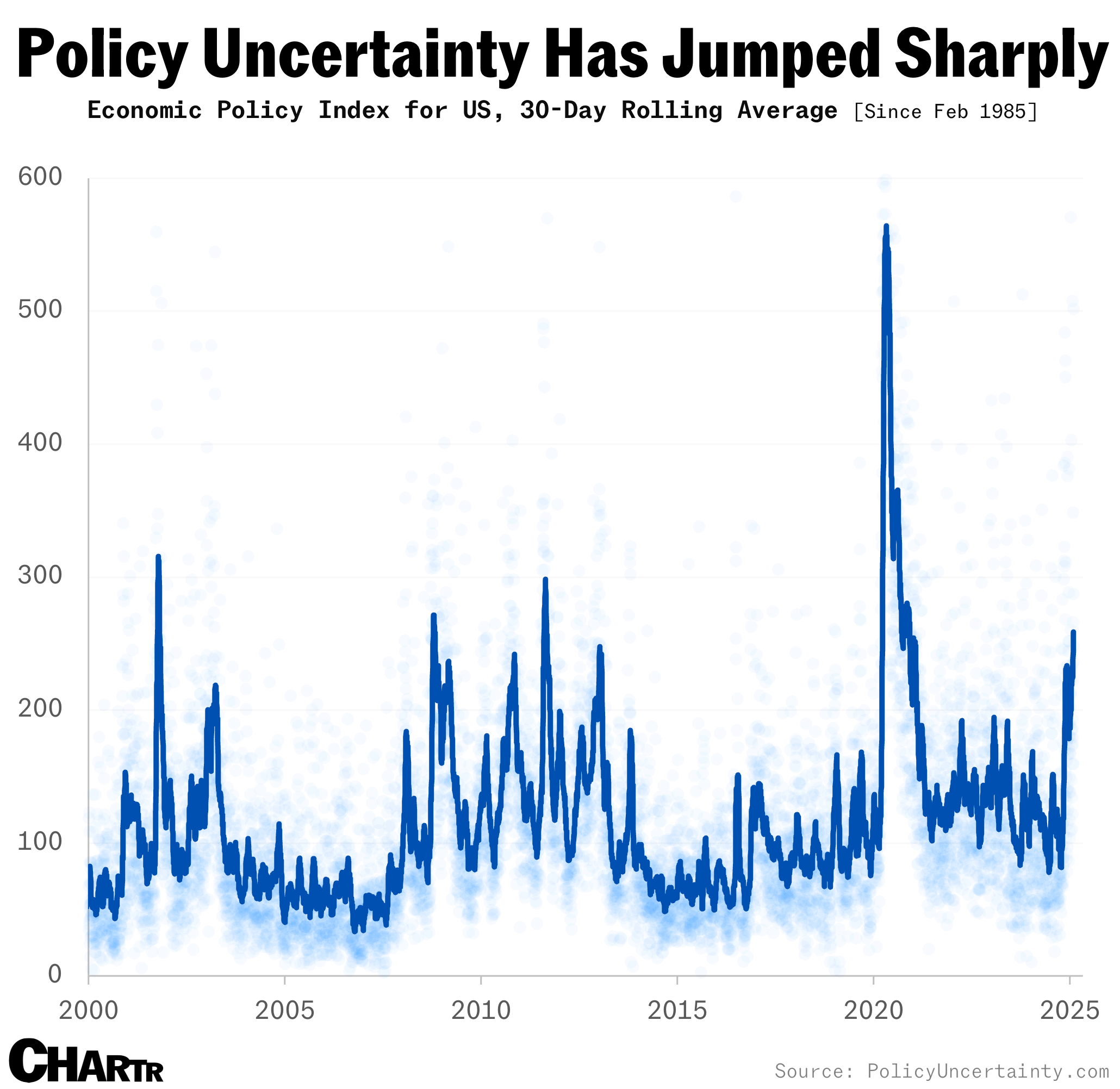
Indeed, the US Economic Policy Uncertainty Index, a measure of how much major US newspapers are referencing economic uncertainty, spiked to a reading of 502 on January 31, with the average of the last 30 days at its highest level since the pandemic.

More Markets

See all Markets
markets

Hardware stocks jump thanks to server demand and record Lenovo revenue

Server stocks are rallying as Dell, Super Micro Computer, and Hewlett Packard Enterprise ride the momentum of Hong Kong-based Lenovo. The PC makers stock rose 19% on Friday, hitting an all-time high, on record Q4 earnings.

Powering the positive earnings report was the companys AI-related revenue, which grew 84% in the fourth quarter and now makes up over a third of total revenue. Investors seem to think the increased demand for servers could have trickle-down effects for other companies.

The companys results and commentary reinforced the outlook for strong AI-infrastructure demand while indicating resilient broader traditional server and storage spending, wrote Woo Jin Ho, a senior technology analyst at Bloomberg Intelligence. Lenovos $21 billion AI-server pipeline and remarks that demand is outpacing supply support Dells AI-demand momentum and point to robust orders.

AIs insatiable computing demand is reshaping the hardware industry and driving up server demand.

Dell will report first-quarter earnings on Thursday, May 28.

Policeman with Piercing Eyes

Take-Two’s “GTA 6” forecast feels absurdly conservative

Take-Two issued a 2027 net bookings forecast about $1 billion below Wall Street’s estimates. The stock is falling on Friday.

The D-Wave 2X quantum system, is operated at the NASA Advanced Supercomputing facility's Quantum Artificial Intelligence Laboratory at NASA's Ames Research Center in Mountain View, Calif., as seen on Tuesday December 8, 2015.

Quantum computing CEOs hope “validating” government backing proves their technology is no longer speculative

The government funding is a push to boost the foundational elements of quantum computing to get the industry ready for prime time. The CEOs of Infleqtion and D-Wave give us their thoughts.

Luke Kawa5/22/26
markets

Ross Stores surges as Q1 results beat expectations, full-year guidance raised

Ross shares are rising after the company delivered strong Q1 results, with sales topping Wall Street’s projections.

The stock soared 6.3% just after the open.

Key numbers:

  • Earnings per share of $2.02 vs. $1.47 year over year (estimate: $1.72).

  • Sales of $6.01 billion, up 21% year over year (estimate: $5.61 billion).

  • Comparable sales growth of 17% (estimate: 8.58%).

CEO Jim Conroy attributed the results to better traffic in stores. “Customer traffic was the primary driver of the strong sales trend as compelling merchandise assortments, higher customer acquisition and engagement from our ongoing marketing initiatives, and an improved in‑store experience are resonating with shoppers.”

The company also noted that transaction volume grew across all key demographics, including “income levels, ethnicities, and age groups, including younger customers.” Sales were also likely buoyed by standard seasonal tailwinds, including consumer spending from tax refunds.

Backed by the strong quarter, the company lifted its full-year targets. Ross now projects same-store sales growth of 6% to 7%, up from the prior forecast of 3% to 4%, topping Wall Street’s estimate of 4.64%. It boosted its annual EPS guidance to a range of $7.50 to $7.74, versus the prior outlook of $7.02 to $7.36.

Ross Stores has been one of the retail sector’s standout performers this year, rising around 20% year to date as of Thursday’s close.

Latest Stories

Sherwood Media, LLC and Chartr Limited produce fresh and unique perspectives on topical financial news and are fully owned subsidiaries of Robinhood Markets, Inc., and any views expressed here do not necessarily reflect the views of any other Robinhood affiliate, including Robinhood Markets, Inc., Robinhood Financial LLC, Robinhood Securities, LLC, Robinhood Crypto, LLC, Robinhood Money, LLC, Robinhood U.K. Ltd, Robinhood Derivatives, LLC, Robinhood Gold, LLC, Robinhood Asset Management, LLC, Robinhood Credit, Inc., Robinhood Ventures DE, LLC and, where applicable, its managed investment vehicles.

