
Markets
Black and White Cow illustration
(Getty Images)
Don’t have a cow

In bad news for protein-hungry Americans, beef is more expensive than ever

Meat-packing giants, meanwhile, are benefiting from beefier prices.

Claire Yubin Oh

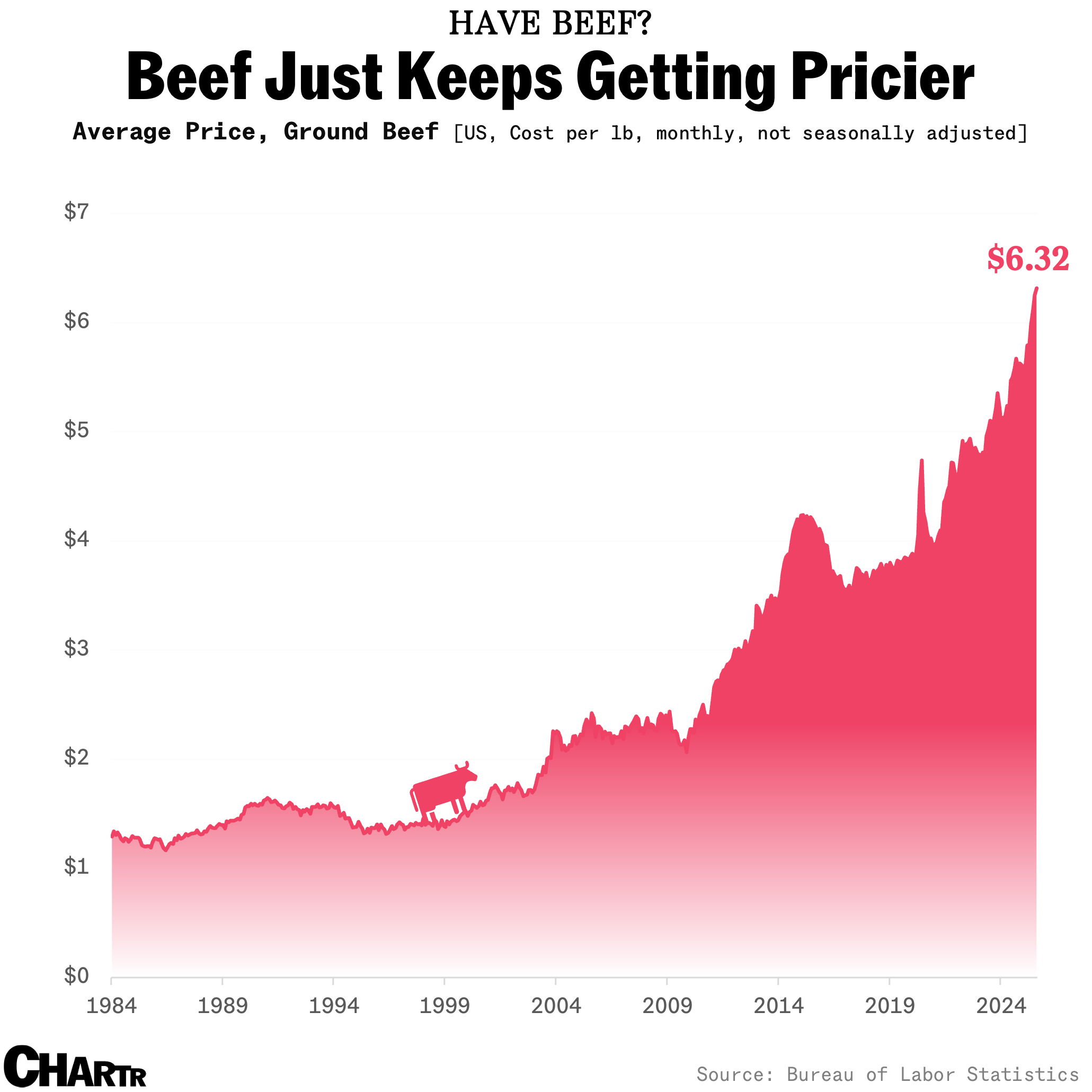
One of the billionaire owners of the world’s largest meat company thinks that the US isn’t producing enough beef to satisfy Americans’ increasingly protein-rich diets. He’s probably not wrong.

“The US is facing the highest beef price in history, and so the US needs to import more and more because production is not there to support the demand,” said Wesley Batista, one of the brothers behind Brazilian meat giant JBS.

While the US has long been a net exporter of beef, imports to the country are now reaching new heights as the nation tries to resolve its domestic beef supply issues, which largely stem from underinvestment in America’s cattle herd a decade ago. Even with President Donald Trump’s “Liberation Day” tariffs in place, the US was importing 30% more beef in the first half of the year than in 2024, as it looked to contain soaring beef prices.
Beef prices are increasing chart
Sherwood News

The growing use of GLP-1 weight-loss drugs might also be driving US beef demand. “No one knows exactly what is the impact of these new drugs, Ozempic or Mounjaro... but something is happening because protein overall became [a trend],” Batista said last month.

A lot at steak

America’s beef landscape is dominated by four big companies, which produced 81% of the nation’s beef in 2021, per a USDA report last year. And with supply tight and demand growing, beef in the US keeps getting pricier — which is making meat-packers, not least JBS, fatter.

The São Paulo-based company made almost $2 billion in profit last year, bouncing back after a loss the year before, and has continued to see a 61% year-on-year uptick in net income in the latest quarter.

Now, JBS is looking to cement its status as the top beef producer in the US, where its wider meat and food business accounted for half its revenue in 2024. With prices increasing and the fact that the business produces most of the beef for its US market on American soil, that may very likely continue to tick up in quarters to come.

Related reading: The US beef industry looks a little unsteady — but Americans are still bullish on steak

More Markets

See all Markets
markets

With their recent surge, Intel shares just hit their highest level since the dot-com era

Intel’s surge of nearly 60% this month has the iconic American chipmaker’s stock price approaching levels last seen during the dot-com era. Bloomberg noted that shares just touched their highest intraday level since the turn of the century:

The stock rose as much as 1.5% to $69.55, topping a peak it hit on Jan. 24, 2020. The shares are up 90% this year, after soaring 84% in 2025. Intel is now roughly 8% from its all-time closing high of $74.88, established on Aug. 31, 2000.

That’s just the most recent late-’90s-era throwback we’ve been seeing in tech shares lately. Oracle is currently pacing for its best week since late 1999.

What’s even more remarkable, however, is that Intel’s forward price-to-earnings ratio today dwarfs the premiums the market was putting on the stock during the nuttiness of the dot-com mania.

That reflects the fact that the recent run-up in Intel shares is, essentially, giving the chip giant credit for a massive turnaround that hasn’t actually happened yet.

One also might wonder if the fact that Intel is partially owned by the US government means it’s more attractive — and therefore worth a higher premium — than other chipmakers without the state imprimatur.

Still, kind of startling.

markets

Eli Lilly’s GLP-1 pill hit nearly 1,400 prescriptions in first week

Eli Lilly rose after preliminary numbers cited by Wall Street analysts showed strong uptake of its new weight-loss pill.

The FDA approved Foundayo on April 1 and shipments began on April 9. In its first week, roughly 1,400 US prescriptions were written for the drug, according to IQVIA data cited by Deustche Bank analysts in a Friday note.

Novo Nordisk, Lilly’s rival in the GLP-1 market, released its GLP-1 pill earlier this year, and early signs show that it’s expanding the market, inviting patients who were turned off by weekly injections. Novo’s pill had a stronger first week than Lilly’s, with its Wegovy pill hitting 3,071 US prescriptions in the first four days after its launch on January 5.

Lilly’s pill has an advantage over Novo’s, which is that it can be taken at any time of day, with or without food. Lilly disclosed in a February regulatory filing that it had $1.5 billion worth of prelaunch inventory ready ahead of the FDA approval — which is about as much as analysts polled by FactSet expect it to sell this year.

Novo Nordisk, Lilly’s rival in the GLP-1 market, released its GLP-1 pill earlier this year, and early signs show that it’s expanding the market, inviting patients who were turned off by weekly injections. Novo’s pill had a stronger first week than Lilly’s, with its Wegovy pill hitting 3,071 US prescriptions in the first four days after its launch on January 5.

Lilly’s pill has an advantage over Novo’s, which is that it can be taken at any time of day, with or without food. Lilly disclosed in a February regulatory filing that it had $1.5 billion worth of prelaunch inventory ready ahead of the FDA approval — which is about as much as analysts polled by FactSet expect it to sell this year.

markets

Critical Metals jumps after Greenland’s government approves CRML to take majority control of the Tanbreez mining project

Critical Metals is up more than 25% in premarket trading on Friday after the critical mining company announced that it now owns 92.5% of the Tanbreez rare earth deposit following an approval from the government of Greenland.

With that latest government support, Critical Minerals added an additional 50.5% stake to its ownership, reportedly acquired from Rimbal Pty Ltd, per Bloomberg News. With access to eight heavy rare earth elements often used in consumer electronics and defense, the site is one of the world’s largest undeveloped rare earth deposits and a key source of rare earth supply outside of China, according to the company.

In Critical Metals’ press release, Chairman Tony Sage commented that the approval “removes the most significant structural overhang on the project and provides the clarity to advance Tanbreez to production with confidence,” especially as Tanbreez’s location offers a significant logistical advantage through its year-round direct shipping access, compared to rival projects.

With 92.5% of the project now vested in Critical Metals Corp., and the remainder owned by European Lithium Ltd., CRML now has full control of the project and is seeking to accelerate development there, with plans for a new international airport and a 150-tonne bulk sample program, which is slated for June 2026.

Latest Stories

Sherwood Media, LLC produces fresh and unique perspectives on topical financial news and is a fully owned subsidiary of Robinhood Markets, Inc., and any views expressed here do not necessarily reflect the views of any other Robinhood affiliate, including Robinhood Markets, Inc., Robinhood Financial LLC, Robinhood Securities, LLC, Robinhood Crypto, LLC, Robinhood Derivatives, LLC, or Robinhood Money, LLC. Futures and event contracts are offered through Robinhood Derivatives, LLC.

