

Markets
College Football Playoff Semifinal at the Goodyear Cotton Bowl Classic - Clemson v Notre Dame
Bald eagle, flyin’ solo (Kevin C. Cox/Getty Images)

International investors want to own US assets — and have nothing to do with the US dollar

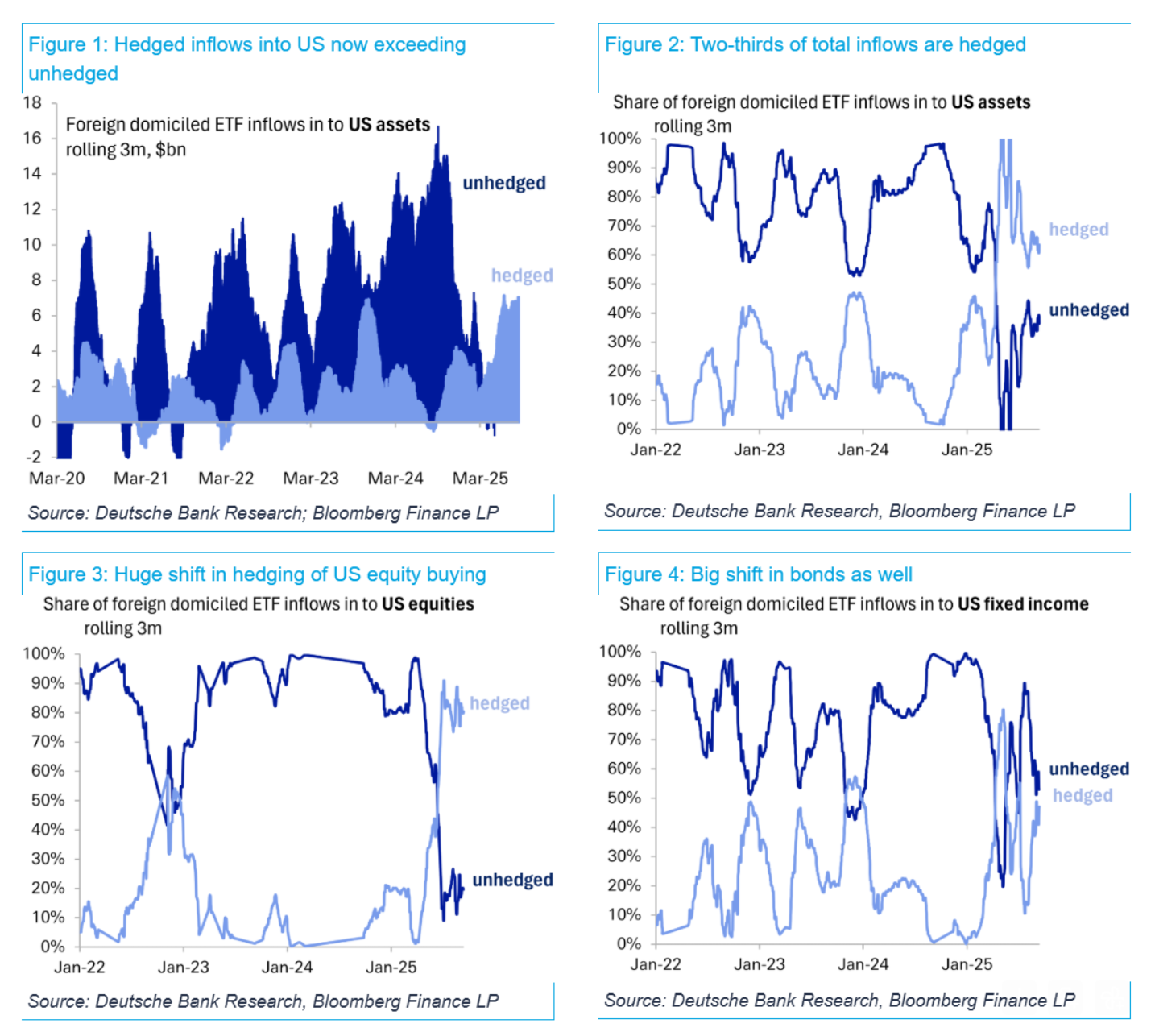
Looking at ETF flows, Deutsche Bank’s George Saravelos found that 80% of recent foreign inflows into US stocks and 50% of inflows into US bonds have been on a hedged basis.
Luke Kawa

“Sell America” — the global downgrade of US assets in the run-up to and immediate aftermath of the reciprocal tariffs announced on April 2 — was a very painful period for markets, but a very fun narrative to write about.

This narrative appears to have been brief, to the extent it existed at all, and could likely have been more appropriately characterized as “Right-Size Hedge Ratios on America.”

That is, traders want to hold lots US stocks and bonds, but don’t want exposure to the US dollar in the process.

And that story is still running strong, as Deutsche Bank’s global head of FX research, George Saravelos, shows.

“How can US stocks be making record highs while the weak dollar is at year lows? We wrote last week that there is nothing ‘exceptional’ about the US market because global equities are also rallying,” he wrote. “But there is also an important flow story: foreign investors are now removing dollar exposure at an unprecedented pace.”

Looking at ETF flows, Saravelos found that 80% of recent foreign inflows into US stocks and 50% of inflows into US bonds have been on a hedged basis.

Foreign inflows into US assets

There are two implications of this trend that immediately spring to mind.

Saravelos with the first:

“Yet it is only unhedged inflows that finance the US current account deficit and these are running 75% below the peak from last year,” he wrote. “The dollar is falling because the unhedged flow picture looks very weak. With the Fed about to start cutting rates while most other central banks are on hold, hedging dollar assets will only get cheaper.”

And I’ll offer up a second, inspired by Karthik Sankaran, senior research fellow at the Quincy Institute for Responsible Statecraft.

Typically, when conditions get very, very rough and there is visible credit market stress, the US dollar rallies because it’s the global funding currency of choice, and everyone scrambles to get their hands on more of it.

I don’t know when, but there will be a time when credit conditions tighten materially again. If, at that time, there is a scramble for US dollars, then the protection typically provided by the safer parts of investment portfolios will not be as strong of an offset as it traditionally has been.

Bonds might be rallying as part of a flight to safety, but the currency benefits portfolio managers have come to rely on would be AWOL.

More Markets

See all Markets
markets

Hardware stocks jump thanks to server demand and record Lenovo revenue

Server stocks are rallying as Dell, Super Micro Computer, and Hewlett Packard Enterprise ride the momentum of Hong Kong-based Lenovo. The PC makers stock rose 19% on Friday, hitting an all-time high, on record Q4 earnings.

Powering the positive earnings report was the companys AI-related revenue, which grew 84% in the fourth quarter and now makes up over a third of total revenue. Investors seem to think the increased demand for servers could have trickle-down effects for other companies.

The companys results and commentary reinforced the outlook for strong AI-infrastructure demand while indicating resilient broader traditional server and storage spending, wrote Woo Jin Ho, a senior technology analyst at Bloomberg Intelligence. Lenovos $21 billion AI-server pipeline and remarks that demand is outpacing supply support Dells AI-demand momentum and point to robust orders.

AIs insatiable computing demand is reshaping the hardware industry and driving up server demand.

Dell will report first-quarter earnings on Thursday, May 28.

Policeman with Piercing Eyes

Take-Two’s “GTA 6” forecast feels absurdly conservative

Take-Two issued a 2027 net bookings forecast about $1 billion below Wall Street’s estimates. The stock is falling on Friday.

The D-Wave 2X quantum system, is operated at the NASA Advanced Supercomputing facility's Quantum Artificial Intelligence Laboratory at NASA's Ames Research Center in Mountain View, Calif., as seen on Tuesday December 8, 2015.

Quantum computing CEOs hope “validating” government backing proves their technology is no longer speculative

The government funding is a push to boost the foundational elements of quantum computing to get the industry ready for prime time. The CEOs of Infleqtion and D-Wave give us their thoughts.

Luke Kawa5/22/26
markets

Ross Stores surges as Q1 results beat expectations, full-year guidance raised

Ross shares are rising after the company delivered strong Q1 results, with sales topping Wall Street’s projections.

The stock soared 6.3% just after the open.

Key numbers:

  • Earnings per share of $2.02 vs. $1.47 year over year (estimate: $1.72).

  • Sales of $6.01 billion, up 21% year over year (estimate: $5.61 billion).

  • Comparable sales growth of 17% (estimate: 8.58%).

CEO Jim Conroy attributed the results to better traffic in stores. “Customer traffic was the primary driver of the strong sales trend as compelling merchandise assortments, higher customer acquisition and engagement from our ongoing marketing initiatives, and an improved in‑store experience are resonating with shoppers.”

The company also noted that transaction volume grew across all key demographics, including “income levels, ethnicities, and age groups, including younger customers.” Sales were also likely buoyed by standard seasonal tailwinds, including consumer spending from tax refunds.

Backed by the strong quarter, the company lifted its full-year targets. Ross now projects same-store sales growth of 6% to 7%, up from the prior forecast of 3% to 4%, topping Wall Street’s estimate of 4.64%. It boosted its annual EPS guidance to a range of $7.50 to $7.74, versus the prior outlook of $7.02 to $7.36.

Ross Stores has been one of the retail sector’s standout performers this year, rising around 20% year to date as of Thursday’s close.

Latest Stories

Sherwood Media, LLC and Chartr Limited produce fresh and unique perspectives on topical financial news and are fully owned subsidiaries of Robinhood Markets, Inc., and any views expressed here do not necessarily reflect the views of any other Robinhood affiliate, including Robinhood Markets, Inc., Robinhood Financial LLC, Robinhood Securities, LLC, Robinhood Crypto, LLC, Robinhood Money, LLC, Robinhood U.K. Ltd, Robinhood Derivatives, LLC, Robinhood Gold, LLC, Robinhood Asset Management, LLC, Robinhood Credit, Inc., Robinhood Ventures DE, LLC and, where applicable, its managed investment vehicles.

