Markets
markets
Luke Kawa

Investors are worried about the US election, but not enough to flee the stock market

Investors are clearly bracing for the US election to leave a mark on markets.

Jeff Jacobson, equity-derivatives strategist at 22V Research, flagged that options markets are pricing in a 2.6% move for the SPDR S&P 500 Trust for the week, and an even larger 3% swing for the iShares 20+ Year Treasury Bond ETF.

But even so, investors aren’t worried to the point of being paralyzed by inaction or sizing down risk ahead of this event, according to Deutsche Bank.

“Our measure of equity positioning has continued to go sideways modestly above neutral, in contrast to sharp declines into underweight territory heading into the last two elections,” wrote strategists led by Parag Thatte.
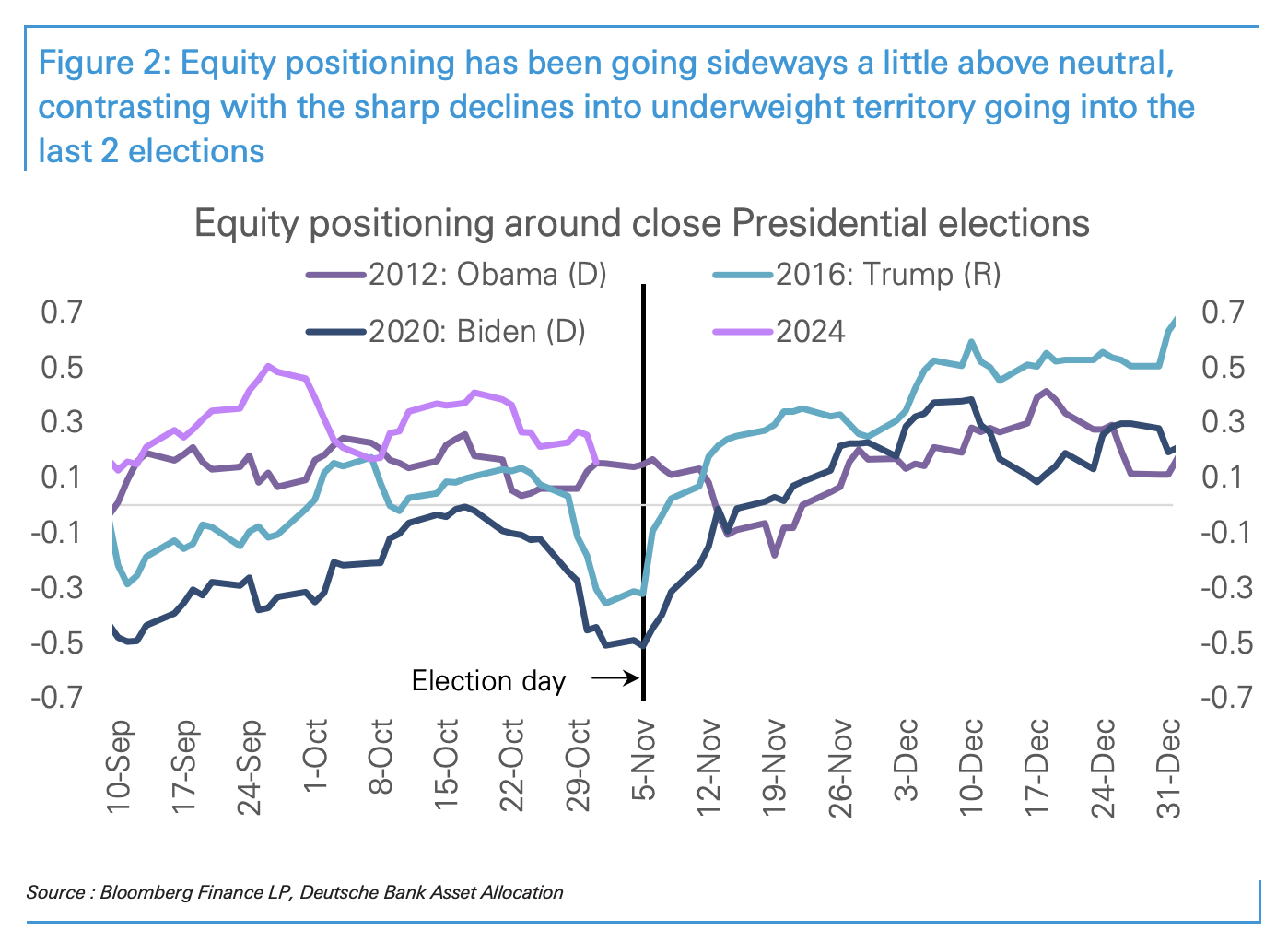
DB equity positioning
Source: Deutsche Bank

The S&P 500 also fell less in October than the benchmark normally does ahead of a tight election, they observed. That’s a continuation of a welcome trend that has seen the stock market do much better in 2024 than it has in a typical presidential election year.
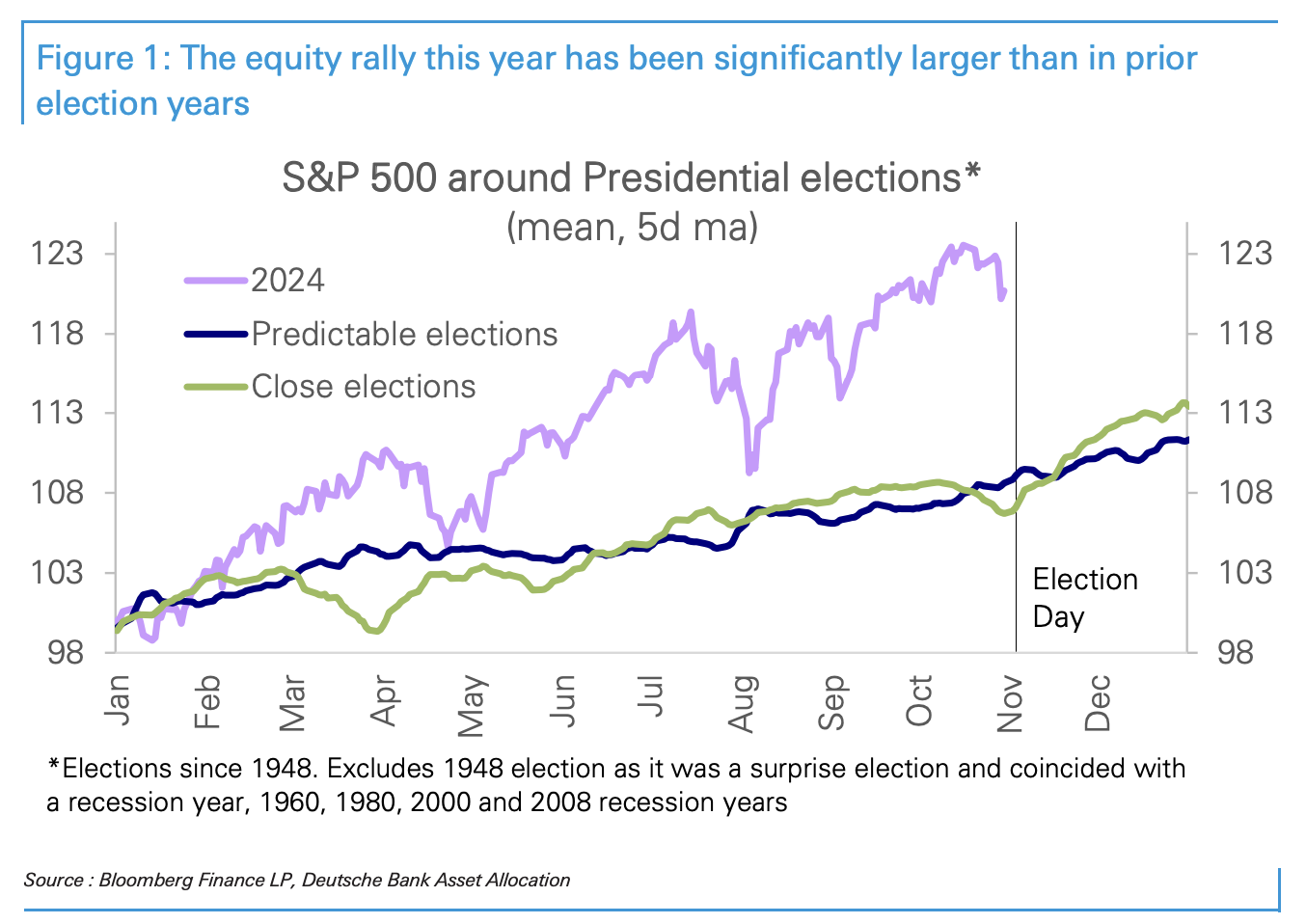
DB election year performance
Source: Deutsche Bank

And to repeat one of our favorite quotes: performance is a magnet for assets.
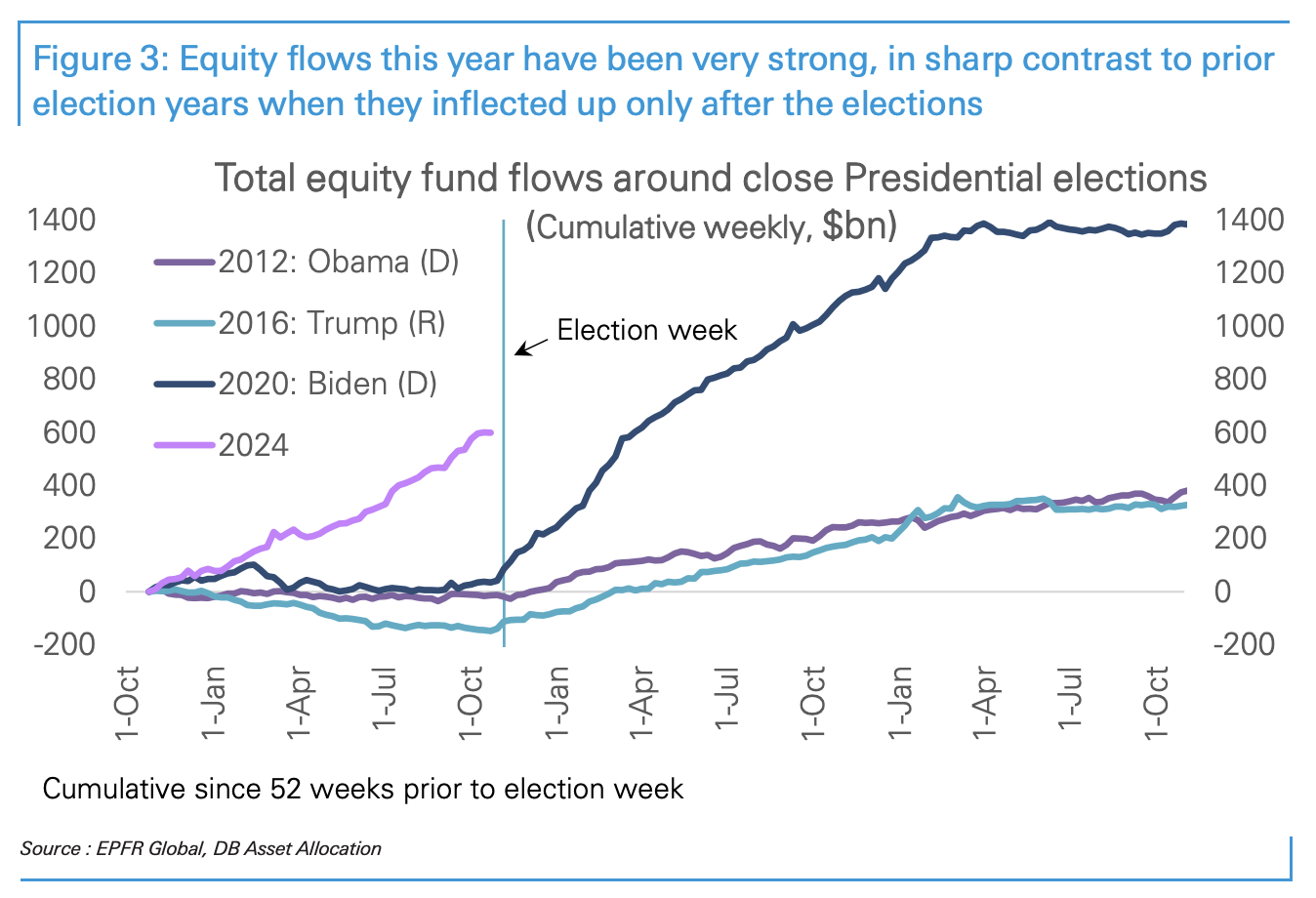
DB equity flows election year
Source: Deutsche Bank

More Markets

See all Markets
markets

Trump administration says tariffs on Chinese semiconductor imports are coming... in 2027

After a year-long investigation into China’s tactics to bolster its domestic semiconductor industry, the US has determined that its practices are “unreasonable” and is going to do something about that in 18 months.

The Trump administration’s office of the US trade representative said today that it plans to impose tariffs on imports of Chinese semiconductors at a rate higher than 0% to be decided at least 30 days before June 23, 2027.

“China’s pursuit of its dominance goals has severely disadvantaged US companies, workers, and the U.S. economy generally through lessened competition and commercial opportunities and through the creation of economic security risks from dependencies and vulnerabilities,” per the USTR’s notice of action.

These levies, should they come to pass, would apply to silicon, diodes, transistors, and more.

US markets were completely unbothered by this revelation, likely because there is no immediate action against Chinese semi companies and therefore no disruption to business-as-usual. This represents a punting of a contentious matter, similar to how China delayed restrictions on rare earth shipments as part of a deal between Presidents Trump and Xi following their October meeting.

It’s another sign of a thaw in the US-China relations over the hot-button issue of semiconductors after President Trump gave Nvidia the go-ahead to sell its H200 chips to buyers in the world’s second-largest economy.

markets

ServiceNow strikes deal to buy cybersecurity firm Armis for $7.75 billion in cash

ServiceNow has agreed to acquire cybersecurity startup Armis for $7.75 billion in an all-cash deal, the largest purchase in the company's history.

That price tag is $750 million above what Bloomberg suggested was the top end of what Armis would cost just last week, and about $1.65 billion above what the company had been valued at in a November funding round.

Armis had been readying itself for an IPO, with many major investors looking to take a stake in the firm.

Instead, it’s now a key cog in the software platform company’s bid to lean on cybersecurity features to bolster its appeal to customers in a world in which the rise of AI adds to the potential threats of business disruptions and data breaches.

Per the press release:

As rapid AI adoption expands the attack surface for organizations, real-time visibility into vulnerabilities and actionable insights for what to fix first are critical to minimize risk and strengthen security posture. The acquisition of Armis will extend and enhance ServiceNow’s Security, Risk, and OT portfolios in critical and fast-growing areas of cybersecurity and drive increased AI adoption by strengthening trust across businesses’ connected environments.

markets

Novo Nordisk rallies after FDA weight loss pill approval

Novo Nordisk’s US-listed shares are up 7% in pre-market trading on Tuesday after the US Food and Drug Administration approved its Wegovy weight loss pill on Monday evening.

Now the first pill of its kind to receive approval from the regulator, Novo’s Wegovy pill is expected to launch in the US in early January 2026, and awaits the European Medicines Agency and other regulatory authorities’ approval after submitting for review in the second half of 2025, per the company’s press release. The 1.5 milligram starting dose of the pill will be sold at an introductory price of $149 a month.

“The pill is here. With today's approval of the Wegovy® pill, patients will have a convenient, once-daily pill that can help them lose as much weight as the original Wegovy® injection,” said Mike Doustdar, president and CEO of Novo Nordisk.

The approval was based on Novo’s Oasis 4 trial, which found participants who took 25 milligram doses of Wegovy pills daily lost 16.6% of their body weight over a 64 week period.

The approval will give Novo — which lost more than 50% of its market cap this year after Eli Lilly took the crown in weekly US prescriptions for injectable weight-loss drugs with its product Zepbound — a first-mover advantage in the expanding market. Lilly, which is down some 1% in pre-market trading today, has said its own oral drug orforglipron could be approved by March 2026.

markets

‘Golden age of profit margins’ seen in 2026

Wall Street tends to be a pretty optimistic place. But on one measure, market watchers are the most optimistic on record.

FactSet data shows the consensus estimate for S&P 500 net profit margins in calendar year 2026 calls for the gauge to climb to 13.9% in 2026.

But if borne out by events next year “it will mark the highest (annual) net profit margin reported by the index since FactSet began tracking this metric in 2008,” wrote John Butters, senior earnings analyst at the financial data company.

A recent story from Barron’s also commented on the expectations for especially fat profit margins embedded into forecasts for next year.

“We are in the golden age of margins,” RBC’s Capital Markets’ head of US equity strategy, Lori Calvasina, told the magazine.

That’s good news for investors looking forward to next year. But the follow up question, of course, is where the growth in profitability is expected to come from. The answer, as you might have guessed, is tech. Though the precise mechanisms by which those profits land in the coffers of the giant tech firms remains something of a mystery. Barron’s doesn’t get into the details, saying “call it benefits from AI, pricing power, or whatever.”

That doesn’t exactly sound like money in the bank. But even die-hard haters of AI have to acknowledge that betting against the ability of giant tech companies to generate massive profit growth has been a bad trade for the last couple decades.

But if borne out by events next year “it will mark the highest (annual) net profit margin reported by the index since FactSet began tracking this metric in 2008,” wrote John Butters, senior earnings analyst at the financial data company.

A recent story from Barron’s also commented on the expectations for especially fat profit margins embedded into forecasts for next year.

“We are in the golden age of margins,” RBC’s Capital Markets’ head of US equity strategy, Lori Calvasina, told the magazine.

That’s good news for investors looking forward to next year. But the follow up question, of course, is where the growth in profitability is expected to come from. The answer, as you might have guessed, is tech. Though the precise mechanisms by which those profits land in the coffers of the giant tech firms remains something of a mystery. Barron’s doesn’t get into the details, saying “call it benefits from AI, pricing power, or whatever.”

That doesn’t exactly sound like money in the bank. But even die-hard haters of AI have to acknowledge that betting against the ability of giant tech companies to generate massive profit growth has been a bad trade for the last couple decades.

Latest Stories

Sherwood Media, LLC produces fresh and unique perspectives on topical financial news and is a fully owned subsidiary of Robinhood Markets, Inc., and any views expressed here do not necessarily reflect the views of any other Robinhood affiliate, including Robinhood Markets, Inc., Robinhood Financial LLC, Robinhood Securities, LLC, Robinhood Crypto, LLC, or Robinhood Money, LLC.