
Markets
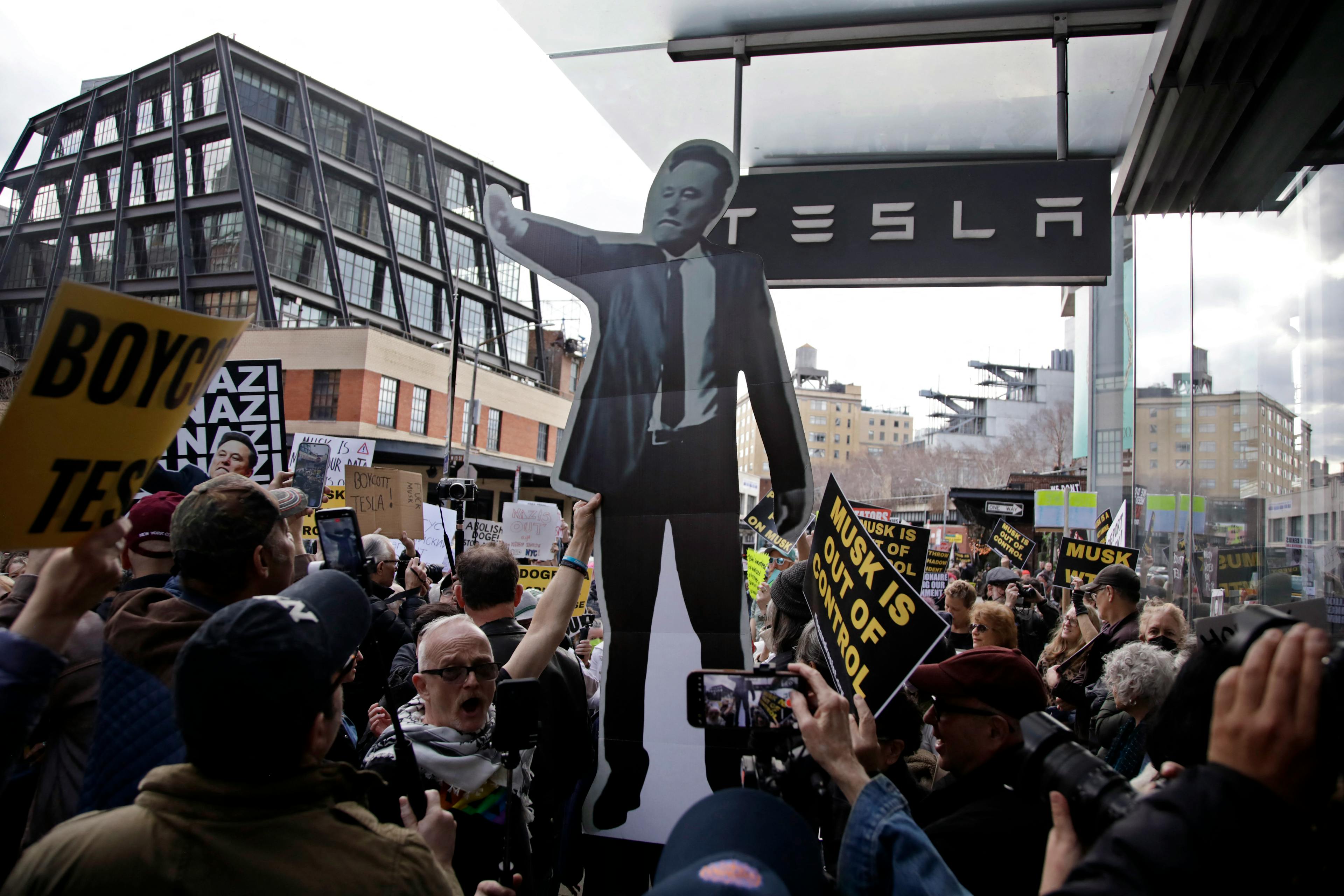
Tesla Protest Musk Salute Cutout
Protestors at a Tesla dealership in New York (Leonardo Munoz/Getty Images)

JPM analysts struggle to understand why Elon Musk is destroying Tesla’s brand

“Mr. Musk’s work with the Department of Government Efficiency has proven controversial.”

JPMorgan’s Tesla analysts joined the parade of Wall Street observers axing forecasts for Tesla vehicle sales Wednesday, reducing their full-year 2025 estimate for deliveries 11% from 1.994 million to just 1.775 million. That would be a year-over-year decline of 1%.

But the more interesting part of the note is the palpable befuddlement the analysts express about Tesla CEO Elon Musk’s behavior, which has generated fury from key constituencies worldwide. In the US, the company’s core consumers are enraged by his work as an agent of the Trump administration’s legally murky campaign to disrupt the federal civil service. Meanwhile, his flirtation with far-right European politics and comments on Ukraine have enraged consumers in Europe. JPM analysts write:

We struggle to think of anything analogous in the history of the automotive industry, in which a brand has lost so much value so quickly, with perhaps the closest example being the decline in sales of Japanese and Korean brand vehicles in China in 2012 and 2017, respectively, amidst various diplomatic disputes (Japanese brand sales recovered after a year, while Korean brand sales never have), although the damage in that case was confined to a single market, whereas the decline in Tesla sales in 2025 is not specific to any one nation or geography.

Citing polling data, they write that Musk’s immersion in Trumpist politics is a problem in the US:

While views toward Mr. Musk have increased and decreased in roughly equal parts amongst Republicans and Democrats, respectively, resulting in the Tesla brand being viewed just as positively by Trump voters (+18 ppts) as it is negatively by Harris voters (-18 ppts), it is Democrats who are more open to purchasing EVs.

Meanwhile, on the continent...

Tesla sales in Europe are under far greater pressure than at home as a consequence of statements by Mr. Musk pertaining to the war in Ukraine, U.S. participation in NATO, and far-right political parties.

While some of those issues may have played into the more than 50% drop in Tesla’s share price since its December peak, retail sentiment, rather than business fundamentals, drives Tesla’s share price. And today, following the softer-than-expected inflation report, the vibes for Tesla and other Trump-related trades are good.

More Markets

See all Markets
markets

SpaceX gets a wave of bullish ratings from Wall Street analysts

SpaceX received more than a dozen positive analyst calls on Tuesday — including from major Wall Street banks — as they initiate coverage on Elon Musk’s space and AI company.

SpaceX went public on June 12 at a $2.2 trillion valuation, the largest debut in history. While the company hasn’t yet posted a profit, it seems to have convinced Wall Street that it will get there and grow its valuation on the way.

Of the at least 17 analysts that gave a rating on Tuesday, all but one gave it a “buy” or “outperform” rating. MoffettNathanson was "neutral."

The ratings come as SpaceX joined the Nasdaq 100 index, a benchmark tech-heavy basket of companies that underpins millions of portfolios. The inclusion adds built-in demand for the stock from index funds and ETFs.

Still, SpaceX fell more than 5% on Tuesday amid a broader sell-off, and is currently effectively flat from its opening price of $150 a share.

markets

Nike sinks to lowest level since 2014 after warning of “challenged” sales environment in Q4 report

Did Nike do it?

Investors had a mixed reaction after the global sports apparel company reported its fourth quarter earnings on Tuesday after the bell. Shares initially rose 5% as Nike beat out Wall Street expectations amid a hefty tariff refund bonus. However, the stock then sank to its lowest level since August 2014 in postmarket trading.

Here are the Q4 numbers:

  • Revenue of $11.0 billion (estimate: $10.8 billion).

  • Adjusted earnings per share of $0.20 (estimate: $0.12).

Ahead of this report, Nike warned that results would be flattered by a one-time tariff refund (now estimated at roughly $0.52 per share for the bottom line). That gave the company an extra cushion in snapping its streak of seven quarters of year-over-year profit declines.

Over the past year, the company had been punished by tariffs on imported goods, stagnant consumer spending, and increasing competition from other footwear brands like New Balance, Adidas, and Hoka.

Outgoing CFO Matthew Friend deemed it an “increasingly challenging operating environment, where sell-through remains challenged.”

Latest Stories

Sherwood Media, LLC and Chartr Limited produce fresh and unique perspectives on topical financial news and are fully owned subsidiaries of Robinhood Markets, Inc., and any views expressed here do not necessarily reflect the views of any other Robinhood affiliate, including Robinhood Markets, Inc., Robinhood Financial LLC, Robinhood Securities, LLC, Robinhood Crypto, LLC, Robinhood Money, LLC, Robinhood U.K. Ltd, Robinhood Derivatives, LLC, Robinhood Gold, LLC, Robinhood Asset Management, LLC, Robinhood Credit, Inc., Robinhood Ventures DE, LLC and, where applicable, its managed investment vehicles.

