


JPMorgan warns on the first “persistent signs of weakness” from retail traders in 2026
It takes a lot to shake the resolve of retail traders. War and oil price spikes might just be enough.
Scott Rubner, head of equity and equity derivatives strategy at Citadel Securities, recently called retail investors the “strongest hand in the entire market.”
War, and the ensuing spike in oil prices, looks to be prompting some of those strong hands to consider folding.
“For the first time this year, retail investors are showing persistent signs of weakness, with weekly purchases decelerating by ~30% after defying seasonal patterns and making February their 3rd largest month on record,” wrote JPMorgan strategist Arun Jain. “In fact, Monday marked the largest net-selling day in single stocks in a month, before purchases resumed at a positive, yet below YTD average pace on Tuesday and Wednesday.”
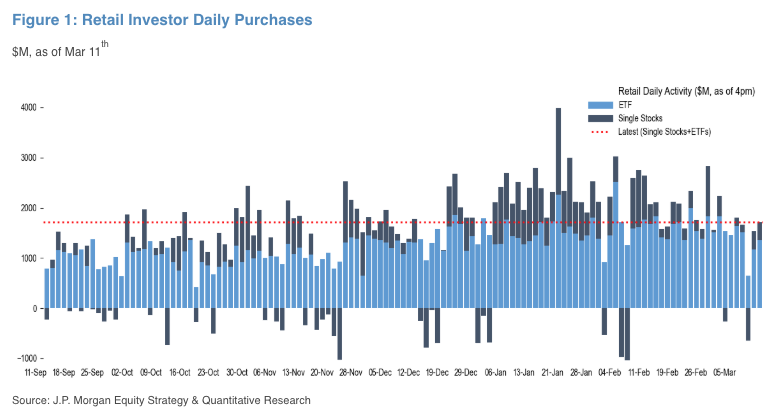
Extreme oil price volatility like the kind we’ve seen over the past month is typically accompanied by elevated stock market volatility and increased recession risk.
Of course, per the chart and Jain’s clear statement, deceleration is not contraction. Aggregate retail inflows are slowing, but not yet turning into outflows.
Retail traders crushed it last year due to both market timing and stock selection, with a heavy focus on AI-linked plays. In 2026, their stock preferences remain pretty much the same, per Jain. The cohort has also preferred to get exposure to the war-induced supply crunch in crude through ETFs like the United States Oil Fund LP, which offers exposure to the commodity through futures and swaps, rather than baskets of large energy companies like the Energy Select Sector SPDR Fund.
“Notably, their stock picking choices — aside from reduced sizes — remained relatively optimistic: retail investors were again positive Tech Mega Caps (incl. ORCL pre and post-earnings), while cutting their exposure in energy stocks,” Jain added. “The behavior resembles what we saw in 2022 during the Ukraine‑Russia conflict — an initial few weeks of buying energy stocks and ETFs, a brief turn negative, followed by a return to net buying in the case of Ukraine-Russia as the conflict unfolded.”
It takes a lot to break the resolve of retail traders. In 2025, the group was undaunted by the tribulations that the market encountered in the first four months of the year. The masses were buying the dip in megacap tech stocks well after their momentum had sputtered in Q1 2025, and were a net buyer of stocks through the entire month of March even as tariff risk escalated, per JPMorgan.
April 3, 2025, the worst day for stocks since 2020 — the session following the announcement of reciprocal tariffs on “Liberation Day” — was met with the largest level of retail stock purchasing in a decade, according to JPM.



