

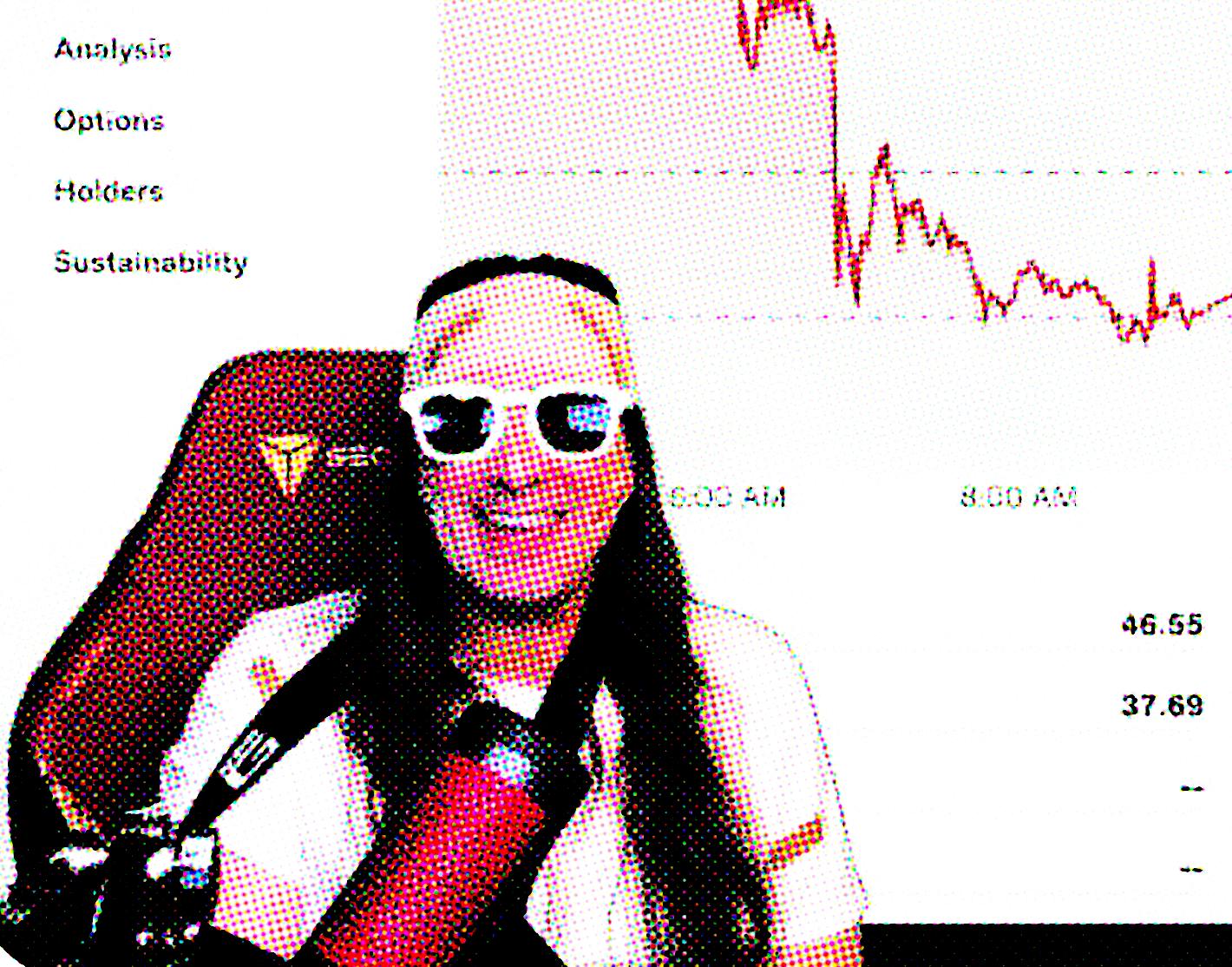
Why Roaring Kitty matters
He’s the latest in a long line of popular American financial tricksters who, by flouting both the odds and authority, turn the logic of money upside down.
At the apex of the original GameStop frenzy, way back in January 2021, I was talking to loads of Wall Street sources, asking them for their two cents.
They hated it, of course. The whole thing. The David versus Goliath framing. The fact that online goofballs had mortally wounded one of their own, a hedge fund called Melvin Capital. The possibility that such hysteria could spread.
But I was also struck, and surprised, by something else: How palpably offended they were. They couldn’t stand that these retail jokers, with piddling brokerage account balances, were treating the markets and money — their lives’ work — as a game.
Roaring Kitty returns
Those conversations came back to me last week, when I, along with a 600,000-odd others, watched the online re-emergence of the man at the heart of the story, Keith Gill, aka Roaring Kitty.
Gill, who had popularized the GameStop trade, had always been something of a financial shapeshifter. Despite the zaniness of his YouTube persona — the head and wrist bands, beer-drinking and ubiquitous kitty paraphernalia — he was actually fairly sophisticated, a registered securities broker who worked for a Boston based insurer during the day.
He obviously wasn’t dumb. And yet, even after the enormous run up in shares back in 2021, he claimed to be letting that life-changing amount of money — upwards of $30 million — ride by holding onto his GameStop positions.
I remember thinking this had to be some kind of con, or to put it more politely, a bluff. He couldn’t actually be, as he said the last time we heard from him, holding on to his positions in this dog of a stock based on whatever flimsy thesis he had concocted? The market had dropped a massive windfall at his feet, all he needed to do was sell.
Fast forward to June 7, when he once again revealed his E*Trade brokerage account. It showed — the stock was down 40% that day — a massive $235 million collapse in the value of his holdings that trading day. Gill’s GameStop positions just a few hours earlier had been worth upwards of a half billion dollars. His response? He laughed, raised a glass of beer, saying “Cheers.”
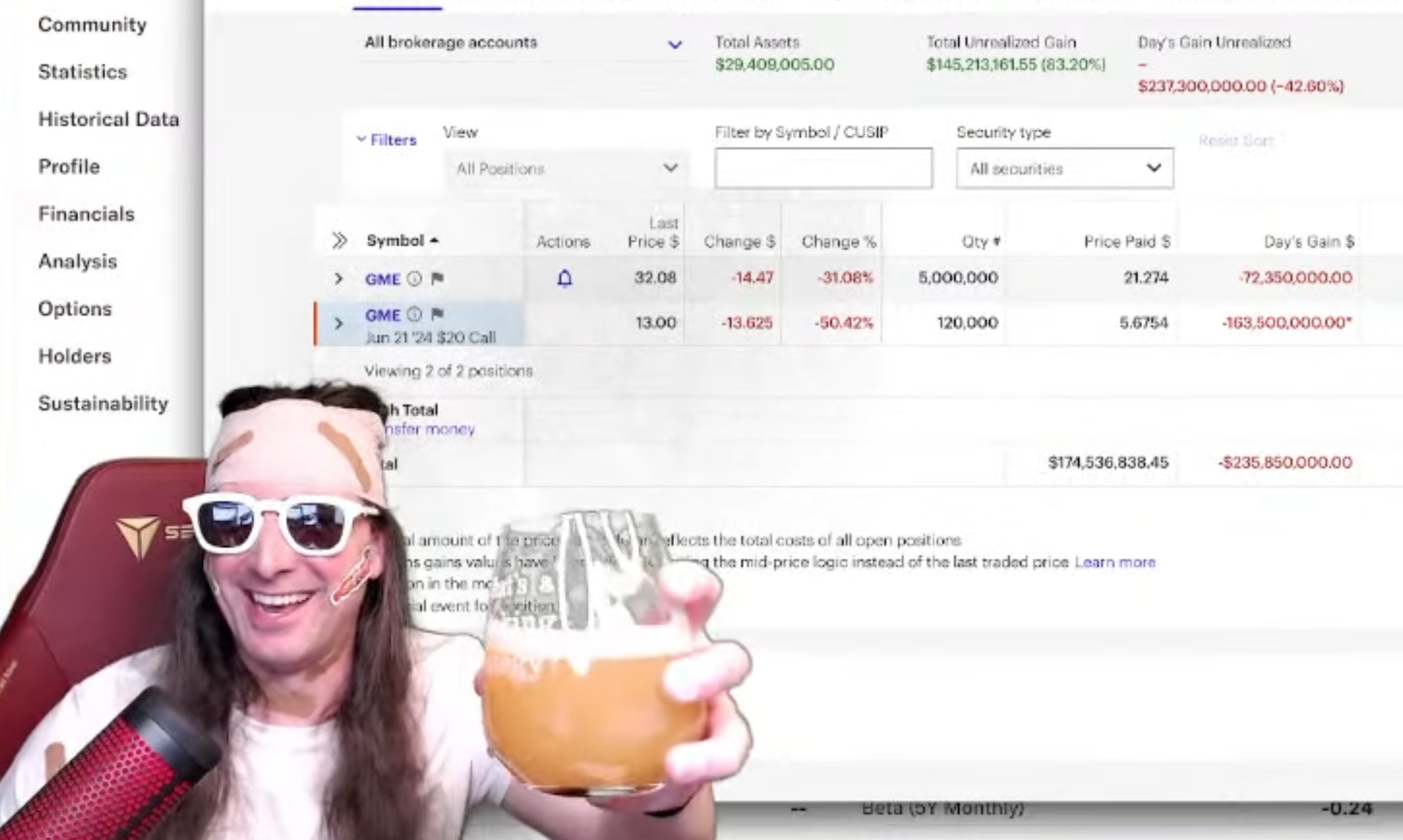
"All investments, especially ones I'm involved in because they're inherently very risky, they go up, they go down. You can't explain that! They go up, they go down. You can't explain that!,” he repeated, pointing to his losses, seemingly reveling in the irrationality of it all.
The underground culture of luck
Gill is clearly an idiosyncratic figure in today’s financial world.
It’s hard to imagine any other reasonably well-known investor cheerfully sharing his brokerage account with the world on the day he loses a quarter billion dollars.
But he, and the meme-stock movement he is partially responsible for, don’t come from nowhere. They’re actually part of a powerful, and under-appreciated American tradition of luck, chance, gambling and fortune-hunting that long predates professionalized financial markets that have tried to harness the gambling instinct on behalf of finance capitalism.
‘A vast lottery’
Since the early days of the republic, outsiders noted the outsized role luck seemed to play in both American culture and business, a reflection of the uncertainty and opportunity that made life in the United States different from more restrictive, class-bound European societies. In his 1835 opus “Democracy in America,” Alexis de Tocqueville likened all of American economic life to “a vast lottery,” writing that the life of an average American “passed like a game of chance.”
And though the dominant caste of Protestant elites fought a centuries-long battle to suppress and control the gambling instinct, the culture of luck continued to swell below the surface, especially among the cultural outsiders — African-Americans, Catholics, Asian and Jewish immigrants, among others — who continually replenished the country with workers and energy throughout the 19th century.
At times, often during periods of intense economic stress or feverish speculation, this subterranean gambling instinct bursts to the surface, like a geyser.
The ‘psychic substrata of American modernity’
This account is drawn heavily from the work of Jackson Lears, a Rutgers University history professor, who has spent his academic career “excavating the spiritual and psychic substrate of American modernity,” as a New York Times book reviewer elegantly put it.
I’ve been obsessed with Lears’ ideas lately, in part because they illuminate the dark corners of finance and markets, filling in blanks — the crucial roles irrationality and luck — that most Wall Street professionals simply can’t bring themselves to acknowledge, something Lears sees as a profoundly American character quirk.
“We tend to divide society up into, into winners and losers. And the losers have only themselves to blame. And the winners are responsible for all of their, wealth, which they achieve, through hard work or shrewd dealing,” said Lears, in an interview, this week. “The role of just sheer chance, sheer contingency, fortune, it's completely ignored in most cases.”
Lears’ book “Something for Nothing: Luck in America,” is a historical guidebook to this upside down of the American economy. In his telling, this is a longstanding parallel system where entrepreneurs can easily shape shift into confidence men, bankers are unmasked as counterfeiters and supposedly shrewd market speculators reveal themselves as scammers or degenerate gamblers, sometimes both.
What is Keith Gill?
Without, putting too fine a point on it: this is the world of Wall Street Bets, the juvenile subreddit that birthed the meme stock movement and transformed Keith Gill. But where exactly does he fit in? What is he? A con man? An unconventional investor? A gambler running a four-year, half-billion-dollar bluff?
“The confidence man is a guy who gains your, gains your confidence by the manipulation of shiny surfaces, and then takes advantage of you. You may or may not benefit by the transaction, but but he certainly does. And it's certainly not a matter of hard work,” Lears told me.
“The gambler is just a further extension the confidence man. He's not a sharper, you know, he's not a cheater. Because he's not primarily concerned about money,” Lears continued. “He is willing to play with money.”
In his book on luck, Lears repeatedly makes this point. What makes gamblers such subversive figures, he argues, isn’t their pursuit of big money, but their careless disregard for money. It’s their willingness to waste large amounts of it, by betting big and losing. That’s a quasi revolutionary act, a refusal to play by the rules of the regular economic world that, essentially, reduces the status of money from the be-all, end-all of our system “to the status in a mere counter in a game.”
And it struck me that is precisely what what offended those Wall Street guys so deeply years ago, when I spoke with about GameStop. The saga, the willingness to use the stock market as a play thing, downgraded its status, and by extension, their status. For a moment they were transformed from masters of the universe, whose decisions exert an godlike influence on the direction of the economy, to mere schnooks playing a game like everybody else.
I have to say, after watching Gill’s YouTube performance, on Friday, I still have no idea what to make of him. But I found myself kind of liking the guy. Rooting for him even. Maybe it was his goofiness, or the Boston accent, or his seemingly genuine pleasure at being back amongst online friends.
Or maybe it was his willingness to admit that he might be wrong, that his bet on GameStop might not pay off, or that he might change his mind at some point, or his willingness to seemingly laugh off hundreds of millions of dollars of losses. Whatever it was, it was real charisma.
The losses seemed to get worse. On Monday, as GameStop continued to careen lower, Gill put out another of his inscrutable tweets, seemingly mocking his own run of recent GameStop losses.
— Roaring Kitty (@TheRoaringKitty) June 10, 2024
As far as the content of Gill’s investment thesis on GameStop, there really wasn’t much to it. Essentially, he’s got a gut feeling that the new CEO of the company, Ryan Cohen, can turn it around, with the help of billions of dollars raised as a result the meme’d movements of its share price.
“This is kind of, like, it's kind of based on feel,” Gill said of the stock. “You've heard me say that, right? And so I have that feeling.”
That, too, echoed some of Lears’ thinking, from his recent book, “Animal Spirits: The American Pursuit of Vitality from Camp Meeting to Wall Street.” It tracks a concept even more slippery than luck through the course of American history, culture and commerce: the hunt for, well, life-force, action, activity and the “pursuit of vitality,” that John Maynard Keynes famously identified as animal spirits. (I mean the guy actually goes by the moniker Roaring Kitty.)
“Keynes famously used those words to describe what really motivates investors,” Lears said. “And what really motivates investors, as he made clear repeatedly, and it's been made clear ever since, is not rational calculation of expected gain. But, you know, the animal spirits and belief that, 'By god, I just have a feeling this is gonna work.’”




