
Markets
The last time the S&P 500 dropped more than 2% was 512 days ago
Sherwood News

The last time the S&P 500 dropped more than 2% was 512 days ago

US stocks have climbed steadily this year, up 19% so far

Up 20 in ‘24?

The American stock market continues to climb higher, with the S&P 500 Index now just one more little uptick away from a 20% rise for 2024 — a surge that’s been about as smooth as it can be.

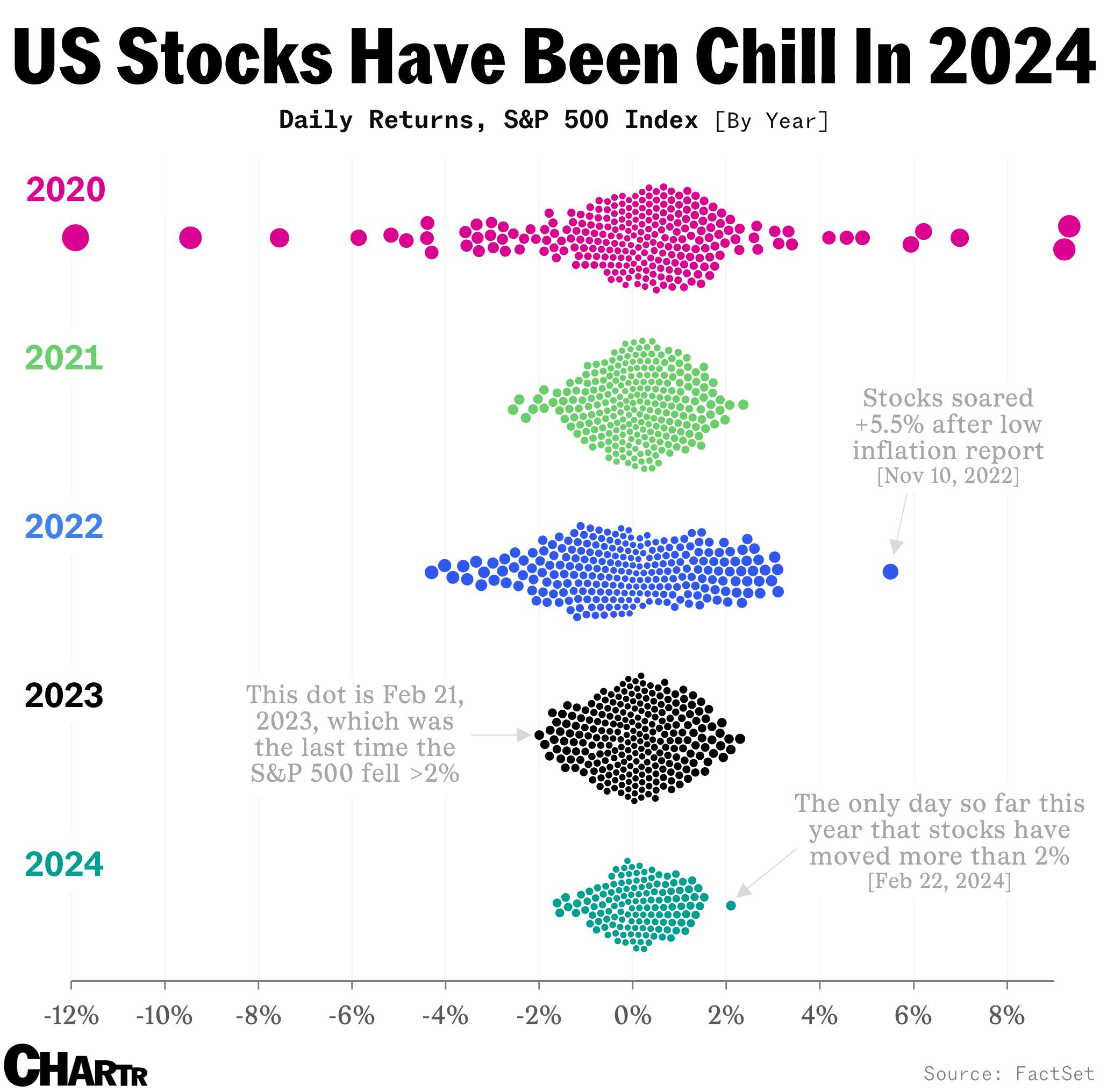
The chart below shows every individual day on the US stock market since 2020: so far this year, the flagship American index has only moved more than 2% in either direction once, when it gained 2.1% back in February.

The last time the S&P 500 dropped more than 2% was 512 days ago
Sherwood News

Indeed, the last time the index fell 2% (a common occurrence during the more volatile days of 2020 and 2022) was all the way back in early 2023. That was 512 days, or 351 trading sessions, ago.

Small but mighty

In recent days, the AI trade — which powered much of the gains earlier this year — has given way to a new sentiment, as investors have rewarded smaller stocks. As Luke Kawa wrote yesterdaythe Russell 2000 Index gained a whopping 3.5%, its fifth straight gain of 1% or more… making it the largest five-day outperformance of small caps versus the S&P 500 on record”.

Ironically, tech stocks have been the laggards of the last few days. But, everything’s relative: technology is still the best performing sector of the year so far (+25% in 2024).

More Markets

See all Markets
markets

Standard Chartered to replace “lower-value human capital,” cutting jobs “in favor of the machines”

Standard Chartered is announcing a major “it’s not you, it’s me” corporate makeover with a 15% cut of its administrative roles (roughly 8,000 jobs) by 2030 in favor of automated systems.

“It is not cost-cutting, but it is replacing, in some cases, lower-value human capital with the financial capital and the investment capital that we are putting in,” said CEO Bill Winters.

Congratulations to Standard Chartered employees who survive this culling; obviously, your CEO thinks you’re at least medium-value human capital.

Defending the strategy at a press briefing in Hong Kong, Winters explicitly rejected framing the large layoffs as a standard budget-slashing initiative.

He noted that the bank does not view the transition as an unmitigated loss of staff, but rather “job role reductions in favor of the machines,” which will “accelerate as we go full-bore into AI.”

The operational downsizing aims to boost profitability and increase overall income per employee by 20% over the next two years.

The bank joins a long list of companies that have announced job cuts in concert with plans to lean more into AI. Per CNBC, the subsequent performance of these stocks varies significantly, with some up more than 40% and others down just as much, or worse.

markets

Hyperliquid Strategies spikes on report that the SEC will soon greenlight an “innovation exemption” for tokenized stocks

Shares of Hyperliquid Strategies are soaring in early trading after Bloomberg reported that the Securities and Exchange Commission is slated to release an “innovation exemption” that formalizes rules around the trading of tokenized stocks.

In what Bloomberg dubbed a “surprise move,” the SEC is slated to permit tokenized stocks (crypto wrappers for traditional shares) even if the public companies don’t consent to their creation.

Hyperliquid Strategies is a digital asset treasury company that holds hype tokens and provides liquidity on the DeFi exchange Hyperliquid.

Tokenized securities offer faster settlement and expanded trading hours, though without the same market depth that typically prevails with traditional exchanges and a higher potential for price fragmentation.

Per the report, which cites people familiar with the matter, these platforms would need to provide their third-party holders with voting rights and dividends in order to list these tokens. As such, the platforms would effectively be required to hold the underlying securities they’d be offering tokenized access to.

markets

Home Depot reports Q1 earnings beat, full-year guidance reaffirmed

Home Depot reported Q1 earnings results with sales up 4.8% from a year earlier, beating Wall Street estimates.

Key numbers:

  • Revenue: $41.77 billion (estimate: $41.50 billion)

  • Adjusted EPS: $3.43 (estimate: $3.42)

  • Comparable Store Sales: 0.6% (estimate: 0.9%)

Comparable sales came in below forecasts while the company reaffirmed its full-year guidance, expecting annual sales to grow between 2.5% and 4.5%.

“Our first quarter results were in line with our expectations,” said Ted Decker, chair, president and CEO. “The underlying demand in our business was relatively similar to what we saw throughout fiscal 2025, despite greater consumer uncertainty and housing affordability pressure.”

While the company has served neighborhood handymen for decades, its recent growth is also partially charged by the finalized acquisition of Mingledorff’s, a premier wholesale HVAC distributor operating 42 commercial locations across the southeastern United States. Home Depot said the transaction gave it access to high-volume commercial mechanics and residential trade contractors, expanding its total addressable market to $1.2 trillion.

The company is also using machine learning to automate parts of commercial building work that have traditionally been manual. One example is its Material List Builder AI, which lets contractors upload architectural blueprints or dictate voice notes from a jobsite to generate materials lists.

Investors are continuing to track whether strategic pricing changes and distribution scale can help the business maintain its full-year gross margin target of 33.1%.

markets

Google and Blackstone to create new AI cloud firm, sending neoclouds like Coreweave and Nebius lower

Alphabet’s Google and Blackstone are creating a new US-based AI cloud company, backed by an initial $5 billion equity investment from Blackstone, the asset manager announced Monday — sending shares of rival AI cloud providers CoreWeave and Nebius down nearly 4% in premarket trading Tuesday.

markets

ServiceNow rises after Bank of America analysts reinstate as a “buy” with a $130 price target

ServiceNow is up 4% in early trading on Tuesday, after Bank of America analysts reinstated coverage of the stock with a buy rating and a $130 price objective.

Now seeing the company as an “AI beneficiary given its entrenched workflow position,” Bank of America analysts led by Tal Liani wrote that “AI increases the need for governance, positioning ServiceNow at the center of workflow orchestration and control.” Replacing NOW with new AI tools, which has been the primary concern for many investors who have dumped the stock this year (the company’s earnings being the latest example), will be “costly and complex,” considering the company’s “deeply embedded mission-critical position” within existing enterprise workflows, according to BofA’s analysts.

The threat of AI agents, which can autonomously do tasks once set up, might actually lead to more demand for ServiceNow’s products, with Liani writing that agentic AI deployments would elevate the need for orchestration, permissions, approvals, policy enforcement and auditability, aligning directly with ServiceNow’s core capabilities and making it the orchestration layer in an AI-driven cycle.

The team also highlighted how ServiceNow’s recent initiatives would benefit from AI, rather than being threatened:

“...we see the company capturing incremental value as AI adoption scales: AI Control Tower defines the strategic role; Action Fabric provides the connective layer into workflows; hybrid pricing creates the monetization model; and the Armis/Veza acquisitions strengthen the security and identity context.”

That’s a much-needed vote of confidence for NOW, which has seen its shares drop more than 40% in 2026 until the past week’s uptick. Other software peers like Workday, Atlassian, HubSpot, and Intuit are also in the green before the bell on Tuesday.

Latest Stories

Sherwood Media, LLC and Chartr Limited produce fresh and unique perspectives on topical financial news and are fully owned subsidiaries of Robinhood Markets, Inc., and any views expressed here do not necessarily reflect the views of any other Robinhood affiliate, including Robinhood Markets, Inc., Robinhood Financial LLC, Robinhood Securities, LLC, Robinhood Crypto, LLC, Robinhood Money, LLC, Robinhood U.K. Ltd, Robinhood Derivatives, LLC, Robinhood Gold, LLC, Robinhood Asset Management, LLC, Robinhood Credit, Inc., Robinhood Ventures DE, LLC and, where applicable, its managed investment vehicles.

