

Markets
Truth Social - Photo Illustration
Photo Illustration by Jonathan Raa/NurPhoto via Getty Images

The vibes approach to valuing Trump Media

Trump Media's fans don't care about market "fundamentals."

One common reason to invest in a stock might be because you think the company is undervalued, and/or you think that the company’s prospects for increasing in value in the future are favorable.

Another reason to invest in a stock might be “vibes.”

Trump Media and Technology Group went public through a reverse merger with Digital World Acquisition Corp, a SPAC, on Tuesday, and The Financial Times’ Alphaville Research published a research report that included the following quote (emphasis ours):

We believe that a vibes approach to valuing Trump Media is most appropriate. We highlight that the stock has idiosyncratic qualities, in particular around legacy legal exposures. But if November goes as everyone expects, do you really want to be stuck holding anything else? We initiate coverage of Trump Media and Technology Group with a “buy” recommendation and 52 wk target price of $94.

If you are a rational investor, you likely think, “This is a terrible way to value a stock. ‘Vibes?’ Seriously? How about revenue? Profit? Active users?” And then you look at its financials and see that the company earned $3.4 million in revenue with a $49 million net loss, and its declining user base currently sits around 5 million daily active users (X boasts 238 million monetizable daily active users, for comparison). And yet, the company has a $9.34 billion market cap, and its stock price does seem to respond to… vibes.

Before the merger closed, shares of the SPAC, Digital World Acquisition Corp, were publicly traded, and its share price moved in conjunction with Trump’s election odds, spiking in January when Trump won the Iowa Caucus.

And earlier this week, we had another vibe check, per CNBC:

Shares of Digital World Acquisition Corp. soared 35% on Monday after an appeals court substantially reduced the bond former President Donald Trump has to post in a civil fraud case, and the company announced it will start trading as DJT on Tuesday.
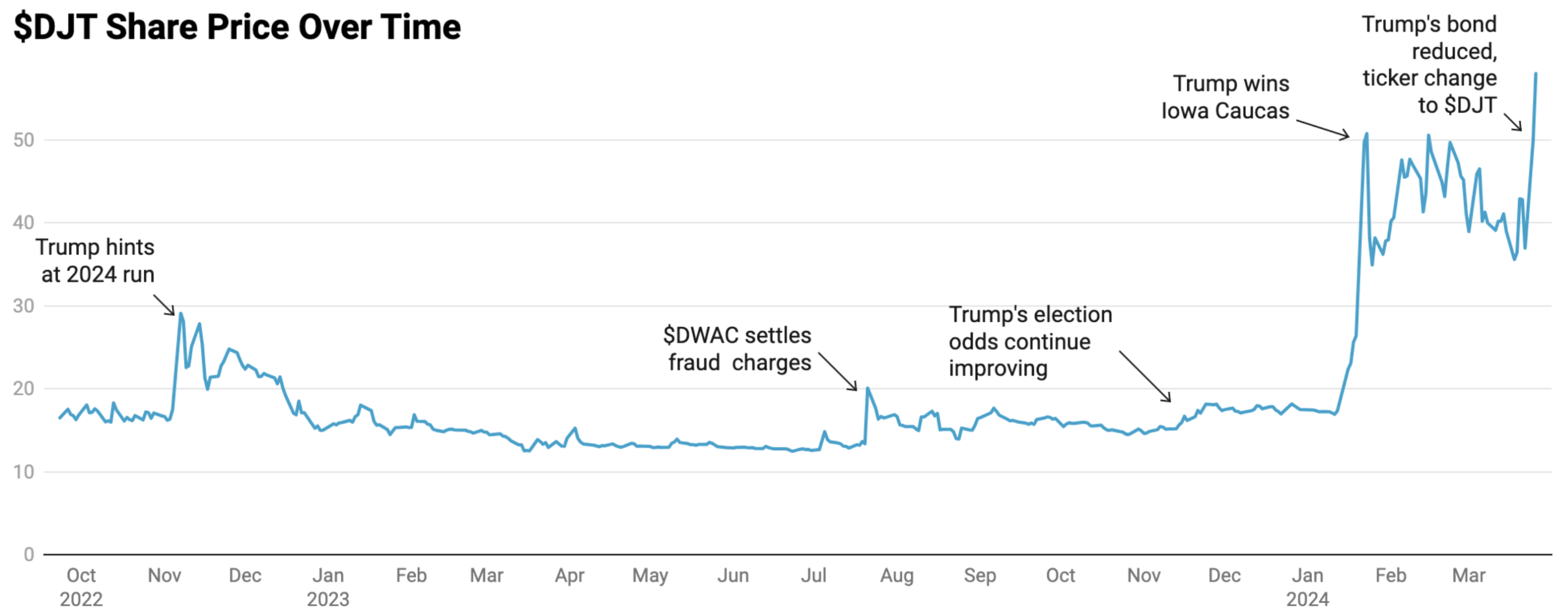
$DJT Stock

An irrational investor who supports Donald Trump’s politics might think, “This is Donald Trump’s company, therefore I want to invest in this company to own the libs. Every time Trump has good news, his stock will go up.”

And this is precisely what has happened so far: Trump wins a primary? Stock climbs. Trump effectively locks in the GOP nomination? Stock soars. Trump’s bond for his nine-figure fraud case gets reduced from $455 million to $175 million? Must be great for the stock!

The reverse is true as well. If Trump were to miss his bond payment, or if he were to lose in the November election, the stock price would be vulnerable to negative vibes from 'Trump haters.' More from Alphaville Research:

Additionally, a percentage of the stock is shorted by parties colloquially known as ‘Trump haters’. While these parties represent a risk to the sentiment-based investment case they may become much less vocal after November 5.

The effectiveness of using traditional methods to value a stock depends on other investors also using somewhat traditional methods to value a stock. If you’re valuing a stock based on its financials, and the average shareholder is valuing a stock based on “Donald Trump’s bond got reduced,” it might be useful to incorporate a “vibes” coefficient to your model.

This stock behavior is no different from the collective “meme stock” craze that we have seen since the pandemic began in 2020. Retail investors can be, collectively, a powerful market force, and the speed of information dissemination is near-instantaneous with social media. The combination of these two factors are a recipe for erratic market fluctuations.

“Buy $DJT because Trump might get elected” doesn’t really make sense, from a fundamentals standpoint, but it doesn’t really matter, assuming that enough people are willing to buy for non-fundamental reasons. It’s just the newest rendition of “Buy $GME to fight back against the evil hedge funds!” Was the present value of GameStop’s future cash flows worth $50 billion? Probably not! But the stock went up anyway.

A rational investor, therefore, might think, “Millions of irrational investors are probably thinking, “This is Donald Trump’s company, therefore I want to invest in this company to own the libs. Everytime Trump has good news, his stock will go up.’ Therefore, I should buy this stock because I know his fanbase will buy his stock.”

So if checking fundamentals doesn’t make sense, what are investors left with other than the vibe check?

More Markets

See all Markets
markets

‘Golden age of profit margins’ seen in 2026

Wall Street tends to be a pretty optimistic place. But on one measure, market watchers are the most optimistic on record.

FactSet data shows the consensus estimate for S&P 500 net profit margins in calendar year 2026 calls for the gauge to climb to 13.9% in 2026.

But if borne out by events next year “it will mark the highest (annual) net profit margin reported by the index since FactSet began tracking this metric in 2008,” wrote John Butters, senior earnings analyst at the financial data company.

A recent story from Barron’s also commented on the expectations for especially fat profit margins embedded into forecasts for next year.

“We are in the golden age of margins,” RBC’s Capital Markets’ head of US equity strategy, Lori Calvasina, told the magazine.

That’s good news for investors looking forward to next year. But the follow up question, of course, is where the growth in profitability is expected to come from. The answer, as you might have guessed, is tech. Though the precise mechanisms by which those profits land in the coffers of the giant tech firms remains something of a mystery. Barron’s doesn’t get into the details, saying “call it benefits from AI, pricing power, or whatever.”

That doesn’t exactly sound like money in the bank. But even die-hard haters of AI have to acknowledge that betting against the ability of giant tech companies to generate massive profit growth has been a bad trade for the last couple decades.

But if borne out by events next year “it will mark the highest (annual) net profit margin reported by the index since FactSet began tracking this metric in 2008,” wrote John Butters, senior earnings analyst at the financial data company.

A recent story from Barron’s also commented on the expectations for especially fat profit margins embedded into forecasts for next year.

“We are in the golden age of margins,” RBC’s Capital Markets’ head of US equity strategy, Lori Calvasina, told the magazine.

That’s good news for investors looking forward to next year. But the follow up question, of course, is where the growth in profitability is expected to come from. The answer, as you might have guessed, is tech. Though the precise mechanisms by which those profits land in the coffers of the giant tech firms remains something of a mystery. Barron’s doesn’t get into the details, saying “call it benefits from AI, pricing power, or whatever.”

That doesn’t exactly sound like money in the bank. But even die-hard haters of AI have to acknowledge that betting against the ability of giant tech companies to generate massive profit growth has been a bad trade for the last couple decades.

markets

Opendoor rises after CEO Kaz Nejatian touts an explosion in its home-buying footprint

Opendoor Technologies gained in early trading after CEO Kaz Nejatian touted an explosion in the company’s home-buying footprint.

In a message on X, the former Shopify COO posted two maps: one of which depicts a fairly limited area in which the online real estate company would buy or sell homes, and the second of which suggests that has now expanded to include the entire lower 48:

In a follow-up tweet, Nejatian attributed the gains to AI, writing, “First pic took 10 *years* of work without AI. Second pic took 10 *weeks* of work with AI.”

On his first earnings call as CEO, Nejatian said the company had adopted a “default to AI approach.”

One of his first pledges was to launch Opendoor everywhere in the lower 48.

markets

Hertz surges on bullish options activity

As millions begrudgingly make their way to the rental car counter amid the winter holidays, investors are pouring into calls and sending Hertz stock soaring.

As of 10:51 a.m. eastern, Hertz had seen 17,861 calls traded. That’s already significantly ahead of the 20-day average volume of 12,956. Hertz shares are up more than 12%.

Seemingly juicing the rally was a post on X that read “car rental companies could end up being the picks and shovels of autonomy” that was reposted by billionaire Bill Ackman, whose hedge fund is one of Hertz’s largest shareholders.

If Hertz’s price action holds, the move will mark its ninth-best trading day of 2025.

markets

POET Technologies jumps on elevated call activity

Optical communications company POET Technologies is up double digits in early trading on Monday as this potential supporting player in the AI boom gets a bid from the options market.

Just an hour after the opening bell sounded, call volumes are already running well above their five-session average for a full day.

The stock became a retail favorite in early Q4 right before many speculative trades began to retreat, with record call volumes of nearly 600,000 on October 7. The last big bump in options activity came on December 3, the session after Marvell’s acquisition of Celestial AI, a customer of POET, offered some validation for its technology as a data center solution.

Latest Stories

Sherwood Media, LLC produces fresh and unique perspectives on topical financial news and is a fully owned subsidiary of Robinhood Markets, Inc., and any views expressed here do not necessarily reflect the views of any other Robinhood affiliate, including Robinhood Markets, Inc., Robinhood Financial LLC, Robinhood Securities, LLC, Robinhood Crypto, LLC, or Robinhood Money, LLC.