Markets
Palantir Tesla Drones Morgan Stanley Analyst
Elon Musk and Alex Karp (Bill Clark/Getty Images)

Maybe Tesla should be Palantir

A Morgan Stanley analyst has some suggestions for new businesses for the automaker struggling with a pronounced sales drop.

If imitation is the sincerest form of flattery, Palantir CEO Alex Karp is probably blushing.

Meta has recently begun to dabble in the world of defense technology, a clear indication that Palantir’s surging share price is getting the attention of Silicon Valley’s elite.

And on Thursday, Morgan Stanley analyst Adam Jonas — a longtime Tesla watcher — seemed to be suggesting that Tesla CEO Elon Musk try to mimic Palantir, writing that the EV company could expand its product portfolio to include some sort of autonomous drone division. (Palantir has been involved in developing AI software for drones.)

The total addressable market of electronic vertical take-off and landing drones could hit $9 trillion by 2050, “far bigger than cars,” Jonas said.

Of the opportunity, he writes:

TSLA’s skills transferability. Manufacturing, material science, navigation/autonomy, electric motor development, battery storage, supporting infrastructure and robotics… Tesla has a host of relevant skills to be a factor in the Low Altitude Economy from both a commercial and (potentially) non-commercial perspective.

Starlink the ‘connective tissue’ in the Low Altitude Economy. Anyone following the situation in Ukraine/Russia over the past 3 years understands the deterministic role of low latency, reliable, resilient/redundant satellite communications in the battlefield to conduct basic to sophisticated maneuvers and operations.

The DOGE Angle. While Elon Musk is no longer working directly with team DOGE, we suggest investors keep a watchful eye on incremental developments on actions and ‘suggestions’ that could prove influential to the reformation of US transportation.”

While Jones concedes that he has no information indicating that Tesla is pursuing an aviation division, his note is a reflection of the attention earned by Palantir, which sells a range of AI, intelligence, and data management software to both government and corporate clients. It’s the performance, stupid.

After last year’s 340% run-up, making it the top stock in the S&P 500, Palantir is up another 74% in 2025, neck and neck with NRG Energy for this year’s biggest gainer among the blue chips — thanks, in part, to a large and loyal base of retail shareholders.

But whether or not a Tesla turn to defense technology would connect with the market is an open question.

As we’ve written before, part of the reason that Palantir shares have exploded is the perception that the company’s connections with the Trump administration — influential right-wing political donor Peter Thiel is a cofounder and the largest individual shareholder in the company, with a stake worth roughly $9 billion — will translate to additional government contracts. The federal government is Palantir’s biggest single customer.

And while Musk has been arguably closer to President Trump himself in the early going of Trump 2.0, that relationship seems to be going off the rails quickly.


More Markets

See all Markets
markets

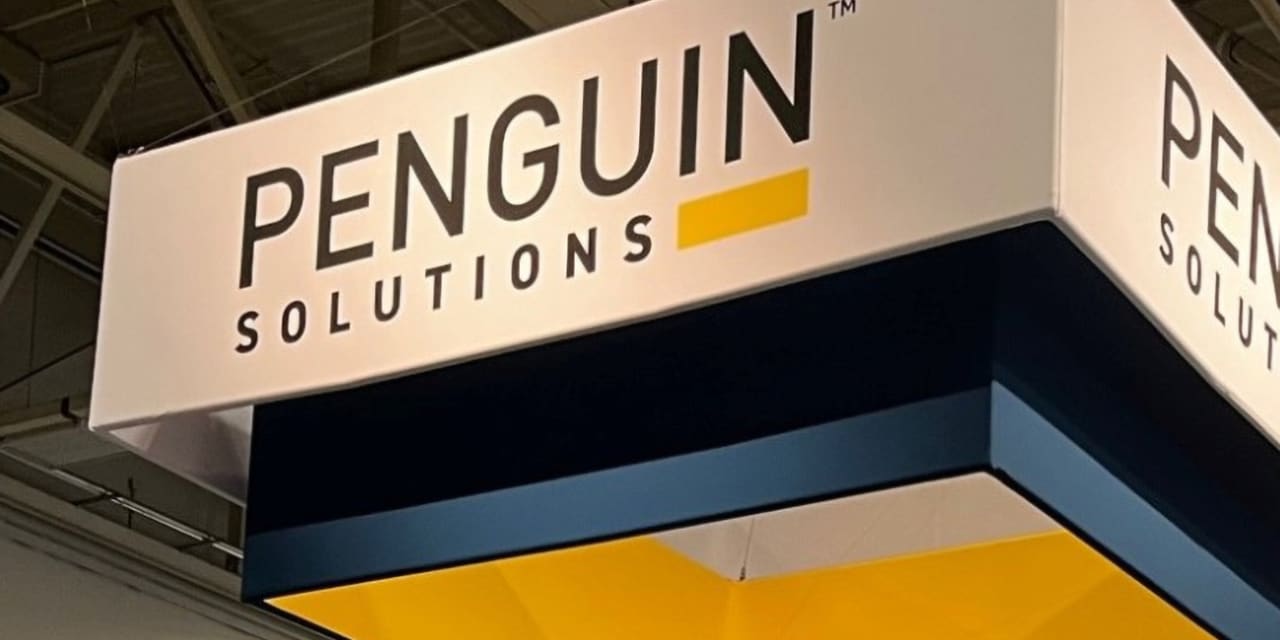
AI server cluster maker Penguin Solutions takes flight

Small-cap AI server cluster maker Penguin Solutions surged Thursday after posting better-than-expected Q2 revenue and profit numbers Wednesday after the close, along with an increase in full-year sales and profit guidance.

The company, which was known as Smart Global Holdings until July 2024, has positioned itself as a provider of “end-to-end AI infrastructure solutions.”

Its Advanced Computing division designs and sells computers, cabling, and cooling systems, the server racks and clusters of racks AI data centers need. Its other main division sells flash and DRAM memory products.

It’s a pretty small company, with a fully diluted market cap of just over $1 billion and roughly 2,900 employees, according to FactSet.

The stock is volatile. Penguin dove during last year’s tariff tantrum that followed “Liberation Day” in April. Then it turned tail and doubled through early October amid a surge of call options activity, which tends to reflect retail interest. From the October peak, it then plunged by about 50%, before Thursday’s renaissance.

For what it’s worth, call options activity in Penguin is pretty busy today, too — relatively speaking — with roughly 2,625 traded as of 1:15 p.m. ET. That’s the most since early January, when the company last reported quarterly numbers. The average volume over the previous 25 trading sessions is about 325 calls a day, FactSet data shows.

The company, which was known as Smart Global Holdings until July 2024, has positioned itself as a provider of “end-to-end AI infrastructure solutions.”

Its Advanced Computing division designs and sells computers, cabling, and cooling systems, the server racks and clusters of racks AI data centers need. Its other main division sells flash and DRAM memory products.

It’s a pretty small company, with a fully diluted market cap of just over $1 billion and roughly 2,900 employees, according to FactSet.

The stock is volatile. Penguin dove during last year’s tariff tantrum that followed “Liberation Day” in April. Then it turned tail and doubled through early October amid a surge of call options activity, which tends to reflect retail interest. From the October peak, it then plunged by about 50%, before Thursday’s renaissance.

For what it’s worth, call options activity in Penguin is pretty busy today, too — relatively speaking — with roughly 2,625 traded as of 1:15 p.m. ET. That’s the most since early January, when the company last reported quarterly numbers. The average volume over the previous 25 trading sessions is about 325 calls a day, FactSet data shows.

markets

Momentum returns to optics stocks as the release valve for AI optimism

Potentially imminent end to the war? Buy optics stocks.

Maybe not? Buy optics stocks anyway.

Effectively all the juice left in the AI trade is coming from optics (and memory) stocks. And the latter group is taking a bit of a breather today while the former continues to surge.

Shares of Ciena Corp., Lumentum, and Coherent are building on recent big gains and among the biggest gainers in the S&P 500 near midday, while Applied Optoelectronics is also surging on Thursday.

These companies all provide solutions that help information move around in data centers, and thus are key beneficiaries of the aggressive capex plans of hyperscalers. Nvidia has invested $2 billion apiece in Coherent and Lumentum in deals that also include purchase commitments.

markets

Space stocks rip during a topsy-turvy day for the equity market

Satellite-services-from-space stocks surged Thursday after reports that Amazon is in talks to buy Globalstar, which provides voice and connectivity services from its satellite network. It also can’t hurt that the general mood around space is ebullient, following the successful launch of Artemis II on Thursday.

Planet Labs and ViaSat also soared on the news.

The gains for EchoStar — seen as a backdoor play at pre-IPO SpaceX exposure — and Rocket Lab were more muted, perhaps because a deep-pocketed competitor like Jeff Bezos getting serious about space services could complicate the plans of the two largest commercial space launch companies.

Rocket Lab and SpaceX see launch services as key to their aspirations of being major providers of voice and data services from low-Earth orbit satellites.

Tesla CEO Elon Musk’s SpaceX is the dominant provider of such services, and the early rumors on the company’s planned IPO — expected to be the largest ever — suggest the market is very excited about the prospects for the industry.

Elsewhere in the space stock world, Intuitive Machines — a maker of space infrastructure that provides services to NASA for lunar missions — also rose.

The gains for EchoStar — seen as a backdoor play at pre-IPO SpaceX exposure — and Rocket Lab were more muted, perhaps because a deep-pocketed competitor like Jeff Bezos getting serious about space services could complicate the plans of the two largest commercial space launch companies.

Rocket Lab and SpaceX see launch services as key to their aspirations of being major providers of voice and data services from low-Earth orbit satellites.

Tesla CEO Elon Musk’s SpaceX is the dominant provider of such services, and the early rumors on the company’s planned IPO — expected to be the largest ever — suggest the market is very excited about the prospects for the industry.

Elsewhere in the space stock world, Intuitive Machines — a maker of space infrastructure that provides services to NASA for lunar missions — also rose.

Latest Stories

Sherwood Media, LLC produces fresh and unique perspectives on topical financial news and is a fully owned subsidiary of Robinhood Markets, Inc., and any views expressed here do not necessarily reflect the views of any other Robinhood affiliate, including Robinhood Markets, Inc., Robinhood Financial LLC, Robinhood Securities, LLC, Robinhood Crypto, LLC, Robinhood Derivatives, LLC, or Robinhood Money, LLC. Futures and event contracts are offered through Robinhood Derivatives, LLC.