

Markets
Several balancing geometric shapes
Getty Images

Megacaps have dragged markets into the red this year, but a majority of the S&P 500 is still in the green

52% of the S&P 500 has made gains in 2025. So far.

Markets have turned red this week, with America’s flagship index, the SPDR S&P 500 Trust, shedding the last of its postelection gains as traders rushed to the exits on “Tariff Tuesday,” compounding Monday’s 1.8% fall.

As companies and investors continue to digest President Donald Trump’s trade policy and the retaliatory measures it has inspired, investors are simultaneously reevaluating the AI trade on the fly. Yesterday afternoon’s price action suggested they aren’t giving up on it just yet.

Middle market

As we take stock on Wednesday morning, it’s worth zooming out and noting that 264 of the S&P 500’s constituents, or a little over 52% of the index, are actually still up in 2025. Indeed, if you woke up this morning after being asleep since New Year’s Eve, you’d have a hard time guessing that we’ve already had the “DeepSeek freak,” uncertainty over rising geopolitical tensions, and tariffs hitting the headlines this year, with the median S&P 500 stock up 0.7% in 2025.
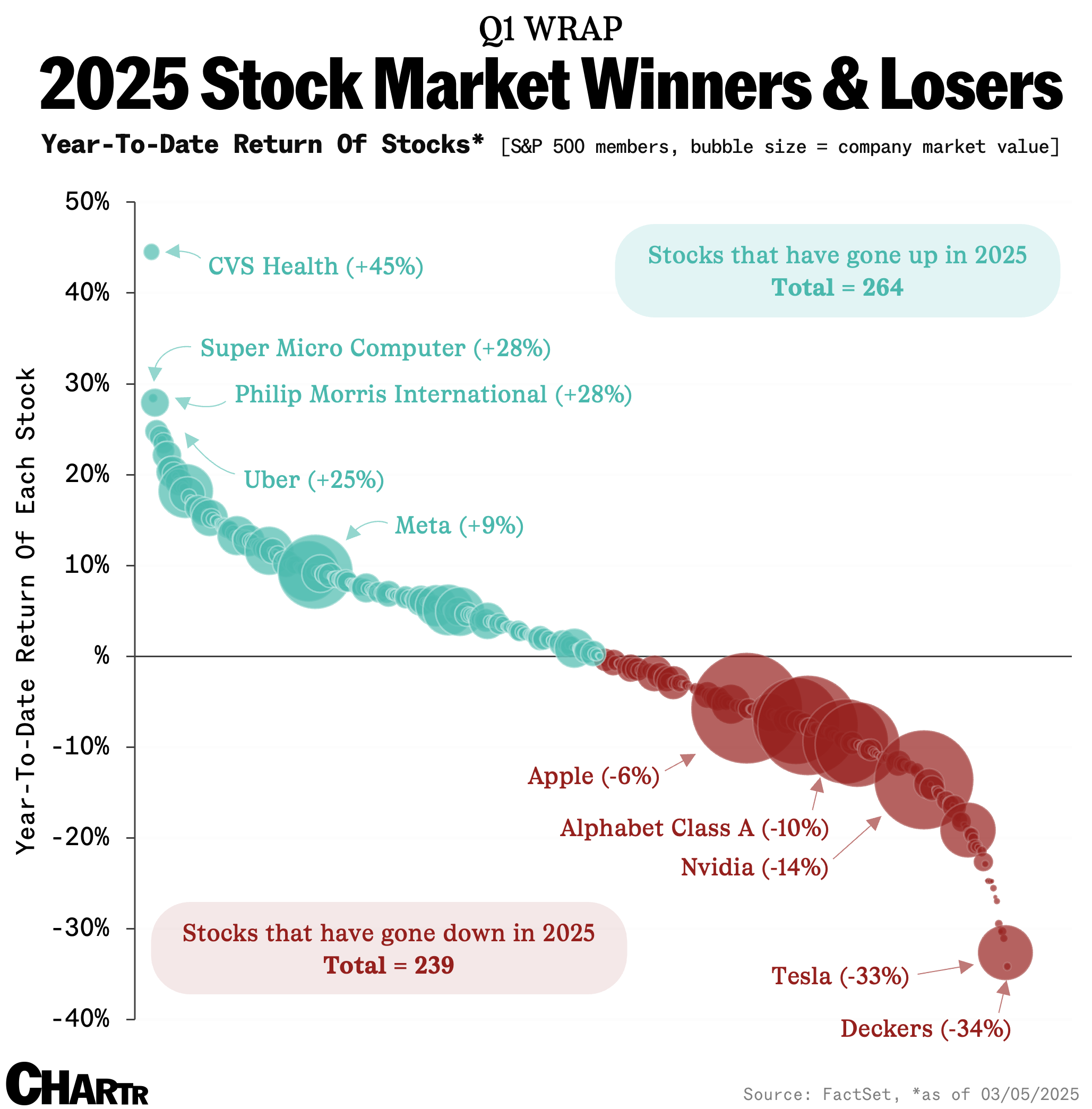
S&P500 Q1 Performance

The star of the S&P 500 Class of Q1 so far is CVS Health, which has jumped 45% since the start of the year, closely followed by Philip Morris International and Super Micro, which is doing the absolute bare minimum to remain on the market. Uber also joins the all-star lineup, ahead of Meta, which is the best of the Big Tech stocks, evading the pain of peers Amazon (-7%), Nvidia (-14%), and Tesla (-33%), which are all down. But the one company that’s down deepest in the trenches is UGG and Hoka shoe company Deckers, which never recovered from getting stomped after its underwhelming Q3 update.

So, not everything is down this year... but if you are nervous about a sustained market drop, it might be helpful to know which stocks are most, and least, sensitive to a market crash. Here’s a handy list of each, based on the last three years of data.

More Markets

See all Markets
markets

China reportedly planning $295 billion data center network to power AI build-out

Beijing may spend roughly $295 billion (2 trillion yuan) over the next five years to build a nationwide network of AI-focused computing hubs, according to a Bloomberg report.

The blueprint would connect data centers across the country into a unified computing network while prioritizing domestic suppliers such as Huawei for much of the underlying technology. State-owned telecom giants, including China Mobile and China Telecom, would operate much of the infrastructure, per the report.

The proposal, still under discussion, would mark one of China’s most aggressive efforts yet to build an AI infrastructure stack largely independent of US technology.

The AI race is increasingly becoming a competition not just over models and chips, but over access to computing power itself.

China’s latest push suggests Beijing has increasingly treated computing power as a strategic national resource, similar to electricity or transportation infrastructure. The latest blueprint would push that strategy further by connecting fragmented regional data centers into a national computing network.

The latest Digital China Development Report issued by the China National Data Administration found that the country had more than 13.7 million standard server racks in operation by the end of 2025, and had built 42 large-scale AI computing clusters. Chinas total intelligent computing capacity has reached 1.59 million PFLOPS, ranking second globally.

A Chinese planning document from the Ministry of Industry and Information Technology targets 2028 for connecting major computing hubs into a unified national system. Much of that infrastructure is expected to be concentrated in regions such as Inner Mongolia, Ningxia, and Gansu, where abundant land and relatively inexpensive power can support energy-intensive AI workloads.

The Chinese documents also highlight the scale of Chinas AI ambitions. The country now has more than 6,200 AI companies and an AI industry worth more than $176.9 billion (1.2 trillion yuan), official data shows.

The timing is notable. In May, Washington cleared around 10 Chinese firms to buy Nvidia’s H200 chips, easing some restrictions aimed at slowing Chinas AI development.

Bloomberg reported the project could be funded primarily through sovereign debt and state-backed investment funds, underscoring China’s willingness to continue spending on strategic technologies even as broader economic growth slows.

markets

AST SpaceMobile rises after announcing June 17 launch date for its BlueBird 8, 9, and 10 satellites

AST SpaceMobile is up 6% in the premarket action just before the start of regular trading, after the space-based cellular broadband network operator announced that its Bluebird 8, 9, and 10 satellites will be launched on June 17 from Cape Canaveral, Florida.

Adding its BlueBird 8, 9, and 10 to its constellation, each satellite featuring the largest commercial communication array ever of ~2,400 square feet, is expected to further expand AST SpaceMobile’s direct-to-device broadband reach and nearly double the peak data speeds compared to its own initial Block 1 BlueBird satellites, per the company’s press release.

The company has seen its shares plummet in recent weeks after a Blue Origin rocket, which was to carry AST’s Block 2 BlueBird satellite, exploded while testing.

markets

Applied Digital leaps on $5.2 billion deal with undisclosed US hyperscaler

Like other AI-adjacent stocks, Applied Digital has hit a bit of a speed bump of late, caught up in the malaise that sent the wider market tumbling at the end of last week. However, after unveiling a new lease agreement with an undisclosed US-based hyperscaler worth at least $5.2 billion, the stock is soaring once again today in premarket trading, up more than 11%.

The deal is with a “high investment-grade hyperscaler,” per the company’s press release, and will cover 210 megawatts of critical IT load at the company’s Delta Forge 2 AI Factory campus under a take-or-pay structure (in which the buyer is obliged to pay a minimum of $5.2 billion over 15 years) with renewal options.

If all renewal options are exercised, the deal would be worth approximately $12.7 billion over a 30-year total term. Initial operations at the Delta Forge 2 site are expected to commence in the first quarter of 2028.

Emphasizing the company’s “franchise model — a core team of design, construction, and operations professionals replicated across every campus, in every market,” CEO Wes Cummins noted that the latest lease is Applied Digital’s third long-term agreement with the same hyperscaler. The agreement also brings the company’s total base-term lease revenue to $36 billion, rising to $86 billion if all options are taken up.

markets

Nvidia and SK Hynix strike multiyear partnership on memory chips, AI data center build-out

Nvidia shares are modestly higher after it announced a multiyear partnership with SK Hynix on memory chips and building out AI data centers.

The agreement secures a long-term pipeline of memory chips for Nvidia. At the center of the partnership is the integration of SK Hynix’s high-bandwidth memory chips into Nvidia’s newly unveiled Vera central processing units. The Vera processor is Nvidia’s first stand-alone data center microprocessor designed to compete directly against traditional enterprise server lines.

The collaboration is also structured to reshape how semiconductors are manufactured. Under the terms of the agreement, SK Hynix will implement Nvidia’s CUDA-X library and PhysicsNeMo framework directly into its memory design and manufacturing workflows.

The announcement happened during a high-profile visit to Seoul by Nvidia CEO Jensen Huang, who arrived on June 5 to align with core infrastructure partners. Over the weekend, Huang met with SK Group Chairman Chey Tae-won, SK Hynix CEO Kwak Noh-Jung, and other top South Korean technology executives during a dinner meeting, according to Nvidia’s blog posts and Reuters.

Last week, SK Hynix told investors that its proposed US listing has received strong backing, which would potentially give US investors an alternative way to play the memory chip crunch.

Latest Stories

Sherwood Media, LLC and Chartr Limited produce fresh and unique perspectives on topical financial news and are fully owned subsidiaries of Robinhood Markets, Inc., and any views expressed here do not necessarily reflect the views of any other Robinhood affiliate, including Robinhood Markets, Inc., Robinhood Financial LLC, Robinhood Securities, LLC, Robinhood Crypto, LLC, Robinhood Money, LLC, Robinhood U.K. Ltd, Robinhood Derivatives, LLC, Robinhood Gold, LLC, Robinhood Asset Management, LLC, Robinhood Credit, Inc., Robinhood Ventures DE, LLC and, where applicable, its managed investment vehicles.

