

Markets
markets
Luke Kawa

Microsoft unveils “community-first AI infrastructure plan” after Trump calls out data centers for high electricity bills

Microsoft is committing to paying up for its data center electricity needs so American households won’t have to face higher costs.

This announcement comes after President Donald Trump posted on Monday evening that his administration was working with leading tech companies to ensure that US households don’t “pick up the tab” for their data center-driven energy demands, which have helped propel electricity bills higher.

Microsoft, he said, would be the first to unveil steps in this direction.

Here’s its plan, from a post attributed to Microsoft Vice Chair and President Brad Smith:
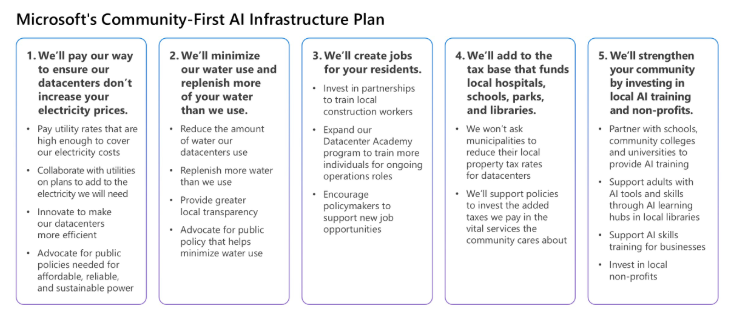
Microsoft community first AI infrastructure plan
Source: Microsoft

From a markets and economics standpoint, the first part is the most interesting. Smith said that Microsoft will ask utilities and public commissions to charge Microsoft enough to cover both data center installation and usage, as well as support two-tier pricing systems (like what’s being proposed in Wisconsin) that will see “Very Large Customers” like data centers face higher costs.

The hyperscalers are walking a fine line of trying to aggressively pursue a build-out of a technology that they believe will be transformative and offer profits for years to come while avoiding public and political backlash due to how resource-intensive these capital outlays and operations are.

“Especially when tech companies are so profitable, we believe that it’s both unfair and politically unrealistic for our industry to ask the public to shoulder added electricity costs for AI,” Smith said. “Instead, we believe the long-term success of AI infrastructure requires that tech companies pay their own way for the electricity costs they create.”

Microsoft’s 12-month forward expected profit margin is above 38%, per analysts polled by Bloomberg, its highest projection on record.

Microsoft, he said, would be the first to unveil steps in this direction.

Here’s its plan, from a post attributed to Microsoft Vice Chair and President Brad Smith:

Microsoft community first AI infrastructure plan
Source: Microsoft

From a markets and economics standpoint, the first part is the most interesting. Smith said that Microsoft will ask utilities and public commissions to charge Microsoft enough to cover both data center installation and usage, as well as support two-tier pricing systems (like what’s being proposed in Wisconsin) that will see “Very Large Customers” like data centers face higher costs.

The hyperscalers are walking a fine line of trying to aggressively pursue a build-out of a technology that they believe will be transformative and offer profits for years to come while avoiding public and political backlash due to how resource-intensive these capital outlays and operations are.

“Especially when tech companies are so profitable, we believe that it’s both unfair and politically unrealistic for our industry to ask the public to shoulder added electricity costs for AI,” Smith said. “Instead, we believe the long-term success of AI infrastructure requires that tech companies pay their own way for the electricity costs they create.”

Microsoft’s 12-month forward expected profit margin is above 38%, per analysts polled by Bloomberg, its highest projection on record.

More Markets

See all Markets
markets

Robinhood jumps as crypto and retail favorites rip

Bitcoin and retail-sensitive stocks are rallying again, so Robinhood Markets is too.

Shares of the brokerage, which counts crypto trading as a key revenue stream, jumped as much as 10% on Tuesday as bitcoin breached $76,000 for the first time since early February. Strong gains for the crypto asset, which doesn’t really have fundamentals, the outfit that’s been synonymous with retail activity, and the stocks retail traders like the most are key signals that risk appetite is returning after the geopolitically induced drawdown.

Separately, Bernstein also sounded a bullish tone on prediction markets, another Robinhood business line, calling for volumes to hit as high as $1 trillion by 2030. Analysts reaffirmed their outperform rating and $130 price target on the shares, saying they offer “asymmetric upside potential.”

(Robinhood Markets Inc. is the parent company of Sherwood Media, an independently operated media company subject to certain legal and regulatory restrictions.)

The brokerage has been trading like three cryptos in a trench coat over the past three months, with the 63-session correlation between the stock and the iShares Bitcoin Trust lingering near its all-time high reached last month.

Robinhood and bitcoin’s all-time highs came in October, with both since suffering large sell-offs along with a host of other speculative assets.

markets

Vertiv’s dominance in data center cooling earns it an “outperform”

Vertiv Holdings added to its nearly 90% 2026 gain early Tuesday after BNP Paribas analysts initiated coverage on the stock with an “outperform” rating — essentially a “buy” — and a $345 price target, about a 15% premium to the market. (Wall Street’s consensus price target for Vertiv is $304, according to FactSet.)

BNP analysts wrote:

With ~80% of sales tied to data centers, VRT is a leader in cooling solutions, notably for high-density AI computing. We believe VRT’s growth is sustainable given its content is structurally rising as higher density AI clusters drive a step-change in cooling requirements. With a ~$15bn backlog (up >100% y-o-y) and book-to-bill of ~3x, VRT’s visibility provides confidence in sustained growth through 2030.

Vertiv is shaking off a bit of a slump in the broader AI data center trade Tuesday, as high-flying AI plays like networking stocks Lumentum, Ciena Corp., and Corning slide, and memory play Sandisk declines.

markets

Sandisk initiated at “outperform” by Evercore ISI, with target of $1,200

Evercore ISI analysts see further upside for Sandisk shares, even after their nearly 2,900% gain over the past 12 months.

In a note initiating coverage on the top-performing S&P 500 constituent — giving it an “outperform” rating and an above consensus price target of $1,200 — Evercore analysts wrote:

“We believe SNDK is levered to one of the most attractive areas of the AI infrastructure stack — data storage, where demand is accelerating and supply remains constrained at minimum through CY28 if not beyond. While concerns around peak NAND pricing and cyclicality persist, we think the current cycle is structurally tighter and more durable, underpinned by AI-driven demand and sustained supply discipline that is creating ‘SCA’s’, providing memory providers with pricing floors and upfront cash payments (Strategic Contractual Agreements between cloud companies and NAND/DRAM providers).”

Even with the positive news, Sandisk shares sold off 4% in recent trading, taking a little wind out of an epic run-up that still stands at 16% over the past five days and 30% over the past month.

Sandisk has been the subject of a fair bit of positive commentary in recent days, with both Citi and Bernstein analysts boosting their price targets for the shares ahead of its earnings report due on April 30.

The broader memory/data storage trade has recovered from its recent big wobble following Google’s release of details about a new, potentially less memory-heavy AI algorithm technology called TurboQuant.

Hard disk drive maker Western Digital has more than doubled since the start of the year, Seagate Technology Holdings is up about 90%, and DRAM maker Micron — DRAM is the basis for the AI-focused memory product called high-bandwidth memory, or HBM — is up more than 50% in the first 3.5 months of 2026.

markets

Lucid climbs after announcements of new CEO and expanded robotaxi partnership with Uber

Shares of luxury EV maker Lucid climbed more than 12% in premarket trading on Tuesday following two announcements, before news of a public stock offering erased most of the gains.

First, the company announced it has found a permanent CEO in Silvio Napoli. Napoli was formerly CEO of the Schindler Group, one of the world’s biggest manufacturers of elevators and escalators.

Lucid has been led by interim CEO Marc Winterhoff for more than a year, who will now step into the role of chief operating officer.

Lucid also announced an expansion of its robotaxi partnership with Uber from 20,000 planned vehicles to 35,000. Uber will increase its investment in Lucid by $200 million, bringing the total to $500 million. The PIF, Saudi Arabia’s sovereign wealth fund, also committed a new investment of $550 million into the company.

The company is still planning a commercial launch of its robotaxi service with Uber later this year in the Bay Area.

Following those updates, Lucid said it would raise an additional $300 million through a public stock offering. Its premarket gain decreased to about 5%.

Latest Stories

Sherwood Media, LLC produces fresh and unique perspectives on topical financial news and is a fully owned subsidiary of Robinhood Markets, Inc., and any views expressed here do not necessarily reflect the views of any other Robinhood affiliate, including Robinhood Markets, Inc., Robinhood Financial LLC, Robinhood Securities, LLC, Robinhood Crypto, LLC, Robinhood Derivatives, LLC, or Robinhood Money, LLC. Futures and event contracts are offered through Robinhood Derivatives, LLC.
