
Markets
WNBA: JUN 23 Indiana Fever at Chicago Sky
(Melissa Tamez/Getty Images)
AIudiophile

Morgan Stanley: Most Gen Zers and millennials in the US listen to about three hours of AI music a week

That’s enough AI music to last the run time of “Avatar.”

Luke Kawa

Video may have killed the radio star, but AI is starting to dance on its grave.

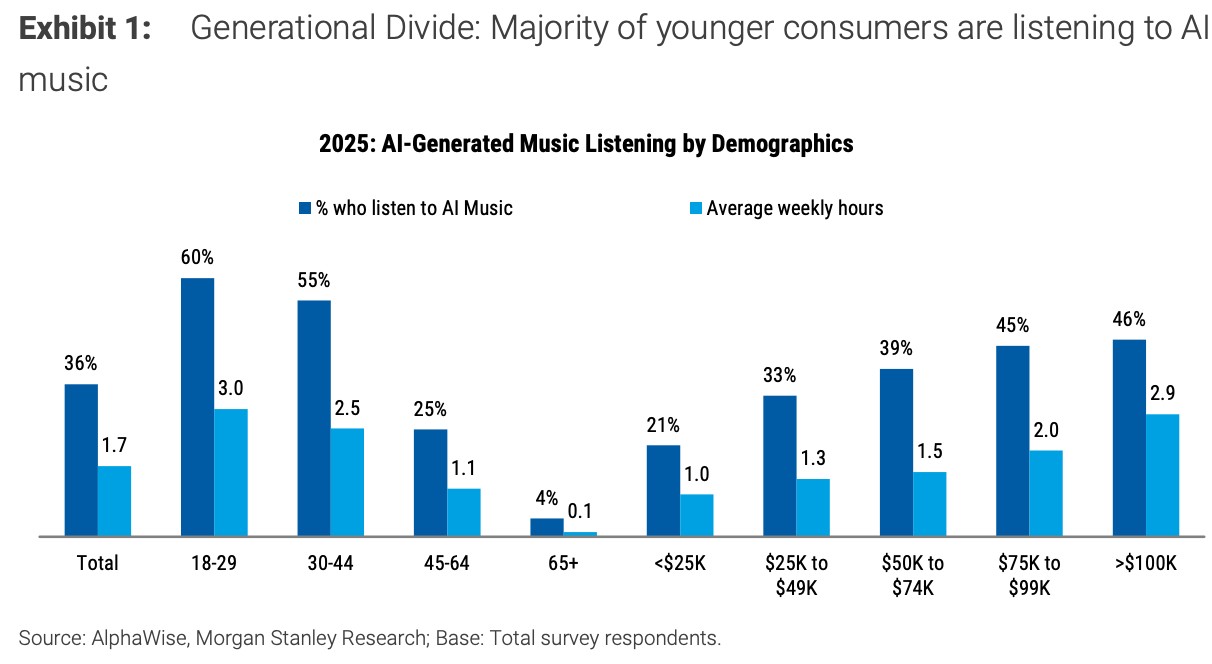
Morgan Stanley’s annual survey of audio habits revealed that younger Americans are listening to an amount of AI-generated music each week that’s roughly on par with the run time of “Avatar.”

“This is the first year we included any AI music questions in our survey,” wrote a team led by analyst Benjamin Swinburne. “What we found surprised us, with 50-60% of listeners 18- 44 reporting 2.5-3 hours per week of AI music listening.”
Morgan Stanley AI listening

The most common sources from which AI music is being ingested are YouTube and TikTok, per Morgan Stanley’s survey. Even so, their analysts remain bullish on Spotify and Warner Music Group, writing:

“As a distribution platform with leading global scale, a history of product innovation, and leveraging machine learning, we see AI as a tailwind to Spotify in 2026 and beyond. Specifically, we expect AI to prove foundational to Spotifys personalization 2.0 efforts. For OW WMG, we expect the rise of AI music to increase the value of scarce catalog assets while potentially creating new competition for front line content. However, we see WMGs recently announced Suno partnership as an important step toward AI music monetization. We believe the multiple compression absorbed by WMG shares in 2025 suggests a lot of AI risk is already priced in.”


More Markets

See all Markets
markets

Intel shares are officially a thing

April most definitely has not been the cruelest month for US chip giant Intel or its shareholders.

The stock is on a remarkable run that’s made it the best performer in the S&P 500 for the month, posting a gain of nearly 43% shortly after 11 a.m. ET Friday. That’s outdone AI darlings like Sandisk, Lumentum, Ciena Corp., Coherent, and Seagate Technology Holdings.

In fact, the monthly view actually underplays the extent of the stock’s performance. Over the eight sessions that ended yesterday — which includes March 31 — the stock was up just shy of 50%. That’s by far its best eight-day streak over the last 30 years.

Investors have eaten up Intel’s announcements this week of partnerships, first with Tesla CEO Elon Musk’s Terafab project, and separately, with Alphabet on developing custom chips for Google Cloud’s AI infrastructure needs.

More broadly, the seemingly relentless demand for computing capacity and chips related to AI seems to present, at least, the prospect of Intel actually solving the long-standing problems at its contract chipmaking business — known as a foundry — that have weighed on the business for years.

Oh, being partially nationalized by the US government amid an increasing global focus on ensuring secure supply chains for crucial technologies like semiconductors probably doesn’t hurt either.

(In case you're keeping track, the US bought a nearly 10% stake in Intel for about $8.9 billion in late August of last year. Today, that stake is worth about $27 billion.)

markets

Palantir’s slide continues, but President Trump tries to help

Investors were selling Palantir shares again on Friday, with the stock falling as much as 6% before stabilizing, thanks to an assist from the White House.

At its worst moments, the sell-off put the retail favorite on track for its worst weekly loss (more than 16%) since February 2021.

But Palantir has powerful friends: President Trump posted on Truth Social celebrating the company’s “great war fighting capabilities,” sending the stock higher, though it remained in the red.

Truth post on PLTR
(Truth Social)

The overall negative sentiment seems to stem from Anthropic’s powerful new AI models, at least judging from the latest epistle from Palantir bull Dan Ives at Wedbush Securities:

“Anthropic released a new product around multi-agent orchestration, which continues to add more headwinds to the software sector. While Anthropic is hitting a new scale with the company now at $30 billion [annual run rate], up from $9 billion at the start of the year, we believe this is not at the expense of PLTR’s business as the company continues to accelerate both its US commercial and government businesses.”

Of course, the specter of AI undermining of other software companies has been a well-established theme for months. And it’s clearly at play in the market on Friday, with Palo Alto Networks, ServiceNow, CrowdStrike, Zscaler, Figma, and Atlassian continuing to get clocked on negative AI implications.

But the recent inclusion of Palantir among the pack of potentially replaceable software providers is newer, with the view popularized by well-followed market commentator Michael Burry’s pronouncement — since deleted — that Anthropic is “eating Palantir’s lunch,” which seemed to contribute to the downdraft for Palantir today.

The stock dove through its 50-day moving average in recent days, underscoring the sputtering momentum for what has been one of the market’s biggest winners over the last couple years. Long-term holders are still up massively, with the stock up about 1,400% over the last three years.

124% 🚗

China exported more than twice as many electric vehicles (and plug-in hybrids) in the first quarter of 2026 as it did in the same period last year, according to the China Passenger Car Association (CPCA).

New energy vehicle exports surged 124% year over year, as major players like BYD and Chery ramped up overseas efforts to combat lower domestic sales. Tesla’s China business also boosted exports, shipping 164% more EVs than the same period the year before.

Nio is ramping up export efforts as well, with a goal to deliver “several thousand” EVs overseas this year and have a presence in 40 countries. Still, the automaker exported 271 vehicles in Q1 — less than half of a percent of the company’s total deliveries.

According to the CPCA, April will see the country’s automotive industry continue its “slow recovery.”

Latest Stories

Sherwood Media, LLC produces fresh and unique perspectives on topical financial news and is a fully owned subsidiary of Robinhood Markets, Inc., and any views expressed here do not necessarily reflect the views of any other Robinhood affiliate, including Robinhood Markets, Inc., Robinhood Financial LLC, Robinhood Securities, LLC, Robinhood Crypto, LLC, Robinhood Derivatives, LLC, or Robinhood Money, LLC. Futures and event contracts are offered through Robinhood Derivatives, LLC.