
Markets
TOPSHOT-FRANCE-TECHNOLOGY-POLITICS-GOVERNMENT-ECONOMY
Meta CEO Mark Zuckerberg speaks with Microsoft CEO Satya Nadella (Charles Platiau/Getty Images)

Morgan Stanley touts a $70 billion boost for megacap tech companies from the One Big Beautiful Bill Act

Tax tweaks are poised to give a huge lift to five of the Magnificent 7’s free cash flows — and they just might send that extra money to another member of the cohort!

Luke Kawa

Morgan Stanley has dotted its I’s and crossed its T’s to figure out just how much of a near-term boost the budget reconciliation bill dubbed the “One Big Beautiful Bill Act” will give to the cash flows of megacap tech companies.

TL;DR: a more than $70 billion improvement to this year’s free cash flow (that is, operating cash flow less capex) for Amazon, Alphabet, Meta, Microsoft, and Apple. If Morgan Stanleys estimates are in the ballpark, this would be the equivalent of adding more free cash flow than Meta generated in 2024 as a whole ($54 billion).
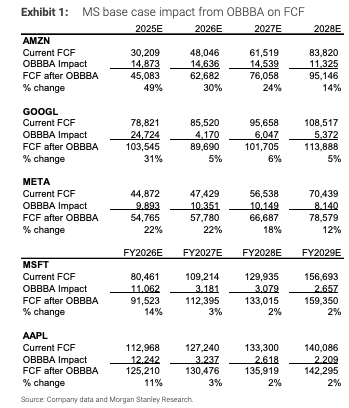
MSFCFTech

What’s fueling this?

  • 100% bonus depreciation on qualified property in its first year in service is restored;

  • Domestic R&D expenses are fully deductible the year they occur, along with allowing retroactive deductions for domestic R&D costs from 2022-24 that were deferred; and

  • Shifts to how foreign-derived earnings are taxed.

In a note titled “The Big Beautiful Tech Tax Bill,” Morgan Stanley’s team, led by Todd Castagno, suggests that the effects could begin showing up this quarter, while cautioning that the ultimate impact “could vary meaningfully.”

These tax tweaks are intended to spur investment. It’s unlikely that this is a major dial-mover on the hundreds of billions that tech companies are dead set on shelling out to enhance their AI footprints, but hey, it doesn’t hurt.

“Rather than altering core investment and capital return strategies, we think excess capital could be used for reinvestment in AI infrastructure and data centers or added strategic M&A flexibility,” the team wrote.

On the one hand, it’s nice to have more cash as you spend it hand over fist. On the other hand, it’s not like these companies aren’t mulling other options to access money for AI-related capex, and capital markets would likely be happy to finance any such endeavors.

More Markets

See all Markets
markets

SpaceX gets a wave of bullish ratings from Wall Street analysts

SpaceX received more than a dozen positive analyst calls on Tuesday — including from major Wall Street banks — as they initiate coverage on Elon Musk’s space and AI company.

SpaceX went public on June 12 at a $2.2 trillion valuation, the largest debut in history. While the company hasn’t yet posted a profit, it seems to have convinced Wall Street that it will get there and grow its valuation on the way.

Of the at least 17 analysts that gave a rating on Tuesday, all but one gave it a “buy” or “outperform” rating. MoffettNathanson was "neutral."

The ratings come as SpaceX joined the Nasdaq 100 index, a benchmark tech-heavy basket of companies that underpins millions of portfolios. The inclusion adds built-in demand for the stock from index funds and ETFs.

Still, SpaceX fell more than 5% on Tuesday amid a broader sell-off, and is currently effectively flat from its opening price of $150 a share.

markets

Nike sinks to lowest level since 2014 after warning of “challenged” sales environment in Q4 report

Did Nike do it?

Investors had a mixed reaction after the global sports apparel company reported its fourth quarter earnings on Tuesday after the bell. Shares initially rose 5% as Nike beat out Wall Street expectations amid a hefty tariff refund bonus. However, the stock then sank to its lowest level since August 2014 in postmarket trading.

Here are the Q4 numbers:

  • Revenue of $11.0 billion (estimate: $10.8 billion).

  • Adjusted earnings per share of $0.20 (estimate: $0.12).

Ahead of this report, Nike warned that results would be flattered by a one-time tariff refund (now estimated at roughly $0.52 per share for the bottom line). That gave the company an extra cushion in snapping its streak of seven quarters of year-over-year profit declines.

Over the past year, the company had been punished by tariffs on imported goods, stagnant consumer spending, and increasing competition from other footwear brands like New Balance, Adidas, and Hoka.

Outgoing CFO Matthew Friend deemed it an “increasingly challenging operating environment, where sell-through remains challenged.”

Latest Stories

Sherwood Media, LLC and Chartr Limited produce fresh and unique perspectives on topical financial news and are fully owned subsidiaries of Robinhood Markets, Inc., and any views expressed here do not necessarily reflect the views of any other Robinhood affiliate, including Robinhood Markets, Inc., Robinhood Financial LLC, Robinhood Securities, LLC, Robinhood Crypto, LLC, Robinhood Money, LLC, Robinhood U.K. Ltd, Robinhood Derivatives, LLC, Robinhood Gold, LLC, Robinhood Asset Management, LLC, Robinhood Credit, Inc., Robinhood Ventures DE, LLC and, where applicable, its managed investment vehicles.

