
Markets
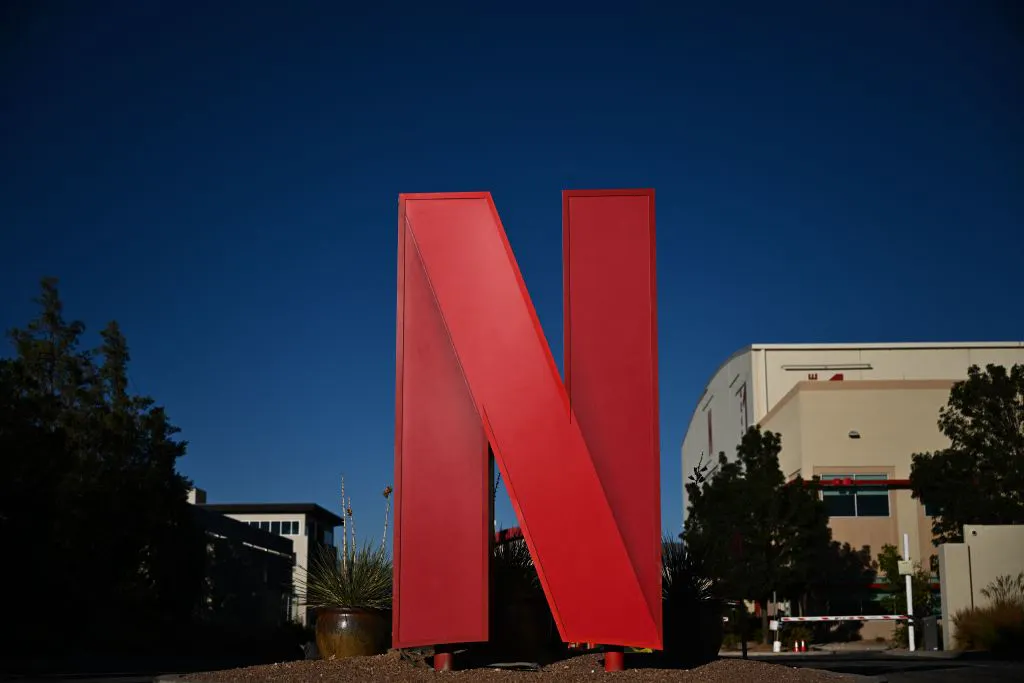
TOPSHOT-US-ENTERTAINMENT-STREAMING-NETFLIX
(Patrick T. Fallon/Getty Images)

Netflix beats on Q1 revenue, issues downbeat Q2 forecast, and says Hastings will leave in June

It’s the streamer’s first earnings report since backing out of the Warner Bros. bidding war in February.

Streaming giant Netflix reported results for its first quarter after markets closed on Thursday. Its shares fell 9% after-hours.

The company reported:

  • Earnings of $1.23 per share, which included the $2.8 billion termination fee related to the Warner Bros. Discovery deal. Wall Street analysts polled by FactSet had expected $0.76, but that may not be comparable because of the fee.

  • Revenue of $12.25 billion, compared to the $12.18 billion consensus.

Netflix also said that cofounder Reed Hastings will exit the board in June in order to “focus on his philanthropy and other pursuits.” Hastings has been with the company since 1997 and stepped back from CEO duties in 2023.

Looking ahead to the second quarter, Netflix said it expects revenue growth of 13%, slightly less than what Wall Street expects, and diluted earnings of $0.78 per share, below the analyst consensus of $0.84 per share. Netflix reaffirmed its earlier annual revenue guidance of between $50.7 billion and $51.7 billion.

Thursday’s earnings report marks Netflix’s first since it backed out of the bidding war for Warner Bros. Discovery in late February, allowing Paramount to step in. Wall Street has viewed Netflix’s choice to bail as a win, and the stock is up more than 25% since, climbing back to its early December levels (before it first announced the acquisition agreement).

With the decision to walk away, Netflix received a $2.8 billion breakup fee — one of the biggest in the history of media mergers — paid out by Paramount.

What exactly Netflix will do with that cash is still up in the air. Last month, the streamer acquired the Ben Affleck-founded AI company InterPositive for as much as $600 million (if the tool meets certain performance targets). In early April, it launched a gaming app for young children. At the same time, Netflix has been spending less on original films: just 23 were released on the streamer in Q1, the lowest output since 2017.

Netflix further boosted its revenue line last month, when it hiked the price of its subscription tiers for the fourth time in four years.

More Markets

See all Markets
markets

Oracle is on track for its best week since 1999

Oracle is up nearly 27% for the week in midmorning trading Thursday, putting it on track for its best weekly gain since June of 1999.

And yes, that run-up — which has added $100 billion to Oracle’s market cap this week — beats the nuttiness of last September, when the stock exploded up 36% in a single day after Oracle disclosed its massive AI-related sales backlog. By the end of that week, the stock ended up a mere 25%.

This week, the company soared 13% on Monday after signing a power deal with fuel cell maker Bloom Energy, as the market continues to be super focused on how quickly hyperscalers can get their AI data centers built and powered up. (Finding off-grid connections to electricity is proving increasingly tricky.)

On Thursday, Oracle also announced a collaboration with Amazon Web Services that would allow customers of both companies to easily move data back and forth and run programs using data center infrastructure from either company.

Oracle, along with other large-cap AI beneficiaries and the rest of the market, has also been getting a lift from a period of relative calm in the Iran war, with stocks hitting new record highs and US crude oil prices declining by more than 10% this month.

markets

Oklo pacing for big week, helped by risk-on appetite and Trump policy directive

Retail favorite Oklo, the “pre-revenue” designer of smaller experimental modular nuclear reactors with close ties to the Trump administration, is on track for its best week since January, even after slumping early Thursday.

Before Thursday’s slight decline, Oklo had posted big gains for four straight days, rising 33% in that time frame. Another stock in the category, Nuscale, rose 27% in the same span.

Oklo shares may have benefited from a directive published Tuesday by the White House Office of Science and Technology Policy directing federal agencies to “establish cost-effective partnerships with private-sector innovators to meet near-term objectives that include safely deploying nuclear reactors in orbit as early as 2028 and on the Moon as early as 2030.”

Oklo’s close ties to the US government could put it in a position to benefit from such orders. US Secretary of Energy Chris Wright formerly served on Oklo’s board of directors.

Separately, Oklo announced new members of its board of directors Tuesday, adding David Christian, a former executive from Dominion Energy, and David Park, CEO of Standard Lithium, among others.

Whether these announcements ultimately translate into a financial gain for Oklo remains to be seen. But it likely won’t be seen for a while.

The company doesn’t expect to generate any meaningful revenue until it brings its Aurora line of modular reactors, none of which have been built yet, to market. (The company has announced approvals of some design plans related to a prototype its building at the Idaho National Laboratory.)

On the other hand, Oklo does have some money to burn, reporting cash and marketable securities worth some ~$1.4 billion at the end of 2025. And with the share price spiking this week, Oklo executives might also be tempted to offer more stock as a source of funding.

Oklo’s upswing comes amid a rebound in retail trading this week that’s sending stocks and crypto beloved by individual traders — such as IonQ, D-Wave Quantum, Hims & Hers, and SoundHound AI — sharply higher, as worries about Iran ease and traders rush to buy whatever remaining “dip” there is.

markets

15 months after crippling quantum computing stocks, Nvidia has sent the industry back into the stratosphere

All of the technological breakthroughs, sales deals, and acquisitions haven’t mattered much for quantum computing companies in 2026.

The speculative fever had broken, with call volumes traded and most retail darling assets having peaked in October, and the subsequent risk-off move during the Mideast war accelerated the retreat from expensive, thematic plays.

Then along came Nvidia to the rescue — the company that kneecapped the industry in Q1 2025 when CEO Jensen Huang said it would likely be a couple decades before quantum computers were “very useful.”

On Tuesday, the chip designer released a family of open models (dubbed Ising) designed to leverage AI to improve calibration and error correction for quantum computers, “two of the most critical challenges in building hybrid-quantum classical systems,” per the press release.

D-Wave Quantum, IonQ, Rigetti Computing, and Quantum Computing have surged between 23% and 42% over the past three sessions, as of 9:50 a.m. ET.

These stocks are all poised for their best weeks since September, and the return of intense call buying definitely appears to be magnifying the buying pressure:

Infleqtion, the relative newcomer on the scene, is up about 16% since Monday’s close.

True to form, Huang threw a bit of a backhanded compliment to the industry along with this lifeline.

“AI is essential to making quantum computing practical,” he said.

markets

Low-cost airlines climb amid report that Spirit Airlines could liquidate as soon as this week

Shares of low-cost US airlines Frontier and JetBlue are up more than 3% in premarket trading following a Wednesday evening report that rival Spirit Airlines could liquidate as early as this week.

Spirit, which has made efforts to emerge from its bankruptcy filed in August, has reportedly been pummeled by elevated jet fuel prices.

JetBlue reached a deal to acquire Spirit in 2022, but it was blocked in 2024 on antitrust grounds. Bloomberg reported that Frontier had been in talks to merge with Spirit in December.

Jet fuel prices have squeezed the industry since the days leading up to the war in Iran. This month, most major US carriers hiked their bag fees in an attempt to offset some of the cost.

Lower oil prices are also moderately boosting airline stocks on Thursday morning. West Texas Intermediate crude futures were down about 3% as of 8:30 a.m. ET.

JetBlue reached a deal to acquire Spirit in 2022, but it was blocked in 2024 on antitrust grounds. Bloomberg reported that Frontier had been in talks to merge with Spirit in December.

Jet fuel prices have squeezed the industry since the days leading up to the war in Iran. This month, most major US carriers hiked their bag fees in an attempt to offset some of the cost.

Lower oil prices are also moderately boosting airline stocks on Thursday morning. West Texas Intermediate crude futures were down about 3% as of 8:30 a.m. ET.

Latest Stories

Sherwood Media, LLC produces fresh and unique perspectives on topical financial news and is a fully owned subsidiary of Robinhood Markets, Inc., and any views expressed here do not necessarily reflect the views of any other Robinhood affiliate, including Robinhood Markets, Inc., Robinhood Financial LLC, Robinhood Securities, LLC, Robinhood Crypto, LLC, Robinhood Derivatives, LLC, or Robinhood Money, LLC. Futures and event contracts are offered through Robinhood Derivatives, LLC.

