
Markets
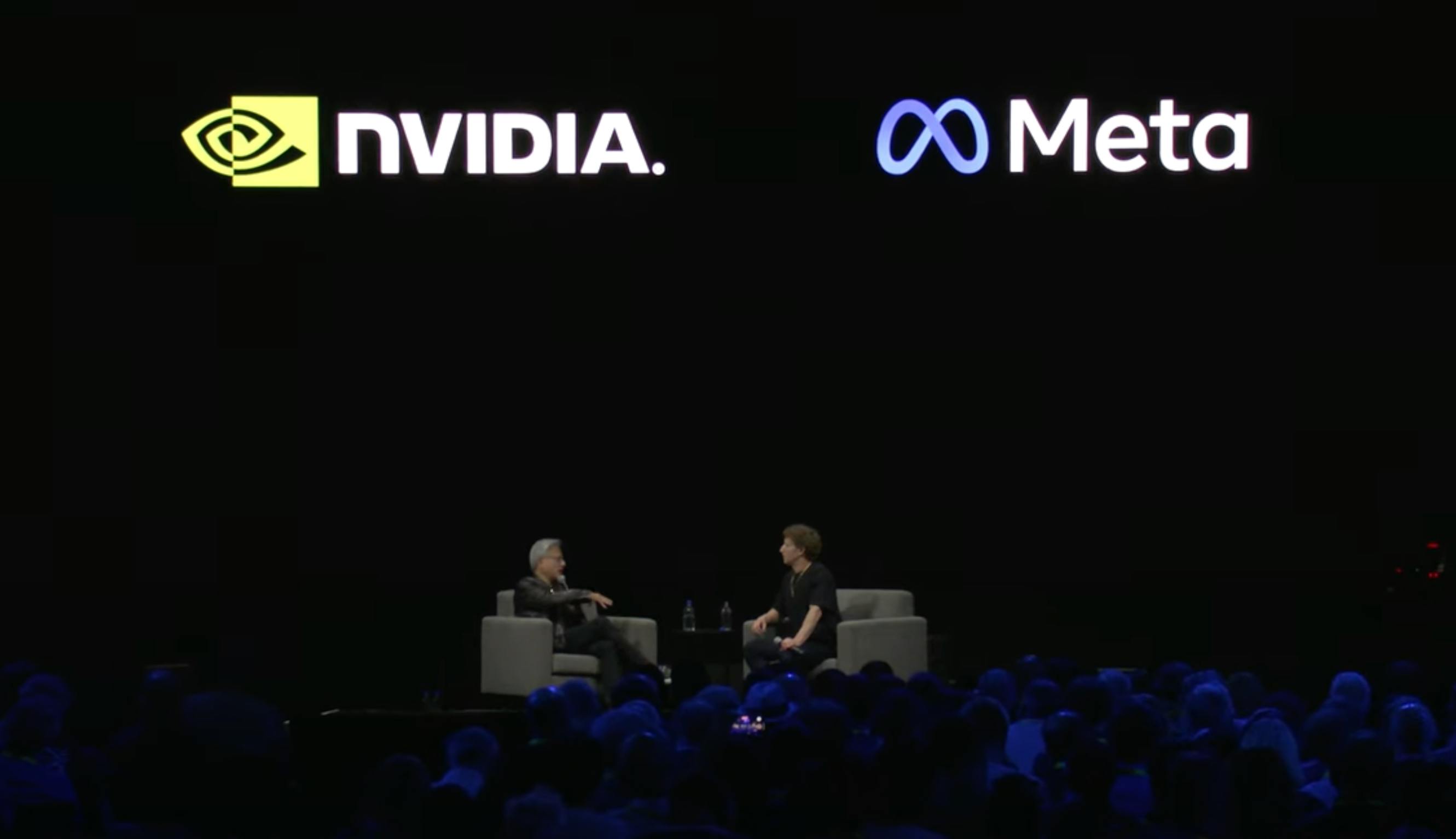
Nvidia CEO Jensen Huang interviews Meta CEO Mark Zuckerberg at the 2024 SIGGRAPH conference in Denver, CO on July 29, 2024.
YouTube

Nvidia enhances partnership with social media giant Meta to deploy “millions” of its GPUs

Winners: Nvidia, Arm. Losers: AMD, Broadcom, Intel, Arista.

Luke Kawa

Meta is laying it out in no uncertain terms: its AI build-out will be brought to you by Nvidia.

In pair of press releases after the close on Tuesday, the social media giant and chip designer detailed a “multi-year, multi-generational strategic partnership” that “will enable the large-scale deployment of NVIDIA CPUs and millions of NVIDIA Blackwell and Rubin GPUs, as well as the integration of NVIDIA Spectrum-X Ethernet switches for Meta’s Facebook Open Switching System platform.”

There’s also a deeper integration with a very commonly used communications tool at play. “Meta has adopted NVIDIA Confidential Computing for WhatsApp private processing, enabling AI-powered capabilities across the messaging platform,” per the press release, with plans to add these capabilities to other use cases at the Mark Zuckerberg-led firm.

One obvious winner, of course, is Nvidia, as investors may now have a clearer line of sight to millions of GPU sales that include not only this generation, but future editions, as well. The inclusion of CPUs in this pact, and with an expanded role in data center environments, also appears to be boon for Arm Holdings, whose IP was utilized to develop these products.

Shares of Nvidia, Arm, and Meta rose in after-hours trading, albeit fairly modestly.

The losers?

Nvidia’s competitors in...

AI chips: Advanced Micro Devices and Broadcom, as the dominant incumbent’s big, long-term deal with a hyperscaler seemingly reduces their ability to gain market share.

CPUs: Intel (and AMD again!).

And an established Meta networking client: Arista Networks, which is seeing Nvidia muscle in on this territory.

Intel was roughly flat in after-hours trading on Tuesday, while the other three stocks fell.

“Metas partnership with Nvidia — spending tens of billions of dollars on its new family of GPUs and, more importantly, making the first major deployment of Nvidias stand-alone CPUs for backend CPU servers — suggests rising market share and associated average selling price gains for Arm,” wrote Bloomberg Intelligence analyst Oscar Hernandez Tejada. “Increasing server CPU share gains for Nvidia stand to aid Arms share growth against x86, posing a clear headwind for Intel.”

The press release did not spell out any contractual purchase obligations on Meta’s behalf, but is more of a statement of intent on how aligned the parties plan to be in attempting to deliver on the promise of the AI boom.

Ian Buck, vice president of accelerated computing at Nvidia, said the companies haven’t assigned a dollar value or timeline to this expanded partnership yet.

“While specifics of the deal are still unknown (value, power, etc), we view this announcement as another positive catalyst for NVDA into 2026 and beyond, reaffirming that hyperscaler propensity to spend on AI infrastructure remains strong and NVIDIA will be a primary beneficiary,” Needham & Co. analyst Quinn Bolton wrote.

More Markets

See all Markets
markets

US job growth crushes estimates in March, with the unemployment rate unexpectedly dipping to 4.3%

US hiring surged in March, with job growth of 178,000 well ahead of estimates while the unemployment rate unexpectedly edged down to 4.3%.

Economists had anticipated non-farm payrolls growth of 65,000 for the month with the unemployment rate holding steady at 4.4%

Event contracts had presumed that job growth would come in between 70,000 and 80,000, a sunnier view than Wall Street.

Prediction markets had anticipated roughly 70% odds that the unemployment rate would hold steady at 4.4%, with a much higher implied likelihood of an increase versus a decrease.

(Event contracts are offered through Robinhood Derivatives, LLC — probabilities referenced or sourced from KalshiEx LLC or ForecastEx LLC.)

S&P 500 equity futures, which were modestly negative ahead of the report in thin holiday trading, were little changed in the immediate aftermath of this release. Treasury yields jumped, with the 10-year yield rising to 4.35% from 4.31%.

The inflationary impact of the higher crude prices in the wake of US-Israeli attacks on Iran and the subsequent challenges shipping oil through the Strait of Hormuz has been the dominant macroeconomic development of the past month, rather than US labor market data.

Before the conflict began, roughly 60 basis points of easing by the Federal Reserve was priced in for 2026. Heading into this release, that’s slimmed to just 5 basis points as US gas prices jumped above $4 per gallon.

The Federal Reserve’s “dot plot” from the March meeting still suggests that officials think it will be appropriate to lower the policy rate this year if the economy unfolds in line with their expectations.

The February jobs report had been a big disappointment, with jobs unexpectedly contracting and the unemployment rate edging higher. With this release, the February figures were revised to show an even larger decline of 133,000.

Strikes which had weighed on employment in health care during February, a critical source of US employment growth in recent years, seemingly reversed. The industry accounted for more than half of net job growth for March.

markets

AI server cluster maker Penguin Solutions takes flight

Small-cap AI server cluster maker Penguin Solutions surged Thursday after posting better-than-expected Q2 revenue and profit numbers Wednesday after the close, along with an increase in full-year sales and profit guidance.

The company, which was known as Smart Global Holdings until July 2024, has positioned itself as a provider of “end-to-end AI infrastructure solutions.”

Its Advanced Computing division designs and sells computers, cabling, and cooling systems, the server racks and clusters of racks AI data centers need. Its other main division sells flash and DRAM memory products.

It’s a pretty small company, with a fully diluted market cap of just over $1 billion and roughly 2,900 employees, according to FactSet.

The stock is volatile. Penguin dove during last year’s tariff tantrum that followed “Liberation Day” in April. Then it turned tail and doubled through early October amid a surge of call options activity, which tends to reflect retail interest. From the October peak, it then plunged by about 50%, before Thursday’s renaissance.

For what it’s worth, call options activity in Penguin is pretty busy today, too — relatively speaking — with roughly 2,625 traded as of 1:15 p.m. ET. That’s the most since early January, when the company last reported quarterly numbers. The average volume over the previous 25 trading sessions is about 325 calls a day, FactSet data shows.

The company, which was known as Smart Global Holdings until July 2024, has positioned itself as a provider of “end-to-end AI infrastructure solutions.”

Its Advanced Computing division designs and sells computers, cabling, and cooling systems, the server racks and clusters of racks AI data centers need. Its other main division sells flash and DRAM memory products.

It’s a pretty small company, with a fully diluted market cap of just over $1 billion and roughly 2,900 employees, according to FactSet.

The stock is volatile. Penguin dove during last year’s tariff tantrum that followed “Liberation Day” in April. Then it turned tail and doubled through early October amid a surge of call options activity, which tends to reflect retail interest. From the October peak, it then plunged by about 50%, before Thursday’s renaissance.

For what it’s worth, call options activity in Penguin is pretty busy today, too — relatively speaking — with roughly 2,625 traded as of 1:15 p.m. ET. That’s the most since early January, when the company last reported quarterly numbers. The average volume over the previous 25 trading sessions is about 325 calls a day, FactSet data shows.

markets
Luke Kawa

Momentum returns to optics stocks as the release valve for AI optimism

Potentially imminent end to the war? Buy optics stocks.

Maybe not? Buy optics stocks anyway.

Effectively all the juice left in the AI trade is coming from optics (and memory) stocks. And the latter group is taking a bit of a breather today while the former continues to surge.

Shares of Ciena Corp., Lumentum, and Coherent are building on recent big gains and among the biggest gainers in the S&P 500 near midday, while Applied Optoelectronics is also surging on Thursday.

These companies all provide solutions that help information move around in data centers, and thus are key beneficiaries of the aggressive capex plans of hyperscalers. Nvidia has invested $2 billion apiece in Coherent and Lumentum in deals that also include purchase commitments.

markets

Space stocks rip during a topsy-turvy day for the equity market

Satellite-services-from-space stocks surged Thursday after reports that Amazon is in talks to buy Globalstar, which provides voice and connectivity services from its satellite network. It also can’t hurt that the general mood around space is ebullient, following the successful launch of Artemis II on Thursday.

Planet Labs and ViaSat also soared on the news.

The gains for EchoStar — seen as a backdoor play at pre-IPO SpaceX exposure — and Rocket Lab were more muted, perhaps because a deep-pocketed competitor like Jeff Bezos getting serious about space services could complicate the plans of the two largest commercial space launch companies.

Rocket Lab and SpaceX see launch services as key to their aspirations of being major providers of voice and data services from low-Earth orbit satellites.

Tesla CEO Elon Musk’s SpaceX is the dominant provider of such services, and the early rumors on the company’s planned IPO — expected to be the largest ever — suggest the market is very excited about the prospects for the industry.

Elsewhere in the space stock world, Intuitive Machines — a maker of space infrastructure that provides services to NASA for lunar missions — also rose.

The gains for EchoStar — seen as a backdoor play at pre-IPO SpaceX exposure — and Rocket Lab were more muted, perhaps because a deep-pocketed competitor like Jeff Bezos getting serious about space services could complicate the plans of the two largest commercial space launch companies.

Rocket Lab and SpaceX see launch services as key to their aspirations of being major providers of voice and data services from low-Earth orbit satellites.

Tesla CEO Elon Musk’s SpaceX is the dominant provider of such services, and the early rumors on the company’s planned IPO — expected to be the largest ever — suggest the market is very excited about the prospects for the industry.

Elsewhere in the space stock world, Intuitive Machines — a maker of space infrastructure that provides services to NASA for lunar missions — also rose.

Latest Stories

Sherwood Media, LLC produces fresh and unique perspectives on topical financial news and is a fully owned subsidiary of Robinhood Markets, Inc., and any views expressed here do not necessarily reflect the views of any other Robinhood affiliate, including Robinhood Markets, Inc., Robinhood Financial LLC, Robinhood Securities, LLC, Robinhood Crypto, LLC, Robinhood Derivatives, LLC, or Robinhood Money, LLC. Futures and event contracts are offered through Robinhood Derivatives, LLC.

