Markets
Nvidia Unveils Robot Training Tech, New Gaming Chips, and Toyota Deal
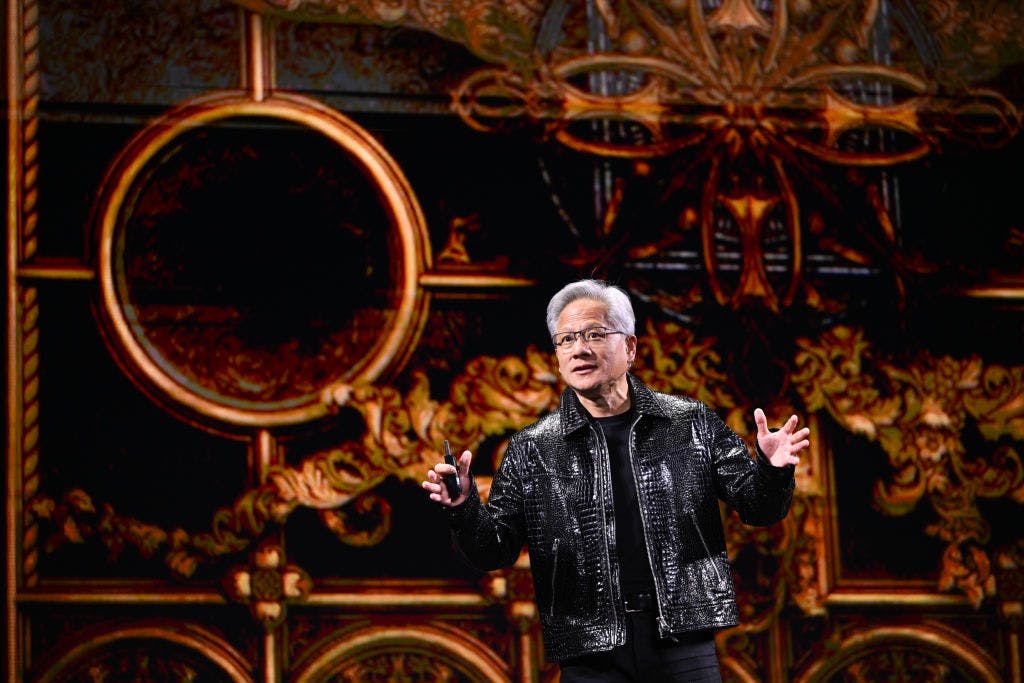
Nvidia CEO Jensen Huang delivers a keynote address at the Consumer Electronics Show (Artur Widak/Getty Images)
chips smushed

Nvidia slips after poor guidance from one of its “great partners” and fears of chip export curbs

SK Hynix’s quarterly results and comments from the Dutch prime minister are casting a pall over the industry.

Luke Kawa

Nvidia is falling in the premarket after one of its suppliers delivered a lackluster outlook and the Dutch prime minister cautioned that additional export restrictions on chips may be in the offing.

South Korea-based SK Hynix — one of Nvidia’s “great partners,” per CEO Jensen Huang — reported blowout fourth-quarter earnings and raised its dividend. But its guidance for the current quarter and plans to only modestly increase capital spending this year disappointed investors, contributing to a pullback in its shares along with those of the $3 trillion chip designer.

However, the parts of its business most linked to the AI boom still look to be in good shape. Management said that sales of its high-bandwidth memory (HBM) chips, a key input for data-center build-outs, are expected to more than double this year after being up 4.5x in 2024. Meanwhile, the company is looking for “inventory adjustment” in the consumer market in the near term before a recovery in the second half of 2025.

SK Hynix’s outlook, along with comments from Dutch Prime Minister Dick Schoof, appear to be driving consolidation across the semi space after a hot run saw the VanEck Semiconductor ETF rise nearly 9% over the last five trading days amid the rollout of the Stargate project. Micron and Dutch-based ASML are two notable underperformers in early trading on Thursday.

Schoof warned that further export curbs to China under US President Donald Trump’s administration were likely.

More Markets

See all Markets
markets

Nio just reported its first-ever quarterly profit in its Q4 results

Chinese EV maker Nio jumped in premarket trading on Tuesday after it reported solid top- and bottom-line results, booking its first-ever quarter of positive (non-GAAP) operating profits, some 1,251 million yuan ($179 million), on a quarterly basis.

Nio reported adjusted net earnings of $0.04 per share in Q4, beating the $0.02 loss per share expected by Wall Street analysts (compiled by FactSet).

The company booked $4.95 billion in revenue, also topping the $4.86 billion consensus estimate, and deliveries came in at 124,807, up more than 70% year on year.

Looking ahead, the company says that it expects deliveries of vehicles “to be between 80,000 and 83,000 vehicles” in Q1 — an acceleration in growth, with those figures implying annual rises of 90% and 97% from the same quarter of 2025. However, Bloomberg estimates suggest this figure might marginally disappoint — with analysts currently penciling in 88,700 deliveries for Q1 2026.

Celebrating its first quarter of profits, CFO Stanley Yu Qu cited the company’s “strong delivery and revenue growth, an optimized product mix, and cost reduction and efficiency enhancement initiatives” in its press release.

CEO William Bin Li also added, “Looking ahead to 2026, we will continue to invest decisively in our twelve full-stack core technologies, launch new models, enhance the commercial and operational capabilities of our battery swapping and charging network, and continue upgrading our sales and service network.” Nio shares climbed in late February after it announced that it had reached 1 million battery swaps — its alternative to fast charging — in less than a week amid the Lunar New Year holiday. This month, Nio’s Chinese rival BYD unveiled a fast-charging battery seen as a direct challenge to the EV maker’s swap station network.

markets

Oil slides and stocks tepidly rise after Trump says US-Iran war is nearing its end

Oil prices dropped on Tuesday morning, with front-month crude futures down more than 6%, as traders digested President Trump’s comments late Monday suggesting the US-Iran conflict may soon end — easing fears that have rattled global energy and stock markets over the past 10 days.

On Monday, Trump told CBS News reporter Weijia Jiang in a phone interview that the war is “very complete, pretty much.” He later tempered that somewhat at a separate press conference held at Trump National Doral in Miami, saying the conflict would end “very soon,” though not this week.

Since US and Israeli strikes on Iran began on February 28, markets have been experiencing relentless volatility: Brent crude surged to nearly $120 per barrel during Monday's trading session, the highest intraday price since the early days of the Russia-Ukraine war in 2022. Gas prices, which largely track crude, even breached the $3.50 per gallon mark, with analysts and prediction markets eyeing the $4 mark as a real possibility if the conflict drags on.

Despite Tuesday’s pullback following Trump’s remarks, oil prices remain elevated, up roughly 50% since the start of the year as disruptions continue around the Strait of Hormuz, through which about a fifth of the world’s oil flows.

After turning a deeply red day into a green one yesterday, equity traders continued to breathe a tentative sigh of relief. After the S&P 500, Nasdaq, and Russell 2000 closed higher Monday, wiping out steep intraday losses, S&P 500 futures were modestly in the green early on Tuesday, while Europe’s Stoxx 600 rallied ~2%.

As of 9:07 a.m. ET, however, S&P 500 futures have dipped 0.22% and oil has pared some of its earlier losses, following comments from Defense Secretary Pete Hegseth’s warning that today would be the “most intense day of strikes inside Iran.”

Go deeper: Why extreme oil price volatility sets off alarm bells for markets and the economy

markets

TSMC grew its sales 30% year on year in January and February

Taiwan Semiconductor ticked higher in premarket trading on Tuesday after the chipmaker reported a 30% jump in sales for the first two months of 2026, compared to the year before.

A key supplier for AI industry giants like Nvidia and Advanced Micro Devices, TSMC saw its combined January and February revenue grow to NT$718.9 billion ($22.6 billion), per its monthly revenue report, published early on Tuesday morning.

The company notched NT$317 billion in February alone, growing 22% from a year ago and decelerating from Januarys 37% year-on-year growth. For the coming full Q1, analyst estimates compiled by Bloomberg are anticipating growth of 33% — suggesting a strong March will be needed to meet that figure.

Charles Shum, a Bloomberg Intelligence analyst, noted that the modest weakness in the first two months is more likely due to softer performance in smartphones and PCs, rather than cooling AI chip demand, as soaring memory prices put pressure on shipments.

Latest Stories

Sherwood Media, LLC produces fresh and unique perspectives on topical financial news and is a fully owned subsidiary of Robinhood Markets, Inc., and any views expressed here do not necessarily reflect the views of any other Robinhood affiliate, including Robinhood Markets, Inc., Robinhood Financial LLC, Robinhood Securities, LLC, Robinhood Crypto, LLC, or Robinhood Money, LLC.