
Markets
A businessman with his head in the clouds.
Getty Images
CLOUDY WITH A CHANCE OF a $1 Trillion market cap

Oracle’s insane cloud infrastructure forecast is giving shades of Nvidia’s data center business

But it’s just a forecast, of course.

Yesterday, Oracle posted arguably the most remarkable quarter of any tech giant this year, sending the stock up as much as 30% in after-hours trading. Actually, the quarter itself was unremarkable — it was the forecast for what’s to come that completely blew analysts away.

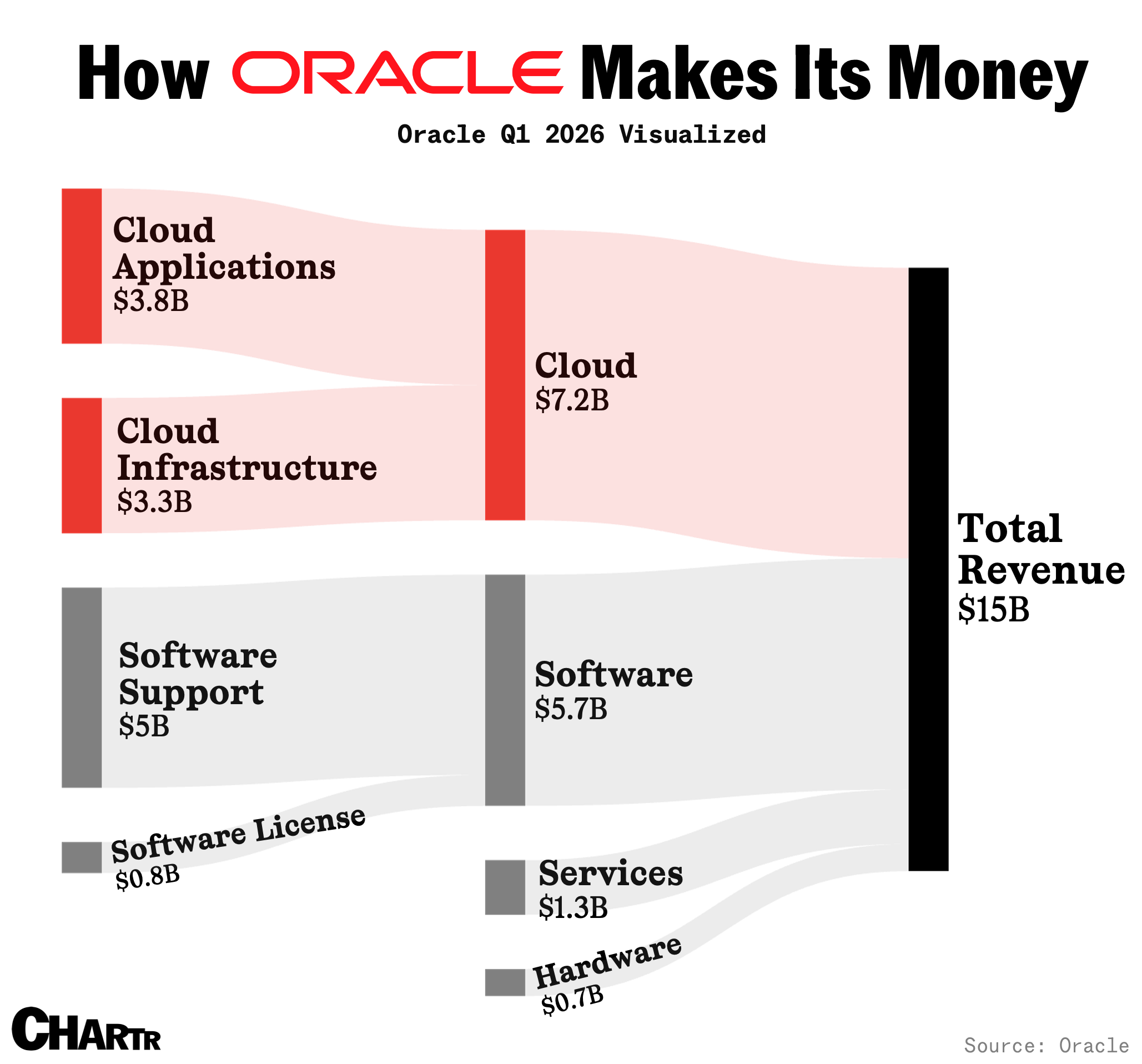
Not a household name like Google, Apple, or Amazon, Oracle has a swath of different specialties, providing software, servers, and cloud services to global businesses.
Oracle sankey - how it makes money
Sherwood News

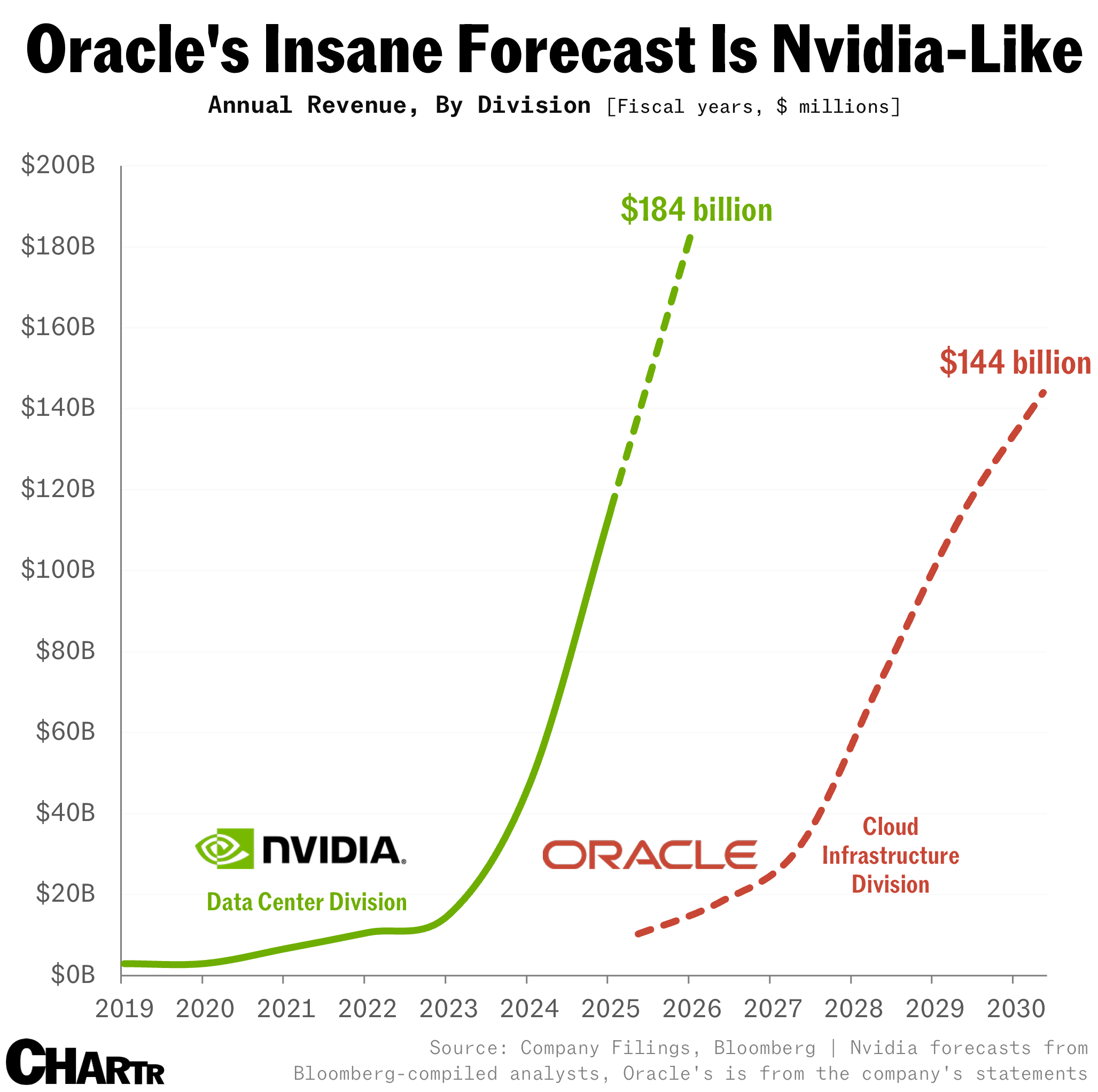
That cloud portion — historically not a major driver of the company’s bottom line — is where Oracle is seeing growth explode, with the company expecting its “Cloud Infrastructure” revenue to rise to an eye-watering $144 billion in its fiscal year 2030. That’s up more than 14x on last year’s ~$10 billion haul.

As hockey-stick revenue projections go, that’s about as bold as they come in terms of sheer scale. If — and it is an if — the company hits that forecast, it will give shades of another AI enabler’s meteoric rise: Nvidia’s data center business, which saw its revenue increase from $6.7 billion in FY 2021 to $115 billion in FY 2025, with analysts anticipating more than $184 billion in data center revenue this fiscal year.
Oracle Vs. Nvidia
Sherwood News

For now, the insane revenue backlog that Oracle revealed, which was up 359% to $455 billion, is enough to be lifting the entire AI space.

At the time of writing, Oracle’s shares are 32% higher in premarket trading, putting the company’s market cap just shy of $900 billion. That’s making Larry Ellison, Oracle’s cofounder, worth an extra $70 billion or so — putting him within spitting distance of unseating Elon Musk as the world’s richest person.


More Markets

See all Markets
markets

EchoStar rises as analysts upgrade stock ahead of potential SpaceX IPO

EchoStar rose Wednesday as Wall Street digested recent reports that Tesla CEO Elon Musk’s SpaceX is planning an IPO next year.

Analysts at Morgan Stanley upgraded satellite operator EchoStar — the current owner of Dish Network and Boost Mobile cell services — to “overweight” (or buy) from “equal weight” (or hold) and upped their price target for the stock to $110 from $82.

In September, EchoStar struck a $17 billion deal — $8.5 billion in cash and $8.5 billion in SpaceX stock — to let SpaceX use some of its spectrum rights. EchoStar expanded that deal in November, selling additional spectrum rights to SpaceX for $2.7 billion in stock.

So, a massive IPO valuation for SpaceX would obviously be a good thing for EchoStar shareholders.

Morgan Stanley analysts wrote:

“EchoStar is receiving SpaceX shares at $212 per SpaceX share. Every $100 of SpaceX share price equals $18/SATS share in value, or 20% to SATS equity. The WSJ reported that SpaceX is launching a secondary sale valuing the company at $800bn, although the CEO denied that was the case. At that $400+/share valuation, our SATS bull case would move to $150.”

EchoStar’s surging performance this year — it’s up 330% — has largely come as the company has shifted to selling access to its stockpile of spectrum rights after pressure from the Trump administration’s FCC.

In August, it inked a deal to sell spectrum rights to AT&T for $23 billion in cash, sending its shares up 70% in a single session. Morgan Stanley analysts see continued strong demand for spectrum assets from wireless companies as another reason for optimism around EchoStar shares.

“Spectrum is an appreciating asset,” they wrote. “And we expect both Verizon and T-Mobile to be aggressive.”

markets

It’s cyclicals over speculation ahead of the Fed meeting

“Sell your high-flying winners and speculative stocks ahead of the Fed, but the US economy is fine” seems to be the market narrative du jour.

The likes of Bloom Energy, IREN, Opendoor Technologies, Rigetti Computing, IonQ, and Oklo all fell at least 2.5% in early trading. Meanwhile, a Goldman Sachs basket that tracks the performance of cyclical stocks relative to more defensive companies is working on its ninth straight day of gains, which would be its longest winning streak since 2017. The SPDR S&P Regional Banking ETF, another very economically relevant part of the market, is also trading to the upside.

Goldman Sachs’ index of high-beta momentum longs (that is, stocks that have been trending higher) is down about 1.5% in early trading, while the opposite group, high-beta momentum shorts, is enjoying a nice bounce.

In other words, it looks like traders are taking down some risk in volatile long/short trades ahead of the US central bank’s final meeting of the year amid fears of a so-called “hawkish cut.” Speculative stocks, and in particular small-caps, had been buoyed by the resumption of rate cuts this year.

markets

Palantir rises on Navy deal announcement

Palantir rose early Wednesday after officially announcing a new deal — valued at $448 million — with the US Navy to manage its submarine maintenance and supply chain.

While Palantir has been rapidly building its business selling software that helps private enterprise companies better use AI technology, its largest customer remains the US government.

markets

Nextdoor soars after Eric Jackson, architect of Opendoor rally, lays out bullish thesis

Nextdoor rose by more than 30% in premarket trading after hedge fund manager Eric Jackson, the architect behind the rally in Opendoor Technologies earlier this year, said he is long on the neighborhood social media platform.

In a thread on X, Jackson explained that Nextdoor has an undervalued opportunity to leverage AI, similar to Opendoor or Carvana, another company he has been bullish on. “Nextdoor checks every layer and is ready like them for a massive re-rating,” said Jackson, head of Toronto-based EMJ Capital, referring to other stocks he is bullish on.

Nextdoor generates revenue predominantly through advertising sales, and has not yet reported a profitable quarter since going public in 2021. As of market close on Tuesday, the company was down about 17% this year and 80% since its IPO.

markets

Chewy’s Q4 forecast underwhelms, overshadowing solid Q3 results

Chewy tumbled as much as 6.7%, before paring its losses, in premarket trading on Wednesday after the online pet product retailer issued softer-than-expected Q4 guidance, which appeared to overshadow solid Q3 numbers.

In the third quarter, revenues rose 8.3% year over year to $3.12 billion, slightly above the $3.1 billion estimate compiled by Bloomberg, while adjusted earnings per share of $0.32 topped the $0.30 forecast. In a statement released today, CEO Sumit Singh said the company continues to outperform the pet category and expand market share, with profits once again growing faster than sales.

The company also revealed that it had 21.155 million active customers, up nearly 5% year on year, and that its autoship (recurring, subscription-like) sales made up nearly 84% of its total revenue.

However, Chewys Q4 outlook disappointed investors, as it expects $3.24 billion to $3.26 billion in revenue and $0.24 to $0.27 in adjusted EPS, both below Wall Streets estimate of $3.26 billion and $0.29, respectively, per Bloomberg.

As of 8:35 a.m. ET, shares have pared back earlier losses and are up 0.66% in premarket trading, bringing year-to-date gains to 3.91%.

Latest Stories

Sherwood Media, LLC produces fresh and unique perspectives on topical financial news and is a fully owned subsidiary of Robinhood Markets, Inc., and any views expressed here do not necessarily reflect the views of any other Robinhood affiliate, including Robinhood Markets, Inc., Robinhood Financial LLC, Robinhood Securities, LLC, Robinhood Crypto, LLC, or Robinhood Money, LLC.