
Markets
Palantir CEO Alex Karp
Palantir CEO Alex Karp: selling again (Stefani Reynolds/Getty Images)

Palantir’s Alex Karp made $6.8 billion last year

It’s good to be the boss.

Matt Phillips

Palantir’s Alex Karp was compensated $6.8 billion in 2024, the company reported Friday, a remarkable figure that would seem to rank among the largest annual pay packages ever recorded for America’s well-remunerated CEO class.

The number was produced as part of the proxy statement the defense, security, and AI software company published on Friday.
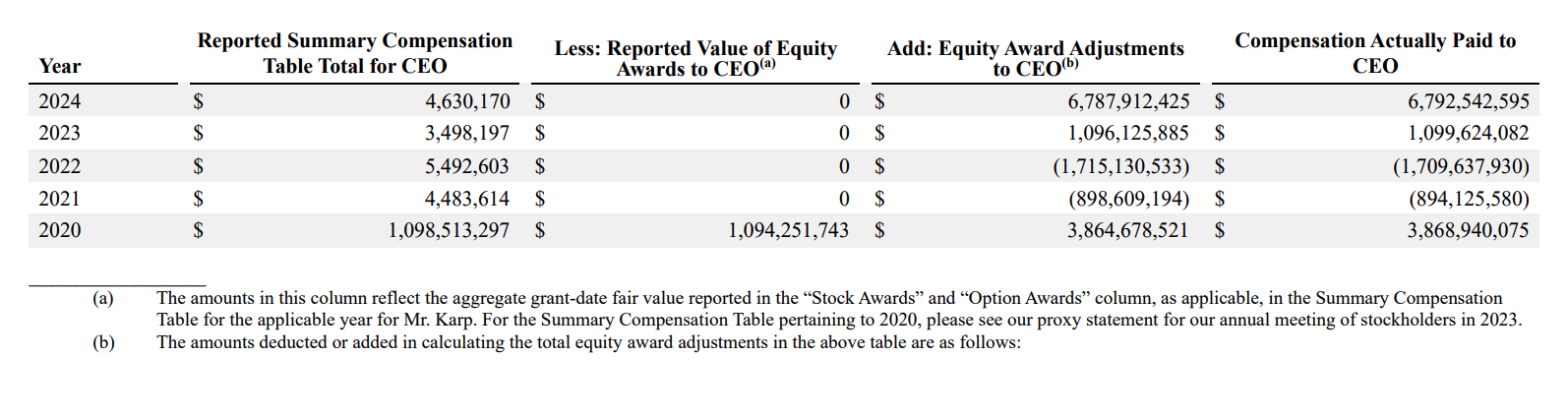
Palantir CEO Alex Karp pay package
Proxy statement on actual compensation paid to Palantir CEO Alex Karp

This comes from the table in the proxy statement labeled “Compensation Actually Paid to CEO,” which is a relatively new measure of compensation the SEC began to require a couple years back. It takes into account the stock and options grants that companies use to pay executives. Palantir reports a separate “summary compensation” table that puts Karp’s pay at just $4.6 million.

The “compensation actually paid” line was added as a means of trying to better capture the total pay that executives receive, accounting for fluctuating values of stock options and other equity awards. Here’s how The New York Times’ Jeff Sommer described it last year:

“The new approach is supposed to help shareholders determine whether an executive’s compensation is aligned with their company’s stock market return. It emphasizes the annual changes in value of an executive’s current and potential stock holdings, in contrast with the traditional approach, which provides a snapshot of the estimated value of a pay package when it is granted.”

Now, given the year that Palantir’s shares had last year — it rose 340% and was the top stock in the S&P 500 — it’s perhaps not surprising that Karp would enjoy a massive payout.

OK, fine. But there’s massive, and there’s massive.

By some rankings, Karp’s “compensation actually paid” number from 2023, $1.1 billion, made him the second-highest-compensated chief executive in the US, after Tesla’s Elon Musk, who made $1.4 billion in 2023 by this measure. (Tesla hasn’t published its proxy statement for 2024.)

Once the total tally of riches reaped by CEOs last year is finalized, we wouldn’t be surprised to see Karp sitting on top.

Now for the record, some companies claim this measure overstates what top executives earn. Palantir would seem to be one of them. In a footnote below the the “compensation actually paid table,” proxy statement included this somewhat Orwellian qualification. 

The term “compensation actually paid” or “CAP” does not reflect the amount of compensation actually paid, earned or received by him during the applicable year. Per relevant rules, Mr. Karp’s CAP was calculated by adjusting the Summary Compensation Table Total values for CEO for the applicable year. 

That’s true as far as it goes. But the “summary compensation table” number for Karp would also seem to be a pretty remarkable understatement of his earnings in 2024. As we know, he sold more than $2 billion worth of stock last year.

More Markets

See all Markets
markets

Akamai climbs to highest level since 2000 after reportedly securing Anthropic as a customer

Akamai’s billion-dollar AI infrastructure customer is Anthropic, Bloomberg reported on Friday. The cloud services company extended gains to trade up over 25% following the news.

On Thursday, the company announced a seven-year, $1.8 billion commitment from a “leading frontier model provider.”

Anthropic has been on a mad scramble to boost compute capacity after facing widespread complaints about Claude usage limits and seeing OpenAI position its accumulation of computing power as a competitive advantage.

In a little over a month, Anthropic has struck or expanded deals with CoreWeave, Amazon, Google, Broadcom, as well as xAI (through SpaceX).

As part of that xAI pact, Anthropic announced that it would be increasing usage limits for paying customers.

Anthropic has been on a mad scramble to boost compute capacity after facing widespread complaints about Claude usage limits and seeing OpenAI position its accumulation of computing power as a competitive advantage.

In a little over a month, Anthropic has struck or expanded deals with CoreWeave, Amazon, Google, Broadcom, as well as xAI (through SpaceX).

As part of that xAI pact, Anthropic announced that it would be increasing usage limits for paying customers.

markets

NuScale Power falls on disappointing drop in Q1 sales

NuScale shares are dropping in the early trading session after it released Q1 earnings yesterday after the bell that are failing to rejuvenate any excitement in the once high-flying, early-stage nuclear energy company.

The company announced Q1 revenue of just $560,000, well below the $10.5 million estimate, with sales down materially year over year thanks to old licensing and design deals that have since been completed.

The lack of financial progress has made NuScale Power more of a momentum-driven way to play the intersection of clean energy and AI infrastructure, particularly as hyperscalers and data center operators search for long-term power sources.

“The demand for reliable, carbon-free power has never been greater, and NuScale is the only SMR technology provider with a U.S. Nuclear Regulatory Commission approved design, an established supply chain and NPM components currently in production for commercial use to meet this essential need,” said John Hopkins, NuScale president and CEO. “We are building the infrastructure that this pivotal moment requires.”

Analysts at Goldman Sachs trimmed their price target to $9 from $10 in the wake of this report.

The company ended this quarter with cash, cash equivalents, and short- and long-term investments of $1.0 billion. The stock has dropped more than 25% year to date.

markets

Nintendo falls, will hike Switch 2 price amid memory crunch

Gaming giant Nintendo reported the results for its fourth quarter, which ended in March, on Friday morning. Its US-traded ADR fell nearly 4% in premarket trading.

Most notably, Nintendo announced it will raise the price of its Switch 2 console in the US by $50 to $499.99 in September. Investors have been waiting for Nintendo to join its rivals Sony and Microsoft in boosting the price of its flagship console, but the company had thus far been unwilling to do so this early in the Switch 2’s life cycle.

Nintendo shares have fallen about 45% over the past 12 months, as the company has been hit by tariffs and costs have increased due to AI’s memory demand and higher global shipping rates amid the war in Iran.

For its fiscal 2026, Nintendo reported:

  • 2.313 trillion yen ($14.8 billion) in total revenue, compared to estimates of 2.31 trillion yen ($14.78 billion) from Wall Street analysts polled by FactSet.

  • 19.86 million Switch 2 sales, compared to its 19 million forecast.

For the fiscal year ahead (which will end in March 2027), Nintendo forecast 16.5 million Switch 2 sales. The company is guiding for 2.050 trillion yen ($13.1 billion) in sales for the full year, compared to Wall Street estimates of 2.5 trillion yen ($16.1 billion).

Latest Stories

Sherwood Media, LLC produces fresh and unique perspectives on topical financial news and is a fully owned subsidiary of Robinhood Markets, Inc., and any views expressed here do not necessarily reflect the views of any other Robinhood affiliate, including Robinhood Markets, Inc., Robinhood Financial LLC, Robinhood Securities, LLC, Robinhood Crypto, LLC, Robinhood Derivatives, LLC, or Robinhood Money, LLC. Futures and event contracts are offered through Robinhood Derivatives, LLC.

