
Markets
Jamie Dimon JPMorgan
Jamie Dimon (Getty Images)
Weird Money

Why pension funds’ love affair with private equity is bad for the environment

Jamie Dimon highlighted that pension funds' private market investments are hindering their ESG goals.

Jack Raines

Back in April, I highlighted some concerns I had with pension funds doubling down on private equity. My issue, at the time, was that I thought it was a risky investment. For context, funding ratios (a pension’s assets divided by its liabilities) for state and local pensions had declined from 100%+ to 78% from 2001 to 2022, despite a strong performance from the stock market over that time.

In an attempt to improve their returns, many funds turned to private equity, as it had outperformed the S&P 500 on a 20-year, 10-year, 5-year, and 3-year horizon. However, with private equity funds now distributing less to investors than they are raising through new funds, and capital being tied up in funds longer and longer, some pensions have had to sell their PE fund stakes on secondary markets at an average of 85% of their recent valuations, creating a drag on returns.
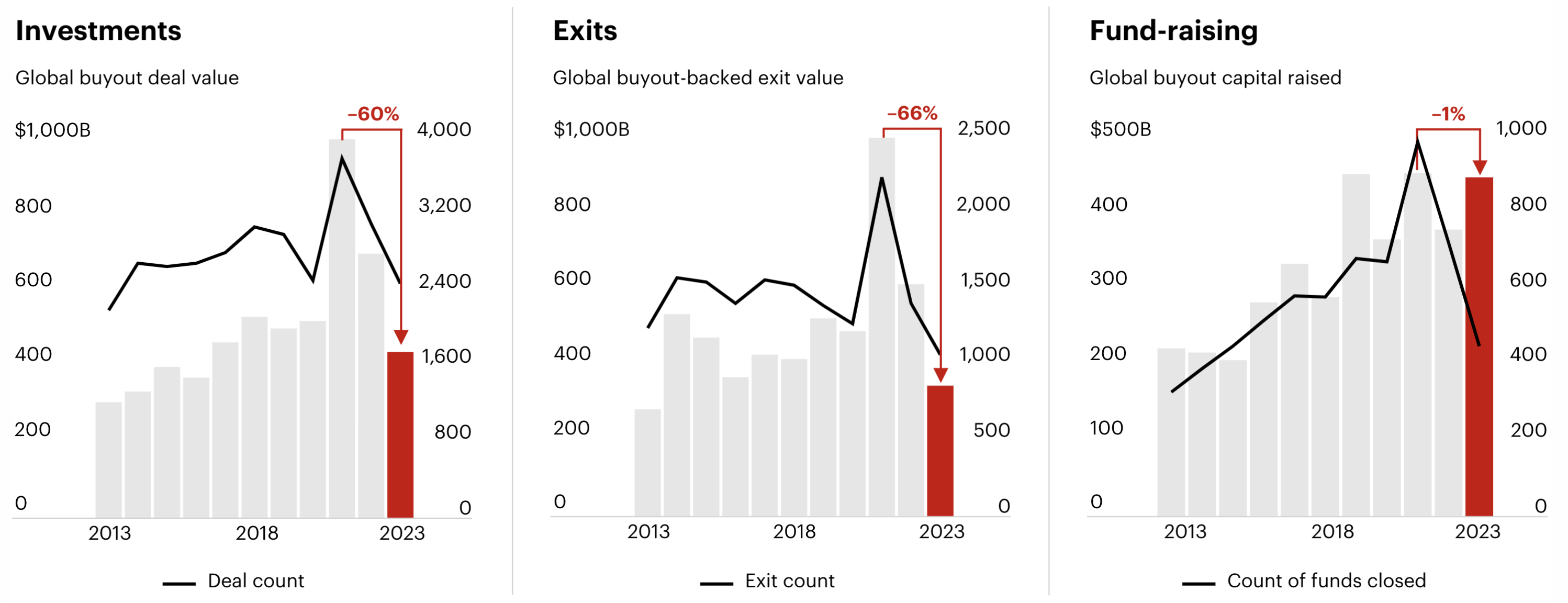
Bain Projections
Source: Bain Capital

However, another consequence that I hadn’t thought of was that pension funds’ love affair with private equity could be hindering their environmental activism. On October 9, Reuters reported that JPMorgan CEO Jamie Dimon recently called out pension fund managers for increasing their allocations to private equity while simultaneously voicing environmental and social concerns:

'You call me up and talk to us about all the issues you're interested in. But when you make huge investments in the private side, you don't get that kind of transparency,’ he told a meeting of the Council of Institutional Investors in New York on Sept 10…

There could be 15,000 publicly traded companies in the U.S. rather than around 4,500 today, Dimon suggested. Instead private markets have taken up a major share of new investments without nearly as much disclosure, liquidity or research, the JPMorgan CEO said.

‘You all are huge causes of that, because you make huge investments on the private side,’ Dimon told the audience that included representatives from Democratic-leaning state and local pension systems that have taken activist stances on environmental and social issues.

Many public pension funds, such as CalPERS, have been outspoken about their environmental activism, with the US’s largest pension plan taking an activist stance against ExxonMobil in May of this year after the company filed a lawsuit to block a vote on a climate proposal.

Unlike public companies, which are beholden to more shareholder disclosures and face increased shareholder scrutiny regarding their ESG disclosures, private companies are less transparent with their operations, making it more difficult for investors to track their environmental impacts.

Given the increased transparency and increased liquidity of public markets, it seems like it would be a win-win, from both a financial and activist perspective, to allocate more capital toward public markets, not less. But considering that CalPERS voted to increase total private market allocation from 33% to 40% in March, it looks like more of the same for the near future.

More Markets

See all Markets
markets

Nintendo climbs for third day as China ramps up its memory production

Nintendo shares are climbing on Tuesday, marking the company’s third straight session of gains — something it hasn’t done since early March. The Mario maker’s US-listed ADRs were up about 4% in Tuesday morning trading.

The return of the Switch 2 game bundle appears to have stoked investor optimism in the company’s console sales, while China’s accelerating memory production plans could alleviate some of Nintendo’s pain from the “RAMpocalypse.” For the better part of a year, memory prices have surged as AI demand hoovers up compute power. That’s squeezed video game console makers — and the broader consumer electronics industry.

Tracking the performance of Nintendo ADRs against memory giant Micron helps put this move in perspective. Nintendo is a big memory consumer, and not in the front of the line in terms of securing supply. Micron, obviously, benefits from its offerings being in high demand.

Tuesday’s price action is just a drop in the bucket, and comes as part of a recent stretch where the stock market’s high-flyers are having their wings clipped while beaten-up laggards rally.

In its first-quarter results on Monday, Chinese DRAM producer CXMT said it’s ramping up production and issued bullish guidance. The company is planning an IPO later this year, and it could be China’s biggest of the year.

For Nintendo, more global memory production could see rising costs start to deflate, improving margins in a vital year for its new console.

markets

Snowflake shares rise after BofA raises price target, predicts strong earnings next week

Snowflake shares jumped after Bank of America Securities analysts raised their price target for the cloud data warehousing company to $205 from $195, with a “buy” rating.

BofA analysts wrote that Snowflake will have a strong quarter because “the robust demand it was seeing heading into this year should continue unabated.” The report called the stock a “a share gainer in the attractive and growing AI business intelligence opportunity.”

Snowflake shares are down about 20% year to date. In November, shares hit a 52-week high of $280.67.

markets

Standard Chartered to replace “lower-value human capital,” cutting jobs “in favor of the machines”

Standard Chartered is announcing a major “it’s not you, it’s me” corporate makeover with a 15% cut of its administrative roles (roughly 8,000 jobs) by 2030 in favor of automated systems.

“It is not cost-cutting, but it is replacing, in some cases, lower-value human capital with the financial capital and the investment capital that we are putting in,” said CEO Bill Winters.

Congratulations to Standard Chartered employees who survive this culling; obviously, your CEO thinks you’re at least medium-value human capital.

Defending the strategy at a press briefing in Hong Kong, Winters explicitly rejected framing the large layoffs as a standard budget-slashing initiative.

He noted that the bank does not view the transition as an unmitigated loss of staff, but rather “job role reductions in favor of the machines,” which will “accelerate as we go full-bore into AI.”

The operational downsizing aims to boost profitability and increase overall income per employee by 20% over the next two years.

The bank joins a long list of companies that have announced job cuts in concert with plans to lean more into AI. Per CNBC, the subsequent performance of these stocks varies significantly, with some up more than 40% and others down just as much, or worse.

markets

Hyperliquid Strategies spikes on report that the SEC will soon greenlight an “innovation exemption” for tokenized stocks

Shares of Hyperliquid Strategies are soaring in early trading after Bloomberg reported that the Securities and Exchange Commission is slated to release an “innovation exemption” that formalizes rules around the trading of tokenized stocks.

In what Bloomberg dubbed a “surprise move,” the SEC is slated to permit tokenized stocks (crypto wrappers for traditional shares) even if the public companies don’t consent to their creation.

Hyperliquid Strategies is a digital asset treasury company that holds hype tokens and provides liquidity on the DeFi exchange Hyperliquid.

Tokenized securities offer faster settlement and expanded trading hours, though without the same market depth that typically prevails with traditional exchanges and with a higher potential for price fragmentation.

Per the report, which cites people familiar with the matter, these platforms would need to provide their third-party holders with voting rights and dividends in order to list these tokens. As such, the platforms would effectively be required to hold the underlying securities they’d be offering tokenized access to.

markets

Home Depot reports Q1 sales beat, reaffirms full-year guidance

Home Depot reversed its initial gains following earnings after a spike in long-term bond yields overshadowed the retailer's solid Q1 results.

Key numbers:

  • Revenue of $41.77 billion (estimate: $41.50 billion).

  • Adjusted earnings per share of $3.43 (estimate: $3.42).

  • Comparable-store sales of 0.6% (estimate: 0.9%).

Comparable sales came in below forecasts, while the company reaffirmed its full-year guidance, expecting annual sales to grow between 2.5% and 4.5%.

“Our first quarter results were in line with our expectations,” said Ted Decker, chair, president, and CEO. “The underlying demand in our business was relatively similar to what we saw throughout fiscal 2025, despite greater consumer uncertainty and housing affordability pressure.”

While the company has served neighborhood handymen for decades, its recent growth is also partially charged by its finalized acquisition of Mingledorff’s, a premier wholesale HVAC distributor operating 42 commercial locations across the southeastern United States. Home Depot said the transaction gave it access to high-volume commercial mechanics and residential trade contractors, expanding its total addressable market to $1.2 trillion.

The company is also using machine learning to automate parts of commercial building work that have traditionally been manual. One example is its Material List Builder AI, which lets contractors upload architectural blueprints or dictate voice notes from a jobsite to generate materials lists.

Investors are continuing to track whether strategic pricing changes and distribution scale can help the business maintain its full-year gross margin target of 33.1%.

Latest Stories

Sherwood Media, LLC and Chartr Limited produce fresh and unique perspectives on topical financial news and are fully owned subsidiaries of Robinhood Markets, Inc., and any views expressed here do not necessarily reflect the views of any other Robinhood affiliate, including Robinhood Markets, Inc., Robinhood Financial LLC, Robinhood Securities, LLC, Robinhood Crypto, LLC, Robinhood Money, LLC, Robinhood U.K. Ltd, Robinhood Derivatives, LLC, Robinhood Gold, LLC, Robinhood Asset Management, LLC, Robinhood Credit, Inc., Robinhood Ventures DE, LLC and, where applicable, its managed investment vehicles.

