
Markets
Food And Drug Administration Headquarters In Maryland
(Sarah Silbiger/Getty Images)

Pharma company Aurinia falls after FDA official uses LinkedIn to call out lupus drug

Lupkynis, which was approved in 2021, is Aurinia’s primary source of revenue.

J. Edward Moreno

Aurinia Pharmaceuticals dropped on Monday after a Food and Drug Administration official criticized a method of evaluating drugs that was used to approve the companys flagship lupus medication.

George Tidmarsh, who has led the FDAs drug evaluation arm since July, said on LinkedIn that voclosporin, which is made by Aurinia under the brand name Lupkynis, has significant toxicity and has not been proven to benefit patients.

Specifically, he criticized the use of surrogate end points, which are indirect measures of patients health after taking a treatment that results in speedier trials. Tidmarsh said the FDA will be evaluating how it uses that kind of data for drug approval. Tidmarsh later deleted that post and in a subsequent post clarified that those were his personal views and not that of the FDA.
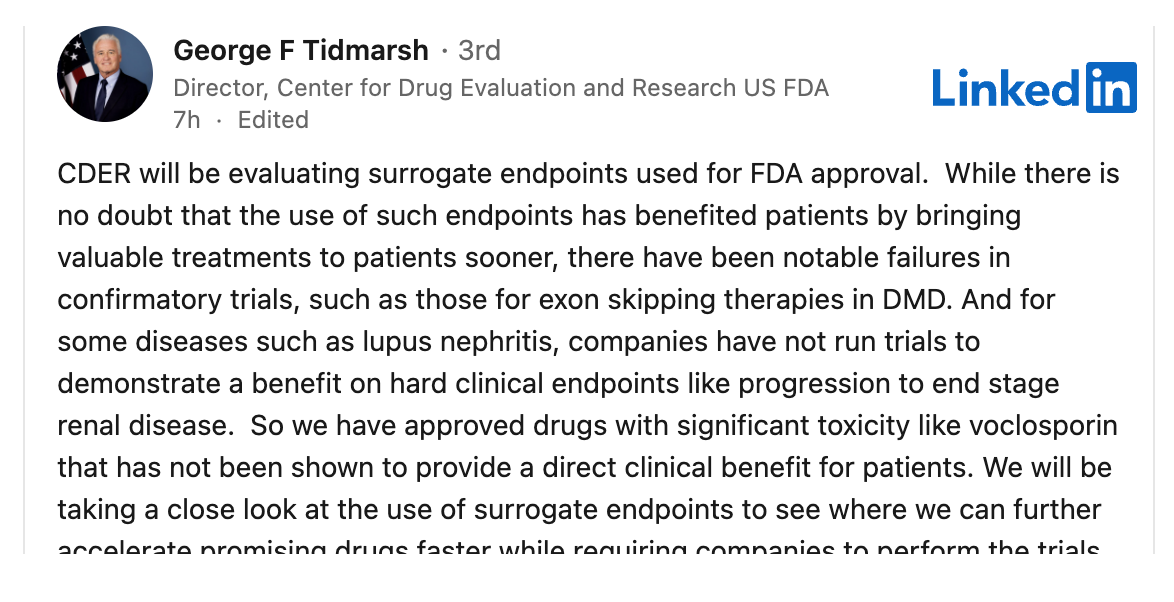
Screenshot 2025-09-29 at 3.57.01 PM
A screenshot of Tidmarsh's LinkedIn post. (Sherwood News)

Tidmarshs complete, since deleted LinkedIn post read:

CDER will be evaluating surrogate endpoints used for FDA approval. While there is no doubt that the use of such endpoints has benefited patients by bringing valuable treatments to patients sooner, there have been notable failures in confirmatory trials, such as those for exon skipping therapies in DMD. And for some diseases such as lupus nephritis, companies have not run trials to demonstrate a benefit on hard clinical endpoints like progression to end stage renal disease. So we have approved drugs with significant toxicity like voclosporin that has not been shown to provide a direct clinical benefit for patients. We will be taking a close look at the use of surrogate endpoints to see where we can further accelerate promising drugs faster while requiring companies to perform the trials necessary to confirm actual clinical benefit.

Lupkynis, which was approved in 2021, is Aurinias primary source of revenue. The company reported $235.1 million in sales last year, and analysts polled by FactSet have penciled in $270.5 million for 2025.

Aurinia fell as much as 21% after Tidmarsh’s post, and it ended the day down 16%.

More Markets

See all Markets
markets

Credit card and bank stocks stumble after President Trump calls for 10% interest rate cap

Shares of banks and US financial services companies are under pressure on Monday morning after US President Donald Trump announced his intention to impose a hard limit on how much money they can make off credit cards.

In a Truth Social post on Friday evening, Trump announced that he would be calling for a one-year cap of 10% on credit card interest rates. Over the weekend, the president said that card issuers with a rate above that as of January 20 would be “in violation of the law.”

As of this point, these statements do not appear to carry the force of law.

“While the president has announced his support for a cap, this cannot be done through an executive order," writes George Pollack, senior US policy analyst at Signum Global Advisors. “Instead, this would require an act of Congress.”

Nevertheless, traders are selling first and asking logistical questions later. Banks including JPMorgan and credit card giants Visa and Mastercard are lower in premarket trading, as are other financial services companies with a significant footprint in this space.

“President Donald Trump's call for a 10%, one-year cap on credit card interest rates, if enacted, would severely hurt the revenue and profit of Capital One, Synchrony Financial and Bread Financial, with a smaller impact on American Express,” write Bloomberg Intelligence consumer finance analysts Ben Elliott and Edward Najarian. “The companies would likely react by raising fees and rapidly reducing credit availability, especially for below-prime customers.”

Financial services companies that offer “buy now, pay later” options, such as Affirm and Klarna, are rising in premarket trading. If Trump’s proposal is realized, this may result in a pullback in credit provided to lower income and less creditworthy Americans, and BNPL firms could see a resultant uptick in activity. Klarna, for its part, applauded the president’s call in a post on X.

Independent (left-leaning) Senator Bernie Sanders as well Republican Senator Josh Hawley have introduced a bill that would cap credit card rates at 10% for five years, while Democrat Representative Alexandria Ocasio-Cortez and Republican Representative Anna Paulina Luna have introduced similar legislation in the House.

markets

Sandisk rides Wall Street price target hikes toward new record

Sandisk leapt Friday, riding a resurgent wave of AI-related market exuberance as well as two price target hikes from Wall Street analysts.

Goldman Sachs lifted its target for the stock to $320 from $280, while keeping a “buy” rating on the stock. Mizhuho lifted its target to a Street high of $410 from its previous target of $250, while maintaining an “outperform” rating on the shares.

Long considered a maker of commodity data storage products, Sandisk was spun off by Western Digital in an IPO in February.

When it dawned on the market sometime in the fall that the AI boom would mean an explosion in demand for data storage, Sandisk shares went parabolic.

Its more than 350% run-up between the ends of August and December led to Sandisk’s inclusion in the S&P 500. And its 560% gain for the year made it the index’s top performer.

markets
Luke Kawa

It looks like the stock market was expecting some tariff relief

The S&P 500 briefly dipped into negative territory and tariff-sensitive stocks swung from big gains to big losses after the Supreme Court declined to give a ruling on tariffs imposed by President Donald Trump under the IEEPA.

A basket of “Trump Tariff Losers” stocks compiled by UBS, which includes Under Armour, American Eagle, Yeti, Mattel, and Deckers Outdoor, was up as much as 1.5% in early trading before falling as much as 1.7% after news of the lack of news surfaced.

The good news is that for the market as a whole (and even this group in particular), the pain seems to have been short-lived, with both bouncing back to erase losses.

It’s a decent little snapshot or case study to show that, yes, as prediction markets imply, the stock market is pricing in tariff relief.

markets

Amazon pharmacy to begin offering home delivery for Novo Nordisk’s Wegovy pill

Amazon Pharmacy announced Friday that it will offer Novo Nordisk’s recently approved weight-loss pill Wegovy, the newest frontier in the drugmaker’s push toward direct-to-consumer options.

Amazon said it will offer delivery for the pill through insurance and cash-pay options. Novos cash-pay price for the pill is $149 a month — less than half of what its injectables cost through the same channel.

Novo has partnered with big-box stores like Costco and Walmart as well as several big telehealth companies, including Ro, Weight Watchers, and LifeMD, to distribute the pill. This comes as the Danish pharma giant is trying to regain ground after Eli Lilly surpassed it in market share, in large part because of its early emphasis on direct-to-consumer channels.

The Food and Drug Administration approved Novos weight-loss pill in December, making it the first approved weight-loss pill to go to market. It has the same active ingredient, semaglutide, as its injectable products, Ozempic and Wegovy. Lillys oral version, orforglipron, is expected to come to market later this year.

Latest Stories

Sherwood Media, LLC produces fresh and unique perspectives on topical financial news and is a fully owned subsidiary of Robinhood Markets, Inc., and any views expressed here do not necessarily reflect the views of any other Robinhood affiliate, including Robinhood Markets, Inc., Robinhood Financial LLC, Robinhood Securities, LLC, Robinhood Crypto, LLC, or Robinhood Money, LLC.
