
Markets
Supreme Court Rules Affirmative Action Is Unconstitutional In Landmark Case With Harvard And UNC
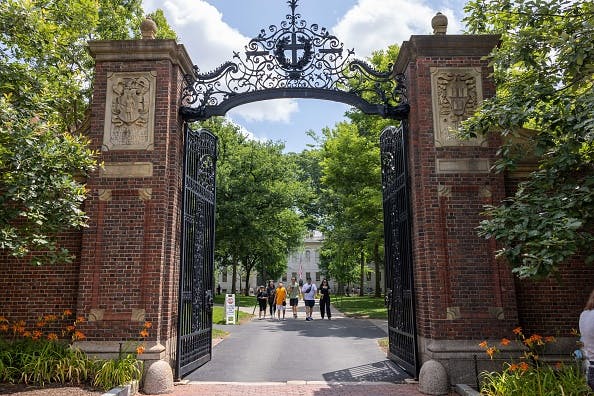
Harvard Yard at Harvard University (Scott Eisen/Getty Images)
Weird Money

The fund managers for Ivy League endowments somehow managed to flop in this market

The reduced volatility of private equity comes with a cost.

Jack Raines

Over the weekend, the Financial Times published an interesting piece on Ivy League endowment returns so far this year. Per the FT, through the 12-month period ending June 2024, six of the eight Ivies underperformed the higher-education average. And, in 2023, all of the Ivies returned below the higher-education average of 6.8%. For context, the S&P 500 was up 24% in 2023.

One reason for the Ivy woes? An overallocation to private equity. From the Financial Times: 

Top endowments have long used aggressive exposure to private investments in pursuit of excess returns they believe are out of reach through public markets. Now, as those investments have yet to pay off, some large endowments like Princeton have issued bonds to meet funding needs, according to the New Jersey Educational Facilities Authority…

Most Ivy League endowments had earmarked more than 30%, and in the case of Yale and Princeton at least 40%, of their assets to PE and VC by the first half of the year, according to Old Well Labs, a financial data provider.

One reason that Ivy League schools have increasingly turned to private equity is that it offers lower volatility than public markets. Minimizing volatility is important for these endowments because they are responsible for funding a portion of their schools’ operating budgets each year. For example, in fiscal year 2024, Harvard’s endowment distributed $2.4 billion to cover 37% of the school’s operating budget. While the Ivies have underperformed over the last couple of years, that reduced volatility paid off in one year. In 2022, the S&P 500 was down 18.1%, but Harvard’s endowment only fell by 1.8%, and Yale’s endowment actually increased by 0.8%. When you have to make multibillion-dollar distributions each year, minimizing risk is far more important than maximizing returns, and private equity offers lower volatility.

However, the reduced volatility of private equity comes at a cost: illiquidity. There was an interesting phenomenon in 2022, where public markets sold off sharply but private-market valuations were less affected. While some private companies may have been more resilient, firms also sold far less of their portfolio companies in 2022 than the year before: exit volume was down 57% year over year through Q3 2022.

If a bucket of publicly traded fintech SaaS companies fell by 50%, you would think that, by correlation, the value of similar-sized privately held fintech SaaS companies would decline by 50%, too. But if the PE firms that own these similarly-sized fintech SaaS companies can say, “Our valuations have only declined by 15%,” and continue to hold those portfolio companies, then boom, outperformance. Of course, there probably aren’t any willing buyers at this valuation (hence the 57% decline in exit volume), but, at least on their own books, private-equity portfolios looked resilient.

However, because endowments have to distribute cash to help fund their universities’ budgets, valuations and “returns” don’t mean much if they don’t eventually yield exits that return cash, and distributions have been slow over the last three years. The result: Ivy League schools have had to issue nearly $3 billion in municipal debt so far through October 2024, up 650% from the year before, to help meet these cash needs.

Paper returns look good, but at the end of the day, an investment is only worth what someone else will pay for it. If you say your company is worth $1 billion, but no one else is willing to pay more than $700 million to acquire it, is it really worth $1 billion? Probably not, as endowments have figured out.

More Markets

See all Markets
markets

SpaceX reportedly files confidentially for IPO

SpaceX confidentially filed its draft IPO paperwork with the Securities and Exchange Commission, Bloomberg reports, citing people familiar with the matter, the next step toward what is expected to be a blockbuster summer listing.

Elon Musk’s satellite and rocket company could raise around $75 billion in an IPO that would value it at more than $1.75 trillion — both records — though the exact amounts won’t be settled until it goes public, likely in June.

Another notable thing about this IPO: the portion of shares committed to individual investors is expected to be much higher than in traditional IPOs — per Reuters, up to 30%, versus the typical 10% — a move that could broaden retail participation in one of the most anticipated public offerings ever.

Another notable thing about this IPO: the portion of shares committed to individual investors is expected to be much higher than in traditional IPOs — per Reuters, up to 30%, versus the typical 10% — a move that could broaden retail participation in one of the most anticipated public offerings ever.

markets

Energy stocks tumble after massive March

Energy and chemical stocks tumbled early Wednesday on growing expectations that the US participation in the Iran war is nearing an end, and West Texas Intermediate crude oil futures slipped back below $100 a barrel.

LyondellBasell, APA Corporation, Dow, Inc., CF Industries, and Marathon Petroleum — the S&P 500’s top 5 gainers last month — all sank.

Natural gas drillers EOG Resources, Devon Energy, Coterra Energy, and Diamondback Energy dropped, as did integrated oil giants Exxon and Chevron. Fuel refiners and marketers such as Phillips 66 and Valero also fell.

Don’t shed too many tears for these energy giants; the S&P 500 energy sector rose 10% in March and 37% in Q1 2026.

The Energy Select Sector SPDR Fund is coming off its second-best quarter on record relative to the SPDR S&P 500 ETF, based on data going back to 1999.

Nio, Li Auto rise as Q1 delivery totals beat internal guidance

China’s EV startup trio — Nio, Li Auto, and XPeng — are all climbing on Wednesday, following the release of March and first-quarter delivery totals.

Nio delivered 83,465 vehicles in the three months that ended in March, up 99% from the same quarter a year ago and slightly beating the upper end of its guidance. Li Auto delivered 95,142 vehicles in the period, up 2.5% and ahead of its guidance range. The figure was bolstered by 12% growth in March deliveries.

XPeng, on the other hand, saw Q1 deliveries drop 33% year over year to 62,682 vehicles — the company’s first quarterly drop since 2023. Shares are still up as of 10 a.m. ET on Wednesday, as the automaker’s March deliveries were up 80% from February’s total.

BYD is down more than 2% on Wednesday, as the automaker posted its seventh consecutive month of sales declines. First-quarter sales fell 30% year over year, Reuters reported.

markets

Data center trade reboots amid Iran relief rally

Memory, networking, chipmaking machinery, semiconductor, and rack-building stocks were all up early Wednesday, in a broad-based reboot of the data center trade on growing optimism about America’s potential exit from the Iran war.

Companies that make all the core components of data center were on the move early. Memory plays Micron, Sandisk, Western Digital, and Seagate Technology Holdings all opened near the top of the S&P 500’s leaders, as they shook off last week’s jitters related to a Google Research announcement about an AI algorithm that might cut demand for memory.

Fiber-optic and networking shares like Ciena Corp., Arista Networks, Corning, Coherent, Amphenol, and Lumentum — popular recent data center plays — also rose. OG data center trades like chip companies Nvidia, Intel, and Advanced Micro Devices gained. And the companies that make the machines that make the chips, like Lam Research and KLA Corp, are also catching a bid.

Even the more hard-hat elements of the AI boom were up, with Comfort Systems USA, Eaton Corp, Carrier, and Quanta Services rising. Server rack builders Dell and HP Enterprise also increased.

Clearly, there’s a big element of relief rally at play in the early bounce, building on Monday’s advance, which saw the S&P 500 post its biggest one-day gain since May.

Latest Stories

Sherwood Media, LLC produces fresh and unique perspectives on topical financial news and is a fully owned subsidiary of Robinhood Markets, Inc., and any views expressed here do not necessarily reflect the views of any other Robinhood affiliate, including Robinhood Markets, Inc., Robinhood Financial LLC, Robinhood Securities, LLC, Robinhood Crypto, LLC, Robinhood Derivatives, LLC, or Robinhood Money, LLC. Futures and event contracts are offered through Robinhood Derivatives, LLC.

