
Markets
'There's nothing perfect in this world of growing apples.' Extreme weather could complicate future harvests.
Honeycrisp apples on the tree at Tougas Family Farm in Northborough, Massachusetts (Jessica Rinaldi/Getty Images)

The remarkable rise of the Honeycrisp and Cosmic Crisp apples

When it comes to apples, America cannot get enough of the crunch factor.

America is a land of diversity where people, cultures, and inspirations clash to create a melting pot of different ideas. But ask a room full of people what their favorite apple is and these days you might get a lot of the same answer: Honeycrisp.

The apple of our eyes

Unfortunately, as reported by The Wall Street Journal earlier this week, farming them is something of a nightmare. Honeycrisps are easily bruised, often grow too densely for their own good, have to be hand-clipped from trees due to their thin skin, and can be afflicted by diseases that blotch the fruit. They are, as one farmer put it, a “diva.”

They’re also valuable, however, dubbed “moneycrisps” by some. And, along with the Cosmic Crisp and Pink Lady, they’re soaring up the apple production league tables toward icons like Gala and Red Delicious, which have seen production drop over time.
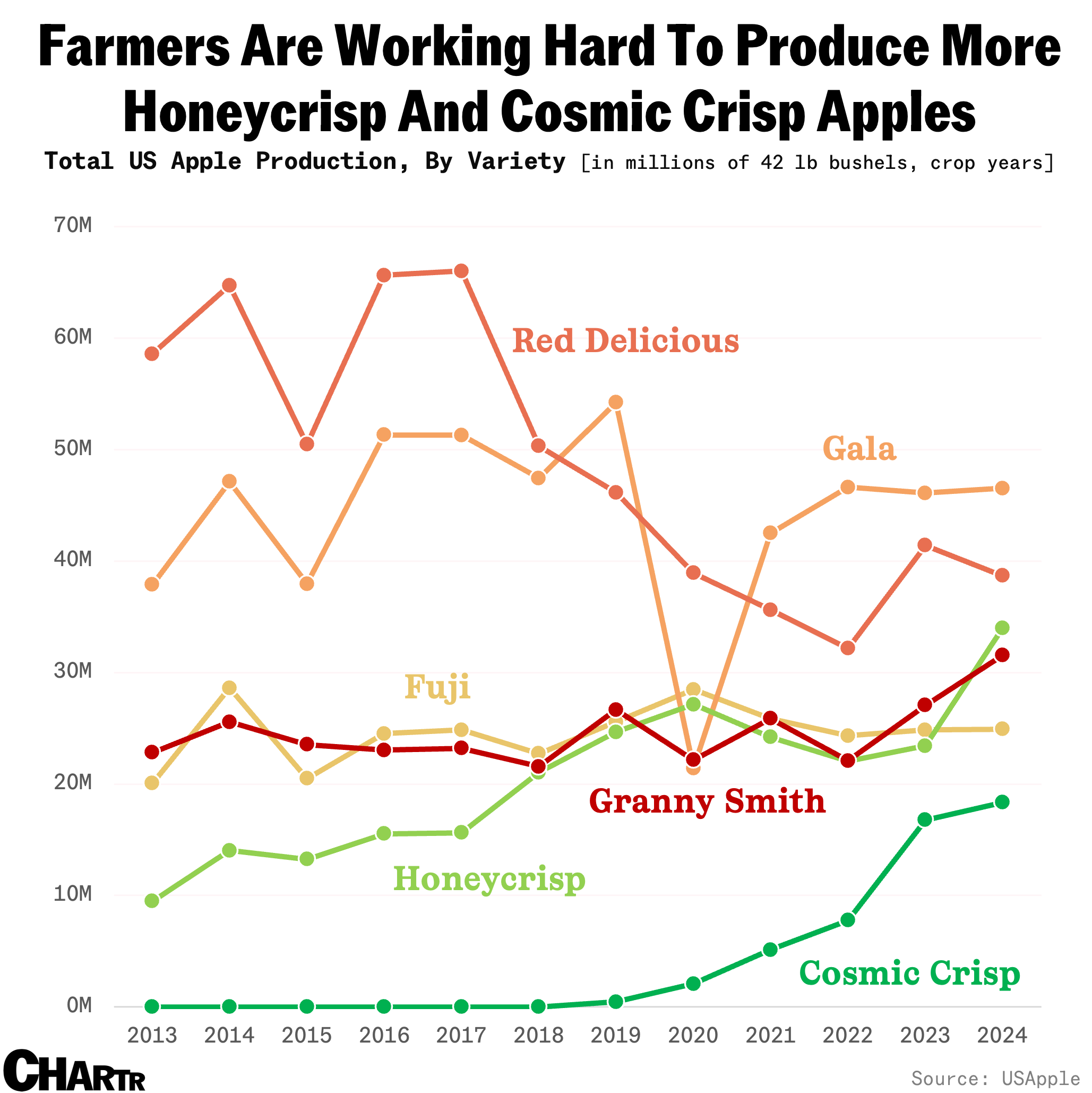
Apple production in the US
Sherwood News

Per data from USApple, the core of the apple-eating market is increasingly the three varieties that make a mouth-watering crunchCosmic Crisp, Pink Lady, and Honeycrisp — production volumes of which have jumped 3,391%, 63%, and 17% in the last five years, respectively.

Remarkably, a study published all the way back in 2013 essentially predicted this boom, finding that when consumers assessed apples based on their appearance, they looked for size and color. When evaluating taste they wanted sweetness and crispness. And they’re willing to pay: per retail price data tracked by USApple, Honeycrisp was the most expensive apple in 2023-24, at $1.88, compared to Gala at $1.49 and Red Delicious apples at $1.26.

But, with production expenses for fruit farms rising across the board, up 49% over the last decade, even producers of the “moneycrisp” have been feeling the pressure in the industry’s bottom line — and the new, crunchier, and crispier varieties also tend to have more volatile prices.

More Markets

See all Markets
markets

Dollar General jumps as Q1 EPS beats estimates, outlook raised

Dollar General shares jumped premarket after the company reported Q1 results with earnings per share beating analysts’ expectations and triggered an upward revision to its full-year profit outlook.

Key numbers:

  • EPS of $2 (compared to analyst estimates of $1.90).

  • Revenue of $10.79 billion (estimate: $10.83 billion).

  • Same-store sales growth of 2% year over year.

Dollar General has also raised its fiscal 2026 profit outlook, now forecasting full-year earnings per share to land between $7.20 and $7.45, up from its previous guidance of $7.10 to $7.35. Meanwhile, management reiterated its full-year same-store sales growth target of 2.2% to 2.7%.

Management noted that the retailer’s increase in profit was boosted by contributions from new stores and growth in same-store sales, partially offset by the impact of store closures.

Heightened economic uncertainty, ongoing US import tariffs, and rising gas prices tied to the Iran war could also be weighing on everyday households’ purchasing decisions, causing them to pull back on spending in general or trade down to more affordable basic essentials.

“Our topline results were highlighted by positive customer traffic and balanced category growth,” Todd Vasos, Dollar General’s CEO, said in the press release. “Looking ahead, we believe the essential nature of our offering and our expansive footprint position us well to navigate the current macroeconomic environment.”

Shares of Dollar General rose 4.7% premarket. They were down more than 17% year to date through Monday’s close.

markets

Marvell soars after Nvidia CEO says it will be the “next trillion-dollar company”

Marvell Technology surged after Nvidia CEO Jensen Huang called the chipmaker, which his company has a stake in, ⁠the next “trillion-dollar company.”

Huang made the comments at the Computex ​expo in Taipei on ‌Tuesday. It’s not the first vote of confidence for Marvell from the world’s most valuable company: Nvidia announced a strategic partnership with Marvell in March, saying that it has invested $2 billion in the company.

Marvell’s market capitalization as of Monday’s close was around $192 billion, meaning that Huang’s prediction would hinge on a more than 420% rally. Huang said computing is becoming increasingly disaggregated and distributed, creating a need for advanced connectivity, which is what Marvell specializes in.

“Thats the reason why Marvell is so essential,” Huang said, standing onstage next to Marvell CEO Matt Murphy. “Thats why you’re going to be the next trillion-dollar company.”

The stock rose 23% in premarket trading on Tuesday and is up more than 145% since the start of the year.

markets

HP Enterprise skyrockets on strong Q2 earnings and full-year guidance boost

HP Enterprise shares soared Monday afternoon following the enterprise software companys Q2 earnings report, which detailed a blockbuster quarter.

The stock was up more than 30% — not a typo — after-hours.

Here are the numbers for Q2:

  • Revenue of $10.7 billion (compared to the analyst estimate of $9.78 billion, per FactSet).

  • Adjusted earnings per share of $0.79 (estimate: $0.53).

The company raised its guidance for the full fiscal year, saying it sees revenue growth of 29% to 33%, compared with its previous guidance for 17% to 22%. It also guided for adjusted EPS of $3.35 to $3.45 for the full year, up from the $2.30 to $2.50 it had estimated in its Q1 earnings release.

For its early fiscal 2027 guidance, HPE said it expects revenue to grow 8% to 12%, compared with analysts expectations for 5.5% growth. It also said it expects adjusted EPS growth of 12% to 16%, compared to analysts forecasts of a 13.5% rise.

Unlike HP, which makes consumer products like PCs and printers, HP Enterprise is primed to support the AI boom — specializing in cloud servers, data storage systems, and AI infrastructure. HPE has gained 90% since January.

Last week, competitor Dell saw a similarly rosy earnings report, which boosted its stock nearly 40%.

On Monday at Computex, HPE announced a new project with Nvidia: a new server powered by the semiconductor company. Agentic AI has arrived, and it needs a new CPU, said Nvidia CEO Jensen Huang. According to the companies, the plan is to support and optimize the New York Stock Exchanges day-to-day infrastructure with industry leading agentic AI CPU performance, memory bandwidth and low latency.

markets

Credo Technology tanks, despite beating on earnings and revenue for Q4

Credo Technology Group shares cratered in after-hours trading after releasing Q4 earnings after the bell, despite crushing analyst expectations for earnings and revenue.

The stock dropped 15% in after-hours trading.

For Q4, the company — which makes high-speed connectivity solutions for data centers — posted:

  • Revenues of $437 million (estimate: $431.8 million).

  • Adjusted earnings per share of $1.16 (estimate: $1.02).

And for the first quarter, the company estimated revenue ranging from $465 million to $475 million, compared with analysts’ estimates for $461 million.

Shares of the company are up 63% year to date, and hit their all-time high of $247 today.

Shares soared earlier in the month after Credo announced its acquisition of DustPhotonics, which makes silicon photonic integrated circuits for high-speed networking in data centers. The acquisition means that Credo will be able to play both ends of the data center connectivity business, by adding advanced photonics to its bread and butter of active electrical cables.

Credo stock was down over 14% in after-hours trading.

Latest Stories

Sherwood Media, LLC and Chartr Limited produce fresh and unique perspectives on topical financial news and are fully owned subsidiaries of Robinhood Markets, Inc., and any views expressed here do not necessarily reflect the views of any other Robinhood affiliate, including Robinhood Markets, Inc., Robinhood Financial LLC, Robinhood Securities, LLC, Robinhood Crypto, LLC, Robinhood Money, LLC, Robinhood U.K. Ltd, Robinhood Derivatives, LLC, Robinhood Gold, LLC, Robinhood Asset Management, LLC, Robinhood Credit, Inc., Robinhood Ventures DE, LLC and, where applicable, its managed investment vehicles.

