

Markets
markets
Luke Kawa

Retail traders are driving off-the-charts volatility when companies release earnings

The increasing prominence of retail traders in dictating price action isn’t confined to just the world of meme stocks.

They’re also playing a key role in fueling how companies’ share prices behave at a time when every investor’s eyes are on them: upon the release of quarterly results.

“During this 2Q earnings season, retail investors frequently exhibited outsized trading behavior in stocks that experienced significant post-earnings price movements,” JPMorgan strategists led by Arun Jain wrote.

That is, substantial retail activity is associated with massive earnings reactions. The y-axis in the below chart tracks how many standard deviations JPM’s measure of retail buying is above or below its one-year average for a given stock.
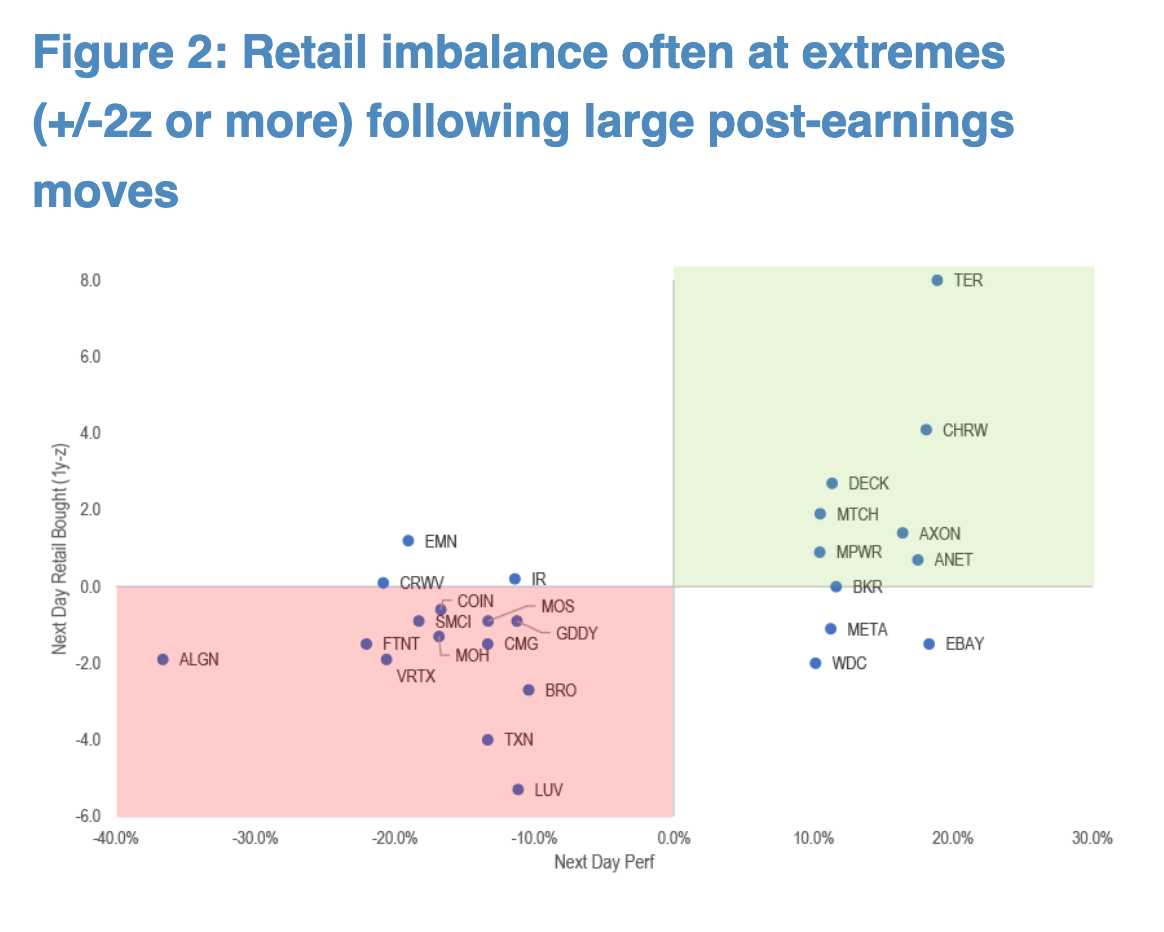
JPM Retail Earnings Reaction
Source: JPMorgan

But it’s not always the case that retail is contributing to (or creating) the obvious trend in response to earnings. Sometimes the crowd is coming in with both hands to catch a falling knife in stocks that nosedived after reporting quarterly results.

While retail’s favorite name to buy was still Palantir over the last week, per JPMorgan, Eli Lilly, The Trade Desk, and CoreWeave jumped to near the top of the leaderboard as they seemingly “provided compelling ‘buy-the-dip’ opportunities following disappointing announcements.”
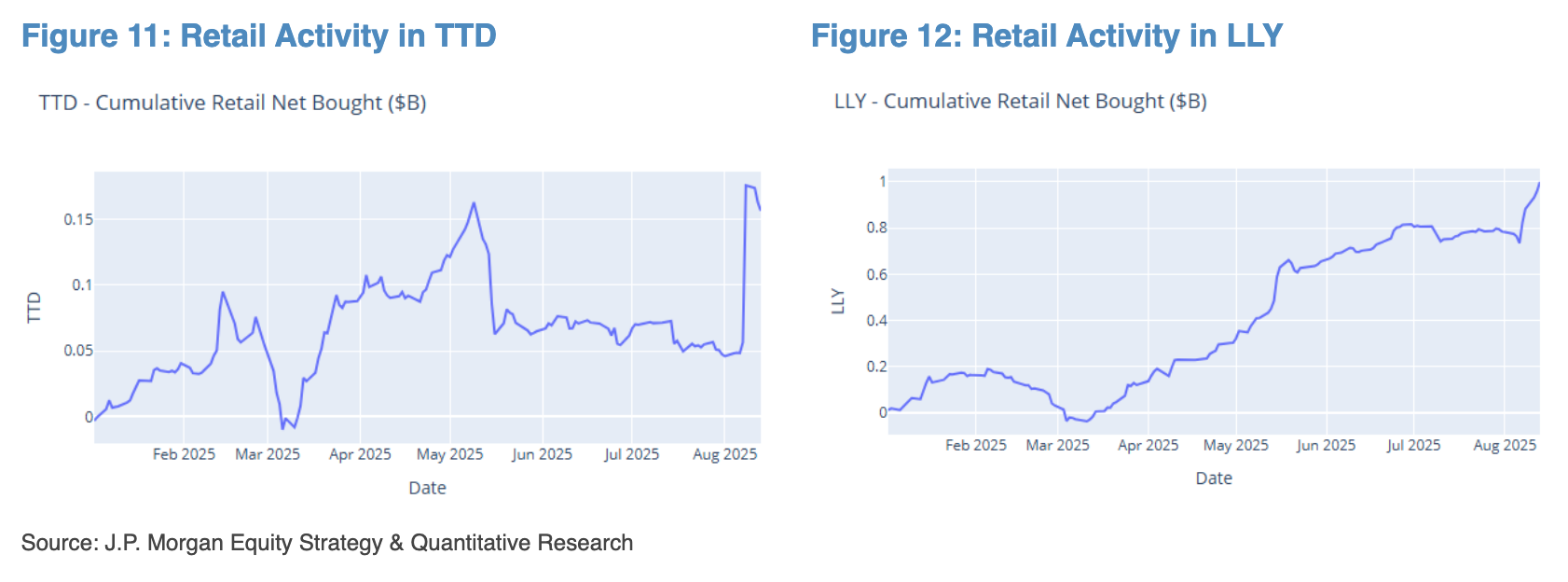
LLY TTD retail buying

As this has been playing out, Bespoke Investment Group observed that the typical (over?)reaction to earnings reports has been trending higher, reaching levels unseen outside of the global financial crisis.
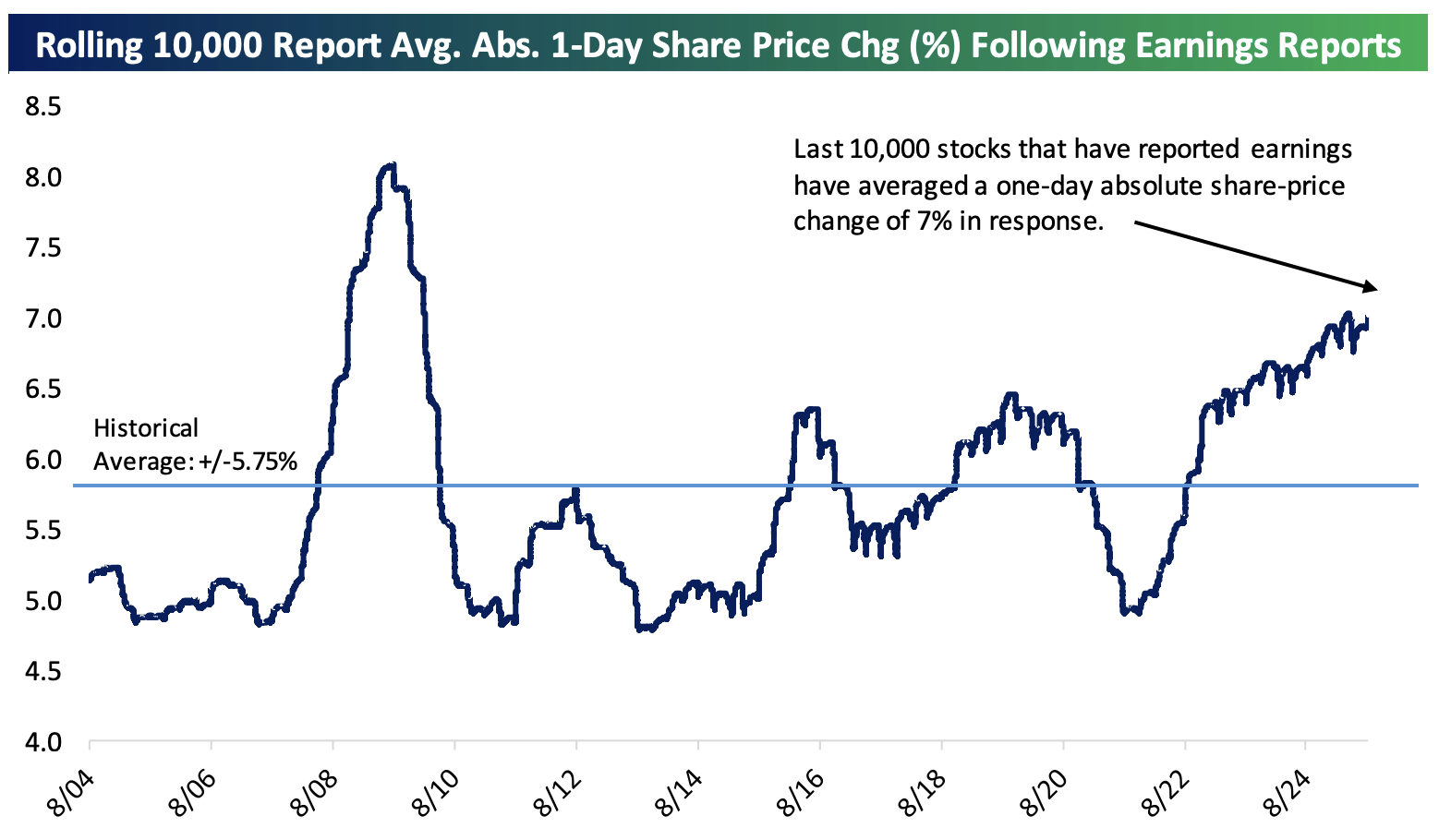
Bespoke Earnings Reaction
Source: Bespoke Investment Group


“In the current day and age of easy, commission-free trading on brokerage apps available right on your smartphone, share-price volatility in reaction to stock-specific earnings news has moved increasingly higher,” analysts at Bespoke wrote. “At the same time, overall market volatility hasn’t seen a similar increase, which means that more and more of a stock’s overall performance is coming from the one trading day per quarter when it posts its financial results and forward guidance.”

So, in sum, retail traders are stepping up their activity in names that move on earnings at the same time that stocks are moving more than they used to on earnings!

More Markets

See all Markets
markets

Blackberry managed to build a real business out of its memestock boom

The former memestock BlackBerry surged on blowout earnings this week — and the bull case has nothing to do with phones. 

  • Q1 Revenue: $152.9 million, up 26% from a year ago 

  • EPS: 4 cents, the fourth time in five quarters that BlackBerry posted a net profit

  • Shares of the stock are up nearly 180 percent over the past year. 

  • Cars on QNX: 275 million, nearly every maker except Tesla

When you think of Blackberry, you probably picture the clunky QWERTY keyboard and yearn for the pre-AI slop era. But for many traders, that nostalgic memory could have been getting in the way of evaluating a rising star

In its first quarter earnings on Thursday, the cell-phone-turned-B2B-enterprise-software-company blew past estimates with revenue up 26% and a 44% EPS beat after back-to-back 30%+ beats before that. The company hiked its full-year profit forecast to 16 cents to 20 cents per share with revenue between $594 million and $621 million. 

“The market still misdefines BlackBerry,” analyst Suthan Sukumar of Stifel said Tuesday in a note to clients. “This is…a mission-critical software layer in the physical AI stack and a dominant partner to silicon leaders like NVIDIA, Qualcomm, and AMD powering the build-out from cloud to edge, across cars, robots, factories, and medical devices.” 

QNX, BlackBerry’s real-time operating system — runs inside of 275 million cars worldwide. “There's more software going into a car these days than ever before, CEO John Giamatteo told Bloomberg on Friday. “That's really where we shine as a company.” 

Modern autos generate terabytes of daily data, from tire pressure to monitoring driving behavior, and QNX is the foundation beneath all of it. The system is safety-certified, that’s engineer talk for does what it's told, every time, whereas AI systems make predictions based on probabilities. 

“As intelligent machines become increasingly autonomous and operate around people, the requirements for safety, security, reliability, and real-time determinism become even more important,” said Giamatteo on Thursday’s earnings call. “Unlike probabilistic AI systems, QNX technology is deterministic and safety-certified, which is exactly why it is so hard to replicate and why customers trust it for systems where failure is not an option.”

About 20% of QNX revenue now comes from non-car segments. Use in robotics, medical devices, drones, and industrial automation are growing. In June, NVIDIA announced Halos for Robotics and QNX is in the stack. Per QNX’s own research, 85% of robotics engineers expect software’s role in their field to increase over the next three to five years. 

Similarly, analysts say the global military drone sector is expected to surpass $25 billion in 2026 and more than double by 2032. QNX is already deployed in unmanned aerial systems as well as used in military-grade encrypted communications.

What does the Street think now? 

  • Raised from $4.75 to $9.50 at Raymond James

  • Raised from $10 to $13 at CIBC 

  • Coverage initiated with Buy at $12 at Stifel 

On Friday, when Bloomberg asked if consumers could swap out iPhones for the nostalgic keyboard again, Giamatteo said “I don't think you'll see us get back into the phone game anytime soon.”

BlackBerry shed its consumer identity years ago. What’s left is a profitable B2B software company that’s already embedded in tech infrastructure from cars to robots to drones. As physical AI scales, the demand for trusted safety-certified software is likely to grow.

markets
Luke Kawa

Wendy’s spikes on heightened attention from Reddit’s retail traders

From flipping burgers to being flipped by retail traders:

It seems Wendy’s may now be a meme stock?

Shares are up over 30% in early trading, with the ticker being the most mentioned on the WallStreetBets subreddit over the past 12 hours, per SwaggyStocks.

As of 9:03 a.m. ET, more money had changed hands trading Wendy’s stock in the premarket than Microsoft, Palantir, Apple, Amazon, or Meta.

(I’m no doctor, but I think pairing this with a short-lived meme stock of 2025, Krispy Kreme, could result in negative health outcomes.)

User u/ElegantCombination43 recently tried to stir up support by posting in r/wallstreetbets that redditors “need to save Wendy’s before it’s too late,” adding that “we’ll all be out of a job” if it goes bankrupt.

On Tuesday morning, the fast food chain announced a C-Suite shuffle, hiring Steve Cirulis from Potbelly to serve as chief financial officer and chief strategy officer.

Wendy’s could certainly use a shot in the arm to bolster its operations: trailing 12-month sales and adjusted earnings per share for Wendy’s are flat and lower, respectively, since the end of 2023.

Anyhow, Wendy’s fries are superb and second to none. Don’t @ me.

markets

Google invests $75 million in film studio A24, forms AI partnership

Google is investing roughly $75 million in independent film studio A24 as part of an AI partnership, according the Wall Street Journal. The investment marks Google’s first direct stake in a film studio.

Under the agreement, A24 will work with Google DeepMind to develop and test AI tools for filmmaking and production workflows, the Journal reports.

The deal comes as A24 continues to expand its business beyond indie films into television, music, and live events. Since its 2013 launch, the studio has produced Oscar-winning films such as Everything Everywhere All at Once. Its revenue has more than doubled over the past two years, according to the Journal, and the company was last valued at $3.5 billion in a Thrive Capital-led funding round in 2024.

Google’s investment comes as major technology companies increasingly deepen ties with media companies as generative AI tools become more integrated into creative industries. For Google, the partnership also expands DeepMind’s reach into entertainment and film production.

The firm and TV industry is pushing to develop AI tools that can be integrated into the time-consuming and expensive production process. In a sign of the potential value of such tools, in March, Netflix announced it would acquire Ben Affleck's startup InterPositive, which is building AI film-making tools, for $600 million.

Latest Stories

Sherwood Media, LLC and Chartr Limited produce fresh and unique perspectives on topical financial news and are fully owned subsidiaries of Robinhood Markets, Inc., and any views expressed here do not necessarily reflect the views of any other Robinhood affiliate, including Robinhood Markets, Inc., Robinhood Financial LLC, Robinhood Securities, LLC, Robinhood Crypto, LLC, Robinhood Money, LLC, Robinhood U.K. Ltd, Robinhood Derivatives, LLC, Robinhood Gold, LLC, Robinhood Asset Management, LLC, Robinhood Credit, Inc., Robinhood Ventures DE, LLC and, where applicable, its managed investment vehicles.
