
Markets
BRITAIN-LONDON-FIREWORKS-NEW YEAR-CELEBRATION
Fireworks explode (Li Ying/Getty Images)

Retail traders’ monthly appetite for stocks ascends to fresh record

“The current ‘new year’ momentum has been sustained and has now pushed retail activity to an all-time high on a rolling monthly basis,” according to JPMorgan.

Luke Kawa

With an insatiable appetite for both single stocks and ETFs to kick off 2026, retails traders have bought themselves into the record books.

“Retail investors continue to set new records this year — reaching an impressive $12.9B this week,” JPMorgan strategist Arun Jain wrote. “This level is comparable to last year’s buy-the-dip episodes (post-DeepSeek, March Momentum Unwind and the V-Shape recovery in April); but unlike those prior episodes, which faded quickly, the current ‘new year’ momentum has been sustained and has now pushed retail activity to an all-time high on a rolling monthly basis.”
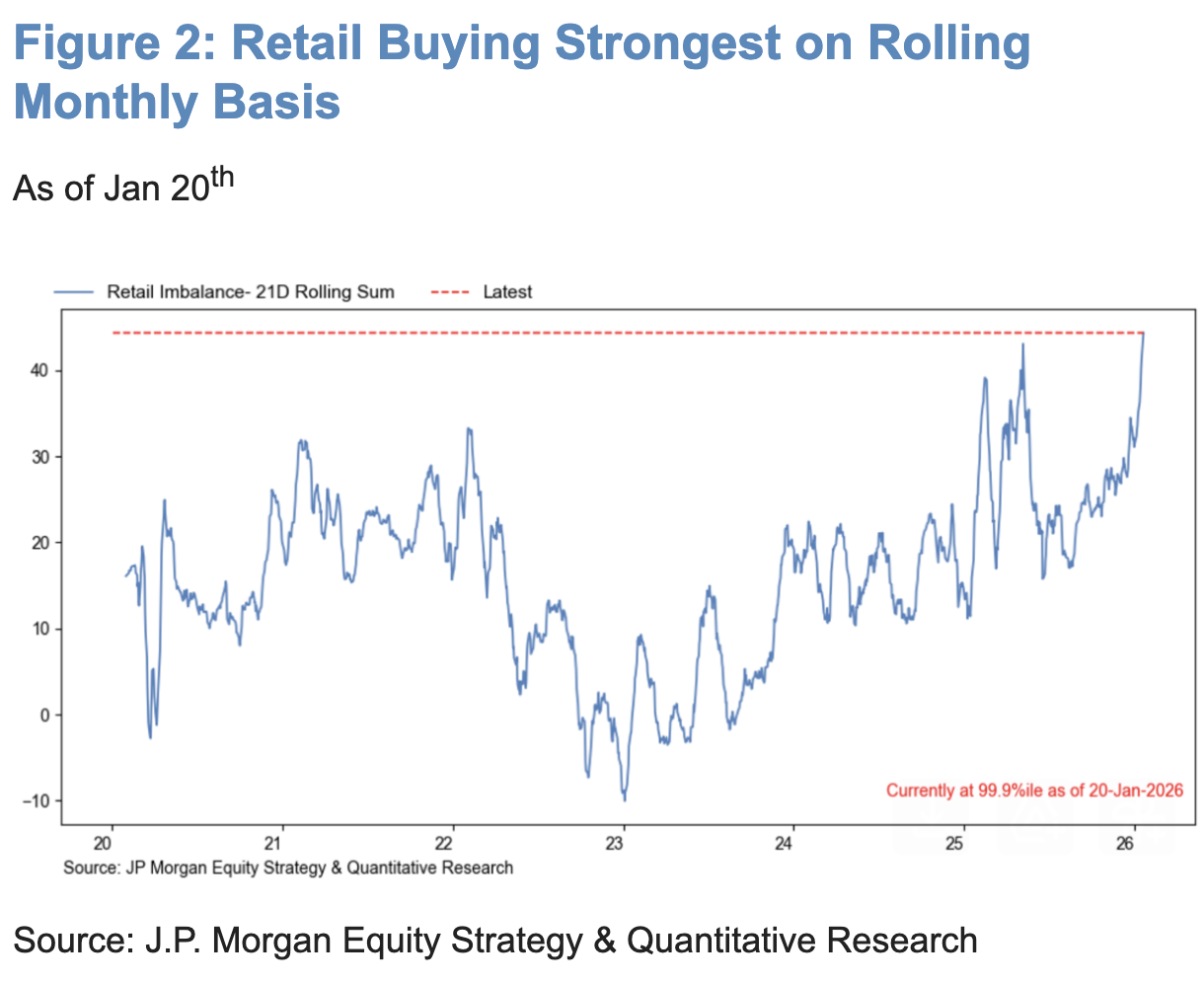
JPM retail demand

Tuesday, when stocks slumped amid tariff and geopolitical tensions, was the third-largest trading day of the past year for retail, per Jain.

An elevated retail presence has unsurprisingly coincided with a strong start to the year for more volatile pockets of the market.

“Improving macroeconomic conditions, firmer growth expectations, and a shift toward more cyclical outcomes have encouraged investors to take on risk,” wrote Dave Mazza, chief executive officer of Roundhill Investments and portfolio manager of the Roundhill Meme Stock ETF. “As confidence has improved, market leadership has broadened beyond mega-cap growth into higher-beta, volatility-sensitive areas.”

In a January 20 email, he flagged Sandisk, Bloom Energy, and Applied Digital as members of the ETF among the chief beneficiaries from “improving price momentum, elevated trading activity, and sustained retail engagement.”

While the current retail footprint in the market has evoked some comparisons to 2021 (well, by me at least), Cboe’s Henry Schwartz, vice president of derivatives market intelligence, pointed out one sign in the options market that there’s less exuberance than in those heady days: the share of single stocks whose calls trade at a higher implied volatility than puts is well shy of its early 2021 peak.
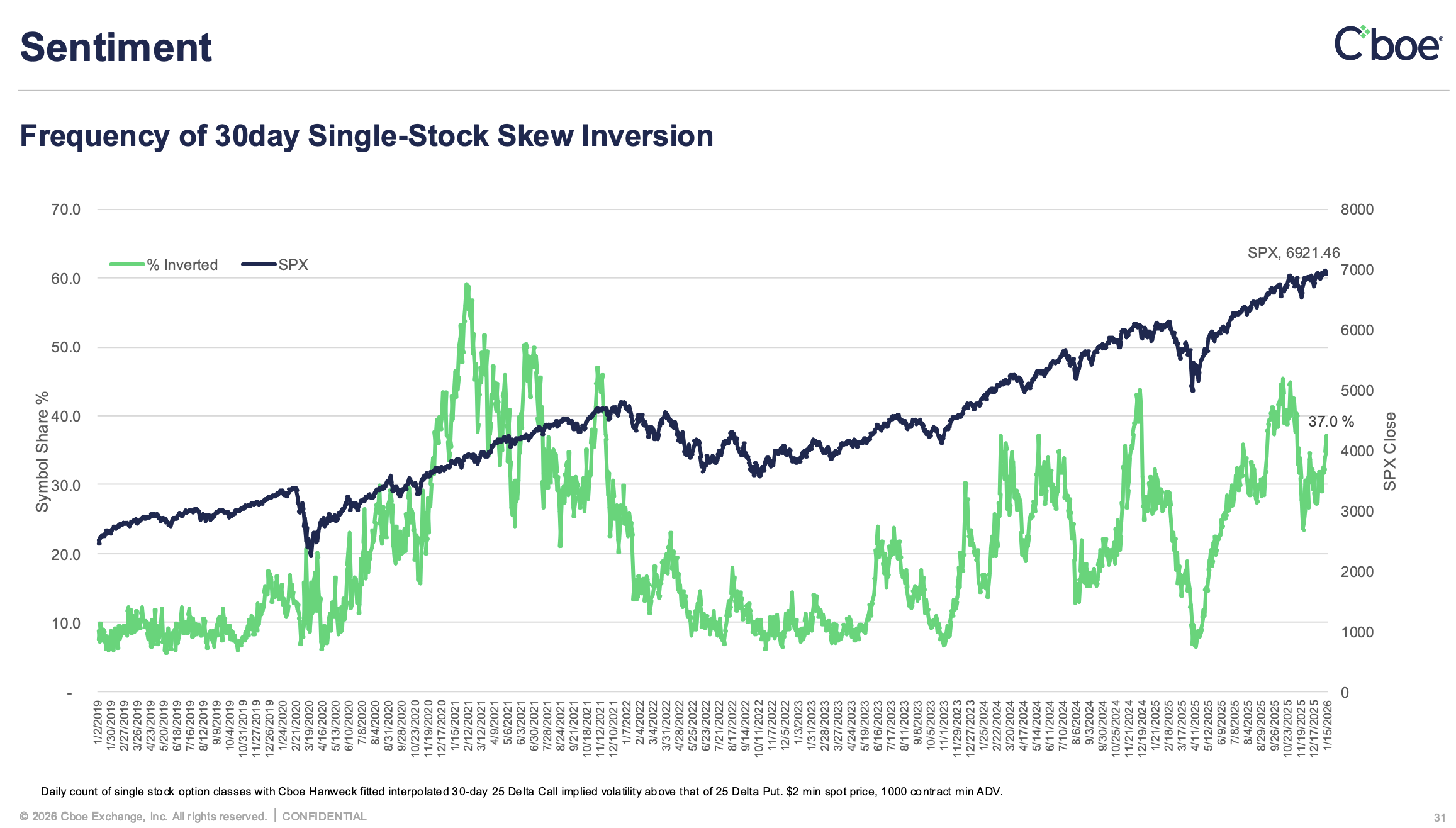
 Single Stock Skew Inversion

More Markets

See all Markets
markets

AI “bottleneck” stocks are the big winners halfway through a tumultuous week

Memory stocks and chip machinery companies are bouncing Wednesday, following a strong Oracle earnings report that bolstered confidence in the durability of the AI data center build-out.

In fact, Sandisk is the top performer of the S&P 500 so far this week, rising more than 21% from Friday’s close, as of shortly after 2 p.m. ET. Memory chip maker Micron is second in line, up more than 13% in weekly gains, and hard disk drive maker Western Digital is also getting a lift.

Other big winners so far this week are some of the so-called semicap shares — makers of the ultraprecise machines that turn silicon into actual semiconductors — with Lam Research and KLA Corp both racking up gains of about 10% on the week. Applied Materials is up about 8% this week.

Thematically speaking, both memory stocks like Sandisk and Micron as well as semicap shares like KLA have been part of the “buy the bottleneck” trade, in which investors buy companies they believe sit at key pinch points in the AI supply chain and therefore have pretty tremendous pricing power. Through that lens, the stocks’ bounce might reflect some additional excitement about the durability of the data center boom after Oracle’s results, which included a larger-than-expected capex number as well as sales guidances that was higher than Wall Street was forecasting.

But the bounce also may be the less interesting market phenomenon of mean reversion rearing its head, as these stocks were also some of the most beaten down in the S&P 500 last week, when Sandisk lost 17% and Lam lost about 15%, for example. So, some snapback may merely be a market reflex.

Other big winners so far this week are some of the so-called semicap shares — makers of the ultraprecise machines that turn silicon into actual semiconductors — with Lam Research and KLA Corp both racking up gains of about 10% on the week. Applied Materials is up about 8% this week.

Thematically speaking, both memory stocks like Sandisk and Micron as well as semicap shares like KLA have been part of the “buy the bottleneck” trade, in which investors buy companies they believe sit at key pinch points in the AI supply chain and therefore have pretty tremendous pricing power. Through that lens, the stocks’ bounce might reflect some additional excitement about the durability of the data center boom after Oracle’s results, which included a larger-than-expected capex number as well as sales guidances that was higher than Wall Street was forecasting.

But the bounce also may be the less interesting market phenomenon of mean reversion rearing its head, as these stocks were also some of the most beaten down in the S&P 500 last week, when Sandisk lost 17% and Lam lost about 15%, for example. So, some snapback may merely be a market reflex.

markets

Papa John’s spikes following report of a $47-per-share take-private offer from Qatari investment fund Irth Capital

A few weeks after announcing it would close 300 stores by the end of next year, Papa John’s is drawing fresh take-private interest from Irth Capital, an investment fund backed by a member of the Qatari royal family.

Papa John’s shares were up 19% on Wednesday afternoon, on pace for their best day since February 2025.

According to The Wall Street Journal, Irth is offering $47 per share for PZZA, valuing the company at about $1.5 billion. The fund currently holds a roughly 10% stake in Papa John’s, per the report.

Irth has tried to take Papa John’s private before, offering $60 per share in a joint bid with Apollo Global in June of last year. In October, Apollo Global again offered to take the company private at $64 per share. That offer was later withdrawn.

Broadly, the pizza category is being increasingly dominated by Domino’s, which opened 700 stores globally last year and has a market cap 9x greater than Irth’s latest reported offer for Papa John’s.

According to The Wall Street Journal, Irth is offering $47 per share for PZZA, valuing the company at about $1.5 billion. The fund currently holds a roughly 10% stake in Papa John’s, per the report.

Irth has tried to take Papa John’s private before, offering $60 per share in a joint bid with Apollo Global in June of last year. In October, Apollo Global again offered to take the company private at $64 per share. That offer was later withdrawn.

Broadly, the pizza category is being increasingly dominated by Domino’s, which opened 700 stores globally last year and has a market cap 9x greater than Irth’s latest reported offer for Papa John’s.

Latest Stories

Sherwood Media, LLC produces fresh and unique perspectives on topical financial news and is a fully owned subsidiary of Robinhood Markets, Inc., and any views expressed here do not necessarily reflect the views of any other Robinhood affiliate, including Robinhood Markets, Inc., Robinhood Financial LLC, Robinhood Securities, LLC, Robinhood Crypto, LLC, or Robinhood Money, LLC.
