
Retail traders are “skipping the dips” to dash for cash and bet against tech stocks
The speculative fever that dominated markets for much of 2025 looks to have broken.
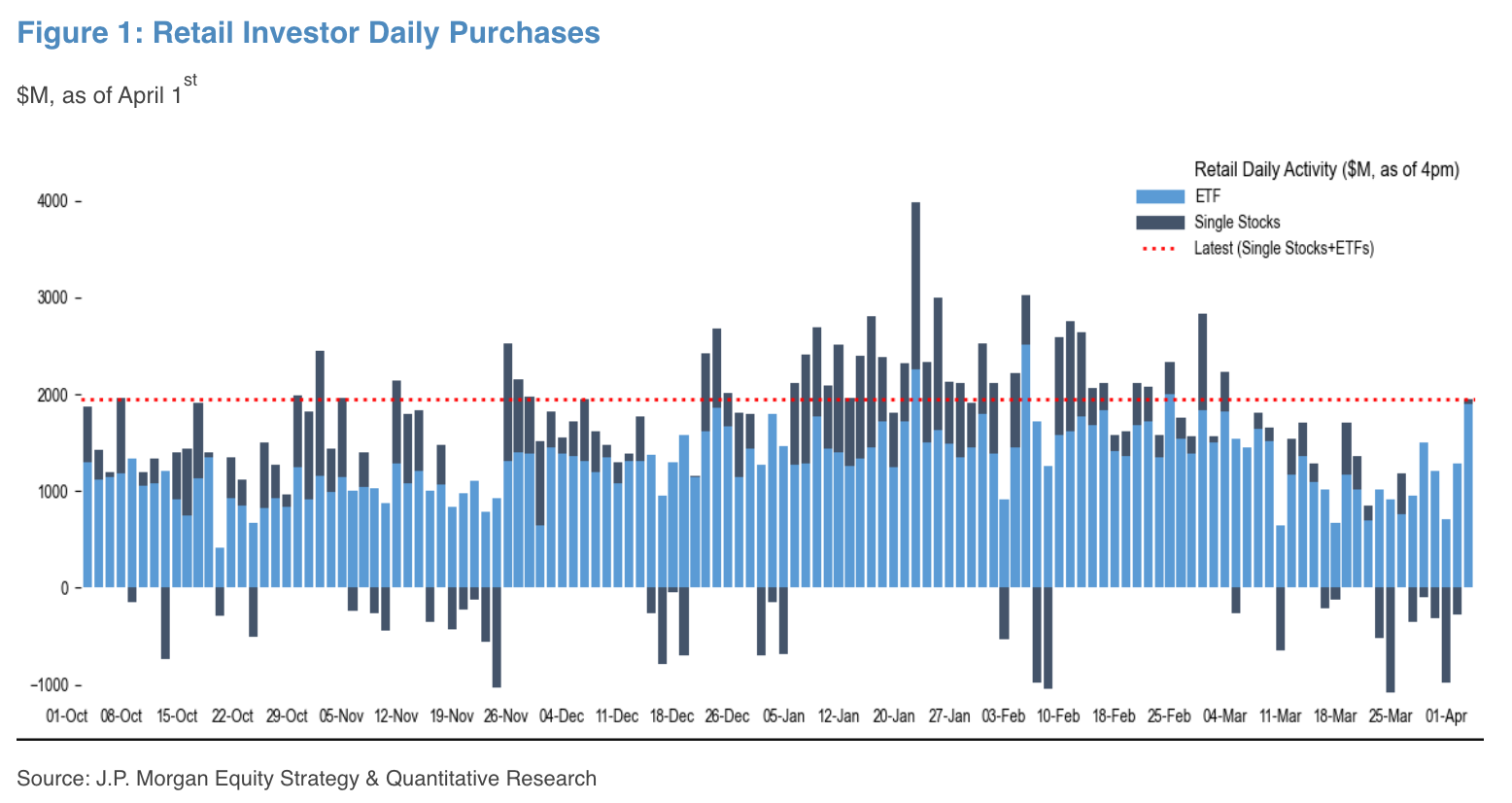
Amid recent market turbulence, retail traders are “skipping the dips, selling into rallies, and positioning more defensively,” writes JPMorgan strategist Arun Jain.
Retail purchases in March were roughly cut in half from January and down 40% from February, per JPMorgan.
And still those headline stats understate how cautious the cohort has been of late.
For instance, two products that the retail community stampeded into on Tuesday and Wednesday were the ProShares UltraPro Short QQQ ETF (3x leveraged short the Nasdaq 100) and the iShares 0-3 Month Treasury Bond ETF (cash, more or less), according to Jain.
In single stocks, Tesla, Nvidia, and Microsoft continue to be bought, but tech more broadly is being sold, with retail positioning in the sector “at its most negative level in six months,” Jain wrote. In particular, Micron and Sandisk have been dumped across the past week on concerns over Google’s TurboQuant algorithm.
Jain’s spotlighting of the newfound risk aversion among retail investors comes roughly a week after Vanda Research said that retail traders had a session in which they sold single stocks, on net, for the first time since November 2023.
Zooming out, the speculative fever that dominated price action for much of 2025 looks to have broken. Call volumes traded across US exchanges (which we highlighted as a key chart to watch for 2026) peaked in October.
That’s also when the Invesco QQQ Trust, Nvidia, bitcoin, quantum computing stocks, and Goldman Sachs’ basket of stocks beloved by retail traders hit all-time closing (or 52-week) highs. (Palantir peaked in early November.)
It will come as absolutely no surprise that another name that reached its zenith along with speculative stocks and bitcoin, the ultimate no-fundamentals asset, is Robinhood Markets, a brokerage that’s become synonymous with retail activity.
(Robinhood Markets Inc. is the parent company of Sherwood Media, an independently operated media company subject to certain legal and regulatory restrictions.)
The put/call ratio suggests bearish activity is now dominant, a rarity over the past six months.