Markets
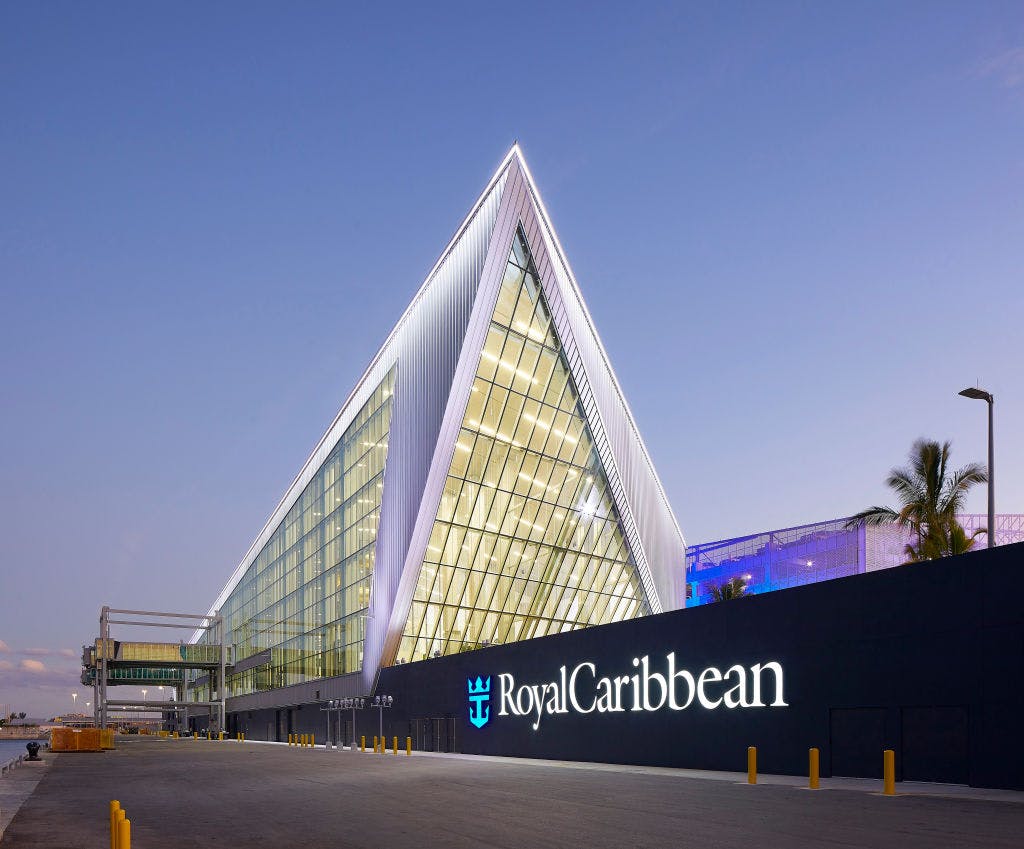
Royal Caribbean Miami Cruise Terminal.
(View Pictures/Getty Images)

Royal Caribbean gets hit with two price cuts as market uncertainty threatens to rock demand

Cruise stocks could have a tough time staying afloat in the near term.

Nia Warfield

Royal Caribbean shares tumbled nearly 6% Wednesday morning, sinking far more than the broader market, after analysts chopped their price target for the cruise line. Morgan Stanley slashed its forecast from $270 to $220 — a steep 18% drop — blaming mounting tariff uncertainty and a dimmer growth outlook.

This follows a similar cut from Stifel, which dropped its target for the cruise giant from $310 to $265 but kept its “buy” rating. Analysts pointed to the rough economic waters and uncertainty over short-term consumer spending. Despite the turbulence, the firm still calls Royal Caribbean “best in class.”

Travel stocks have been caught in the crossfire as tariffs and a slowdown in consumer spending keep the industry on edge. Despite the recent sell-off, Royal Caribbean is sitting on cushy gains of nearly 50% over the past year and is set to report Q1 earnings later this month.

More Markets

See all Markets
markets

Oracle jumps after Q3 results exceed expectations, boost to sales guidance

Oracle had gained nearly 12% in early trading on Wednesday after the company's quarterly results and outlook gave investors reason to cheer.

The hyperscaler reported:

  • Sales of $17.2 billion (estimate: $16.9 billion).

  • Adjusted earnings per share of $1.79 (estimate: $1.70).

  • RPO (remaining performance obligations, or backlog) of $553 billion (estimate: $537.8 billion).

Oracle’s closely watched capex for the quarter was $18.64 billion, above analyst estimates of $14 billion.

Management also raised its sales outlook for the next fiscal year to $90 billion; analysts had expected $86.7 billion.

One year ago, management suggested that its fiscal 2027 top-line growth rate would be around 20%. And last quarter, the company said that 2027 sales would be $4 billion higher than previously expected. Putting this all together, this means Oracle’s previous 2027 sales guidance was in the neighborhood of $84.4 billion ahead of this report.

Breaking down Oracle’s cloud business:

  • Cloud revenue was $8.9 billion, up 44% year on year.

  • Cloud infrastructure revenue was $4.9 billion, up 84% year on year.

  • Cloud application revenue was $4 billion, up 13% year on year.

All of those figures were marginally ahead of estimates.

The cloud company’s elevated indebtedness and expected cash burn compare unfavorably to other hyperscalers, which caused markets to treat its aggressive capex plans as more risky than those of its peers. That’s been exacerbated by OpenAI, itself a cash incinerator, being the source of much of Oracle’s pipeline of future business.

Oracle’s five-year credit default swap spreads widened significantly from mid-September through late January due to this counterparty and credit risk. The company’s perceived creditworthiness recovered after announcing plans to raise money through equity, not just debt, to find its expansion plans, before CDS spreads once again blew out to their widest level since 2009.

“Oracle has been stained by the negative sentiment around OpenAI and is generally viewed as a poster child for AI Capex excess / madness and so a super squeezy rally in the stock could tell us AI Capex fears have peaked for now,” Brent Donnelly, president of Spectra Markets, wrote ahead of this release.

Oracle shares took a beating recently, as a number of analysts have lowered their price targets for the stock, which is down about 56% from its 52-week high of $345.72.

markets

Boeing faces Q1 delivery slowdown after discovering 737 Max wiring issues

Boeing shares dropped on Tuesday following the company’s announcement that it will delay some 737 Max deliveries this month after discovering scratches on wiring within the planes.

According to the plane maker, fixing the issues could take a matter of days for each plane. This could impact March and Q1 delivery figures, but Boeing doesn’t expect yearly totals to be affected.

Boeing is still producing an average of 42 737 Max planes per month, The Seattle Times reported. The FAA raised Boeing’s 737 production cap late last year.

Boeing delivered 51 commercial planes in February, its highest total for the month since 2018. The figure far exceeded the 35 deliveries for Airbus, the company’s European rival.

Boeing is still producing an average of 42 737 Max planes per month, The Seattle Times reported. The FAA raised Boeing’s 737 production cap late last year.

Boeing delivered 51 commercial planes in February, its highest total for the month since 2018. The figure far exceeded the 35 deliveries for Airbus, the company’s European rival.

Tehran’s Shahran oil depot burns after US and Israeli attacks. (Photo by Hassan Ghaedi/Anadolu via Getty Images)

What analysts say they’re looking for next in the oil markets

“It has the makings of a once-in-a-generation market dislocation.”

Latest Stories

Sherwood Media, LLC produces fresh and unique perspectives on topical financial news and is a fully owned subsidiary of Robinhood Markets, Inc., and any views expressed here do not necessarily reflect the views of any other Robinhood affiliate, including Robinhood Markets, Inc., Robinhood Financial LLC, Robinhood Securities, LLC, Robinhood Crypto, LLC, or Robinhood Money, LLC.