
Markets
Brunette crying
(Getty Images)
Wake me up when September ends

Welcome to September, when stocks go usually down

We’re entering a pretty ugly month for financial assets.

Yiwen Lu

Welcome to September. Although given the track record of recent years, perhaps we should say beware, instead: the S&P 500 and the STOXX 600 have lost ground in each of the last 4 Septembers.
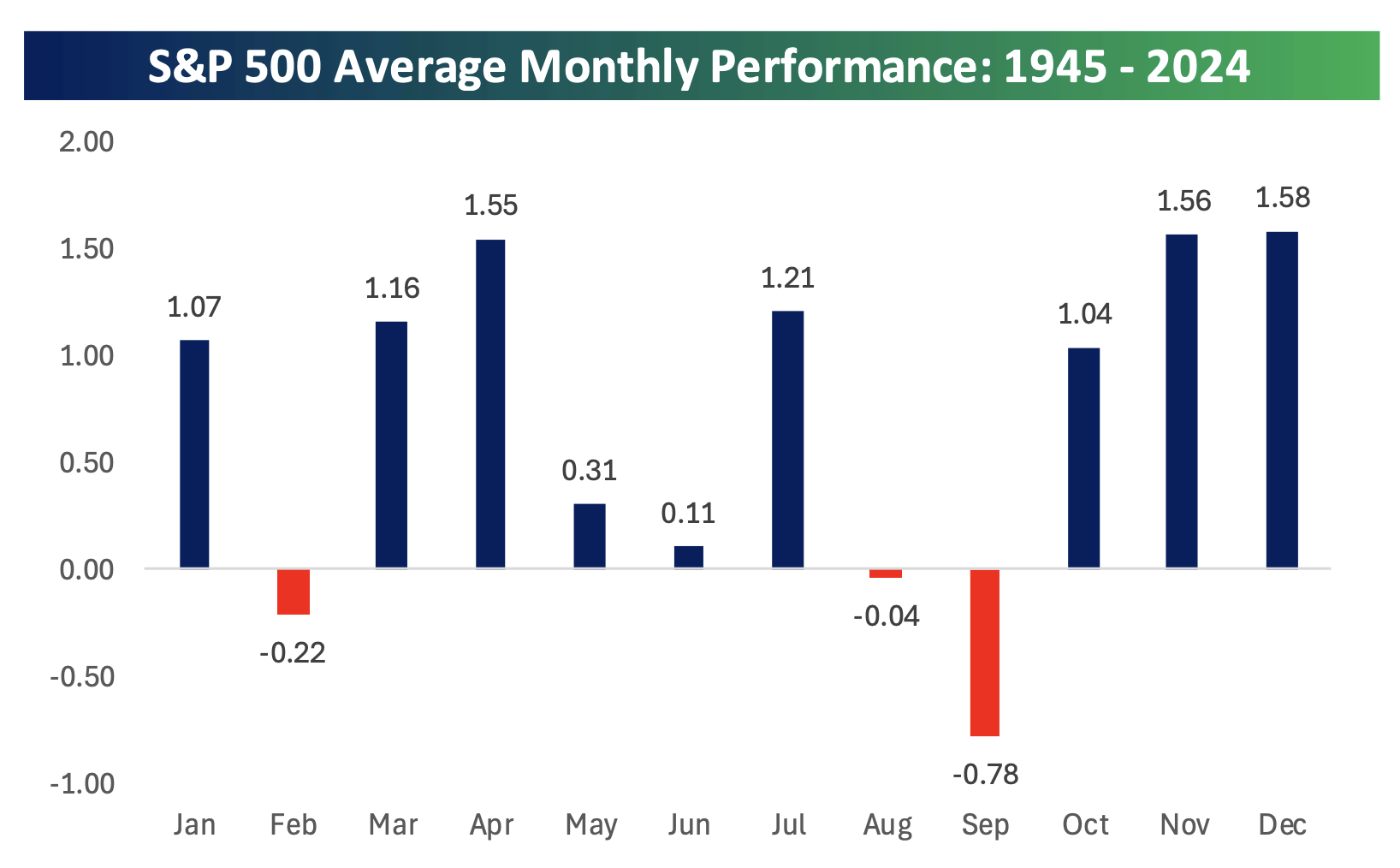
S&P Average Performance
Bespoke Investment Group

And if you’re hoping for respite in fixed income, there hasn’t been any there, either. In fact, Bloomberg’s global bond aggregate is down in each of the last 7 Septembers. So any gains this month would certainly be bucking the trend.
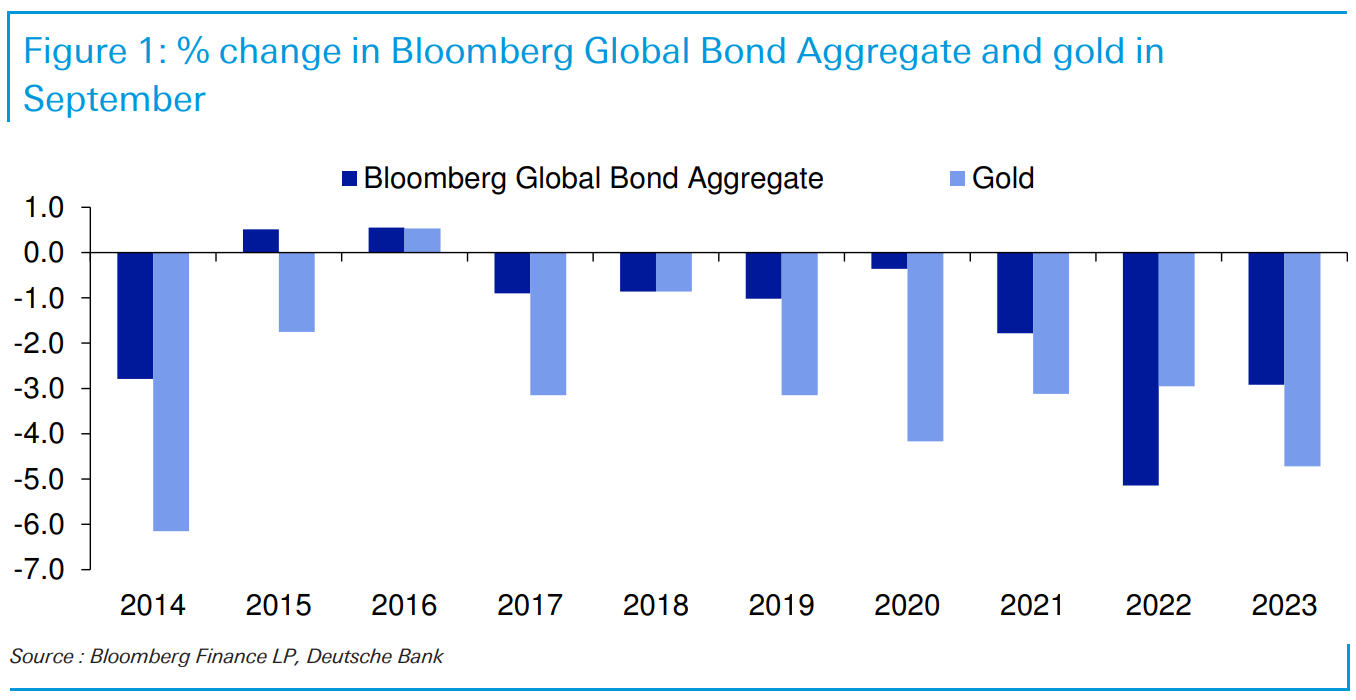
Global Bond Aggregate down in each of the past 7 Septembers, while gold has been lower in 10 of the last 11 Septembers. (Source: Deutsche Bank Research)

Since 1945, the S&P 500 averaged a decline of 0.78% in September. But this negative performance has been exacerbated over the past decade, where the S&P 500’s median performance in September was -2.6%, per Bespoke Investment Group. Only 3 out of 12 months have averaged declines, and September is by far the worst of the three. For the past four Septembers, S&P 500 was down 4.9%, 9.3%, 4.8%, and 3.9%. 

While bulls pushed August into positive territory with a 1.3% gain, “seasonal weakness in September could spoil the momentum,” wrote Adam Turnquist, chief technical strategist for LPL Financial.

One key event this month is the Federal Reserve meeting on September 18, where US monetary policymakers are expected to join many other developed-market central banks in cutting rates. This coincides with the midway point of September, which, historically, is a time when losses begin to crescendo. 
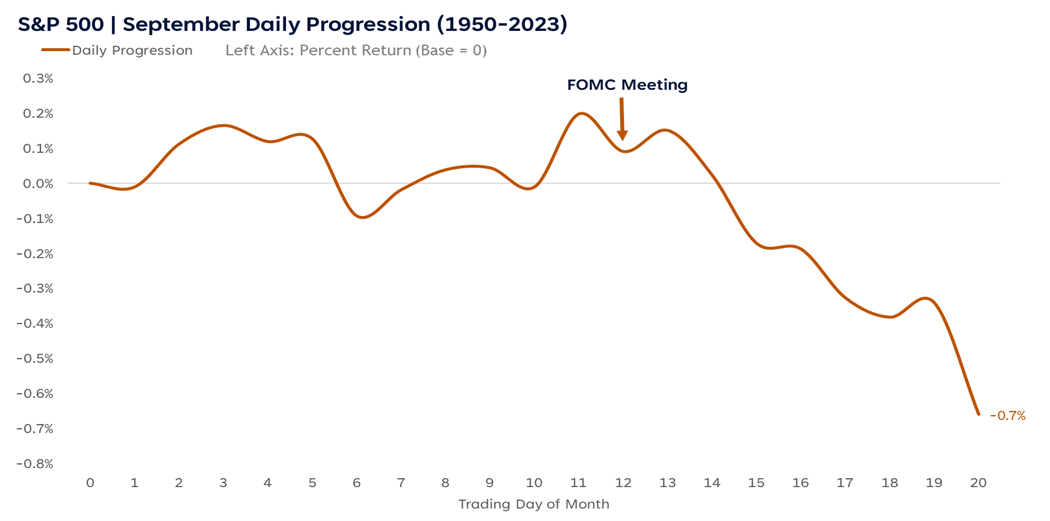
September seasonal setup for S&P 500
(Source: LPL Financial Research; Bloomberg 08/29/24)

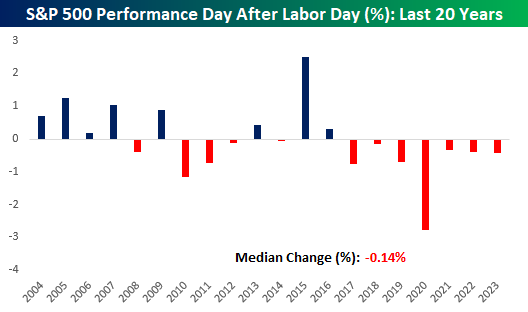
The month is starting just the way you’d expect, given history: S&P 500 is off as much as 1.6% on Tuesday morning. The last time S&P 500 was positive on the first trading day after Labor Day was 2016.
(Source: Bespoke Investment Group)

While everyone is watching seasonality, beneath the hood of the stock market is the big battle: whether tech stocks can carry the rest of the market, or if the world falls off Atlas’ shoulders.

Michael Purves, the founder of Tallbacken Capital Advisors, said that “it’s the elections, not the Fed meeting, which gets our focus.” He noted that if the stocks of the big tech companies couldn’t lead the market, then the overall market could be subject to further volatility due to the election. 

Jim Reid, global head of macro research at Deutsche Bank added that the end of September will mark a five-week countdown to the US election, and close races usually lead to lower stock markets before a rally. 

The final week of August showed how Magnificent Seven stocks dragged the S&P 500 lower, even the majority of S&P 500 stocks went up. Nvidia’s earnings report, which disappointed relative to high expectations, will “contribute to the whipsaws on the index level and delay re-entry to all-time high territory,” according to John Kolovos, the head of technical strategy at Macro Risk Advisors.

More Markets

See all Markets
markets

Chinese tech giants rally after hiking AI prices

ADRs of Alibaba and Baidu are gaining in early trading after the Chinese tech giants announced AI price hikes.

Alibaba said that it’s hiking the price of its AI chips by up to 34% and raising the cost of cloud storage by 30%, with Baidu planning on increasing AI cloud product prices by up to 30%.

Tech companies in China and the US are aiming to show that AI is not just a technological breakthrough but also a core tool for moneymaking. And, well, raising the price of what you sell is one of the most basic ways to make more money!

“Baidus decision to raise AI cloud product prices by as much as 30%, according to Bloomberg News, is a positive development that signals a shift toward monetization rather than price competition,” wrote Bloomberg Intelligence analysts Robert Lea and Jasmine Lyu. “Baidus move mirrors similar steps by Tencent, Alibaba, and Zhipu, catalyzed by surging demand for agentic AI following the launch of OpenClaw.”

markets

The Iran war is producing the sharpest spike in US gas prices since Hurricane Katrina

The average US national gas price jumped a little more than $0.05 to $3.84 on Wednesday, per the American Automobile Association, its highest level since September 2023.

While front-month West Texas Intermediate futures have come off the boil, down roughly 20% from their March 8 peak, front-month gasoline futures are trading about 2% shy of their 2026 peak as of 8:20 a.m. ET.

Prediction markets currently imply that gas prices will end the month near (but below) $4.30 per gallon.

(Event contracts are offered through Robinhood Derivatives, LLC — probabilities referenced or sourced from KalshiEx LLC or ForecastEx LLC.)

Prices are up nearly 29% over the past 20 days, per AAA, making this the sharpest such rise in fuel costs in more than two decades.

Hurricane Katrina, which made landfall in the US in late August 2005, was one of the deadliest and costliest natural disasters in American history. The damage wreaked havoc on energy infrastructure in the region, prompting gas prices to jump above $3 per gallon by early September from less than $2.30 in early August.

markets

Oklo up as analysts spotlight “permits progress”

Oklo shares crept up early Wednesday after reporting a wider-than-expected full-year loss Tuesday after the close.

The company isn’t well covered on Wall Street, but a smattering of analysts spotlighted growing capex plans by the company — which not only has no profits, but no revenues — as a potential issue. On the other hand, they gave credit to the nuclear power startup for progress in securing key government permits and approvals.

Barclays (price target of $82, “overweight rating): “Oklo advanced its momentum with DOE approval of a nuclear safety design agreement for Aurora at INL [Idaho National Laboratory], paving the way for 2028 operations. Management guided higher 2026-27 capex, strengthened fuel supply investments, and enters 2026 with an increase in liquidity.”

Citi (price target $73.50, “neutral/high risk” rating): “Despite strong execution, reaction may skew negative given higher than anticipated 4Q Opex, continued capital raise in Jan, and robust 2026 capex.”

Needham & Co. (price target $73, “buy” rating): “The company did not disclose Aurora unit costs, FY2026 CapEx ($350–450MM) came in above expectations, and [Aurora/Idaho National Laboratory] timing shifted modestly to 2028. We lower our PT to $73 (from $135) on reduced outer-year deployment (~3 GW by 2035) and a lower multiple, but maintain Buy. Execution, cost visibility, and fuel supply remain key gating factors.”

As of December 31, 2025, the company was well capitalized to continue burning cash, reporting cash and marketable securities worth some ~$1.4 billion.

Barclays (price target of $82, “overweight rating): “Oklo advanced its momentum with DOE approval of a nuclear safety design agreement for Aurora at INL [Idaho National Laboratory], paving the way for 2028 operations. Management guided higher 2026-27 capex, strengthened fuel supply investments, and enters 2026 with an increase in liquidity.”

Citi (price target $73.50, “neutral/high risk” rating): “Despite strong execution, reaction may skew negative given higher than anticipated 4Q Opex, continued capital raise in Jan, and robust 2026 capex.”

Needham & Co. (price target $73, “buy” rating): “The company did not disclose Aurora unit costs, FY2026 CapEx ($350–450MM) came in above expectations, and [Aurora/Idaho National Laboratory] timing shifted modestly to 2028. We lower our PT to $73 (from $135) on reduced outer-year deployment (~3 GW by 2035) and a lower multiple, but maintain Buy. Execution, cost visibility, and fuel supply remain key gating factors.”

As of December 31, 2025, the company was well capitalized to continue burning cash, reporting cash and marketable securities worth some ~$1.4 billion.

markets

Rocket Lab drops after announcing at-the-market offering to sell up to $1 billion of equity

What goes up must come down, and that’s exactly whats happened with Rocket Lab shares over the last day or so.

Following a rally that saw the stock rise more than 10% on Tuesday, Rocket Lab shares came back down to earth in after-hours trading, after the company filed an offering that could see it sell as much as $1 billion in common stock over time. RKLB is down about 3% in premarket trading on Wednesday, as of 6:30 a.m. ET.

In the after-hours filing, the space company wrote that it would use proceeds from the offering to “fund future growth, including potential future acquisitions, and for general corporate and working capital purposes.” Rocket Lab’s Neutron rocket, which will be key in any path to profitability that the cash-burning business may forge, was delayed again last month, sending shares down at the time.

RKLB was involved in a wider space, satellite, and drone stock surge yesterday, as investors rallied around the sectors amid the ongoing war in Iran. The FAA had also announced new streamlined launch licensing requirements that will affect companies like Rocket Lab, Firefly Aerospace, and SpaceX. Per the FAA, the new rule, dubbed “Part 450,” will:

“...reduce the number of times an operator needs an FAA license approval and allow one license for a portfolio of operations, different vehicle configurations and mission profiles, and even multiple launch and reentry sites.”

That should cut down on the administrative burden on the industry more broadly.

Latest Stories

Sherwood Media, LLC produces fresh and unique perspectives on topical financial news and is a fully owned subsidiary of Robinhood Markets, Inc., and any views expressed here do not necessarily reflect the views of any other Robinhood affiliate, including Robinhood Markets, Inc., Robinhood Financial LLC, Robinhood Securities, LLC, Robinhood Crypto, LLC, Robinhood Derivatives, LLC, or Robinhood Money, LLC. Futures and event contracts are offered through Robinhood Derivatives, LLC.