Markets
SEAGAMES-2025-THA-FBL
Don’t look so sad, that’s worth A LOT (Lillian Suwanrumpha/Getty Images)

Silver’s parabolic surge to record suddenly reverses

Silver is being talked about way more than gold, Nvidia, and Tesla combined on r/WallStreetBets.

Silver won the gold medal, but now looks to be falling off the podium.

Gold’s non-redheaded stepchild surged to a record high of $84 per troy ounce on Sunday evening, before reversing violently to trade nearly 10% lower than where it ended Friday.

The iShares Silver Trust is by far the most discussed instrument on Reddit’s r/WallStreetBets subreddit over the past 12 hours, with references to its ticker, SLV, more than quadrupling those of the SPDR Gold Shares ETF, Nvidia, and Tesla combined over the past 12 hours, as of 10 a.m. ET.

Even with today’s tumble, silver is still trading about 30% above its 50-day moving average, and has more than doubled year to date.

However, commodities are starting the week off on a rough note amid this silver reversal as well as hopes of progress on Russia-Ukraine peace talks. The Chicago Mercantile Exchange has also raised the margin requirements for positions in silver futures (as well as a host of other metals contracts) on Friday, effective today. Higher margin requirements can crimp speculative appetite by forcing weaker hands out of their positions.

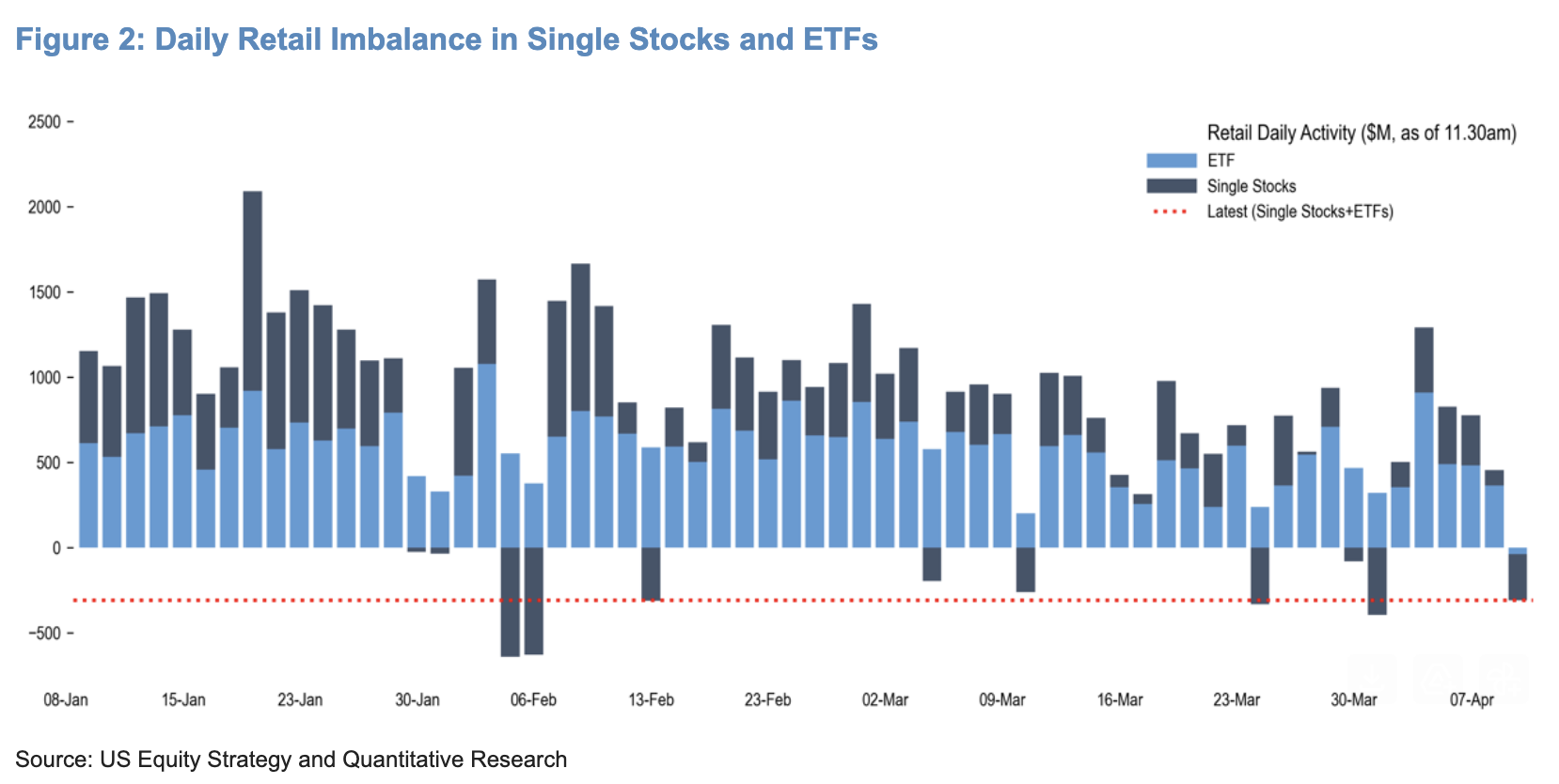
All this retail chatter about silver has been reflected in flows: JPMorgan strategist Arun Jain noted that on December 26 — typically a very sleepy session — retail inflows into commodity ETFs were north of $223 million, or in the 99.6th percentile relative to their one-year average. That came on the heels of a 95th percentile inflow on Tuesday, the last full trading day before the holidays. Retail’s penchant to ride momentum in metals has been a big boon to their performance this year.

But just because it looks like a meme stock move that’s passed its best-before date doesn’t mean there’s no (good) fundamental story to help explain the prior surge.

The silver linings, for bulls, are that this drop comes on the heels of an eye-popping run and that indicators of physical demand still look robust.

Physical silver products (such as coins and bars) typically command a premium to the spot price quoted in markets, and right now those premiums are unusually large: upward of $10 for American Silver Eagle Coins, with silver bars are being marketed for “as low as $8.99 per bar over spot” on APMEX.

Silver futures in Shanghai are trading in backwardation (that is, a downward sloping curve). The willingness to pay up more for silver now versus later is generally considered to be a bullish signal in the commodities space. China also announced that it’s rolling over export restrictions on silver in the new year, prompting Tesla CEO Elon Musk to tweet, “This is not good.” In London, spot silver is also trading above the forwards, sending a similar message about the strength of near-term demand relative to supply.

Black Snow Capital founder Alexander Campell, formerly head of commodities at Bridgewater, has been bullish on silver in light of its industrial uses (particularly in solar panels) as an energy-hungry AI boom looks to devour more and more power.

“The case for silver is that the economics of solar panels (inelastic demand as the silver is/was ~10% of the price of the panel) meets inelastic supply (remember 75% of production comes as a by product to other metals), not staring at tea leaves or lines on a chart,” he posted in a recent message on X. “These are the kind of things that drive short term price movements.”

Nevertheless, given the extreme nature of this run-up followed by the subsequent sharp reversal, there are some who are willing to say the party’s likely over.

“Tax-related (delayed) selling and Bloomberg Commodity Index rebalancing could be negatives for silver in the first two weeks of January 2026,” wrote Brent Donnelly, president of Spectra Markets, who said he’s short silver as of Friday, before going on to allude to Radiohead. “The silver chart looks like a massive Sunday night blowoff top similar to the one oil made after Russia went into Ukraine. Sunday night blowoffs are special. I wish I was special.”

More Markets

See all Markets

Airline stocks dip as US-Venezuela tensions send oil prices climbing

Oil prices are climbing on Monday as tensions between the US and Venezuela escalate, threatening to tighten global supply. West Texas Intermediate crude futures were up more than 2.6% in morning trading.

What’s good for crude isn’t ideal for airlines, which could see higher fuel costs. Shares of several major airlines are down on the price action, including Delta Air Lines, United Airlines, American Airlines, and JetBlue.

Scoop Full of Money

RBC Capital Markets’ US strategist sees big stock gains in 2026

But will it be the year the Magnificent 7 finally lose their position as market leaders?

RUSSIA-LIFESTYLE-NEW YEAR

The top 5 charts to watch for 2026

Hyperscaler valuations, retail’s option-trading binge, downstream AI spending, the bitcoin versus gold battle, and credit-sensitive pockets of the US stock market.

markets
Luke Kawa

If this really is an AI bubble, let’s see some more inflation

If the AI trade were to have already peaked, we’d probably retroactively refer to this stretch as a mix of an earnings bubble (like the period of over-earning based on some unsustainable credit trends that preceded the financial crisis) and a valuation bubble (like the dot-com boom, where rapidly expanding price-to-earnings ratios were the key driver of explosive gains).

But if we’re doing anything close to running back the late ’90s, well, this bubble is going to get some more air to inflate it.

The so-called “Fed model” used to value the S&P 500 by subtracting its expected earnings yield from bond yield currently sits at about 0.35% in nominal terms and 2.6% in real terms, versus lows of -2.75% and -0.4%, respectively, during the dot-com episode. Lower readings indicate a higher willingness to buy risky securities relative to risk-free US government obligations.

In a recent report, Bank of America equity derivatives strategists led by Benjamin Bowler wrote:

“The AI revolution represents another profound technological leap, one that we think is likely to also result in an asset bubble. Strikingly, the late 90s analogy suggests that 2025 is tracking 1996, an interesting parallel even if coincidental. Moreover, a unique tailwind this time is the amplification coming from government support and the perceived existential threat AI dominance presents to geopolitical power. In our view, the likelihood of avoiding a significant asset bubble in AI seems low given this backdrop.”

Using its in-house methodology for assessing whether assets are in a bubble, they judge that “​​the core of the AI trade in the S&P, Nasdaq and the Magnificent 7 stocks remains far from these levels,” which suggests “the AI trade may still have room to run into 2026.”

Indeed, none of the publicly traded hyperscalers has a forward price-to-earnings ratio anywhere near Cisco’s peak of over 130 during the dot-com bubble.

Amazon, Meta, Google, and Microsoft don’t really trade at ridiculously high multiples on this metric, relative to their own history or the S&P 500. But for all except Amazon, these stocks have set fresh valuation peaks based on price to estimated free cash flow in 2025, data from Bloomberg shows.

(Oracle seems to be its own kettle of fish, so we’ll leave that alone to its Sam Altman-filled sea of doubts and debt here).

The difference here is capex, which weighs on earnings over time via depreciation expenses but impacts how much money is going in and out of the door immediately.

Ryan Cummings, chief of staff at the Stanford Institute for Economic Policymaking, notes that AI isn’t anywhere close to the lion’s share of sales or earnings for these firms, and estimates that AI-centric sales are being far outstripped by AI capex.

That’s pretty reasonable, considering that we’re still arguably in the early stages of pushing this technological frontier and that a good chunk of this spending is dedicated to making AI models better — putting them in a position where they will be bigger drivers of financial performance going forward.

One way to square this circle between elevated, not crazy forward valuations based on one metric and sky-high ones based on another is to conclude that the lack of runaway forward price-to-earnings ratios suggests that the market does continue to have some skepticism about the long-term earnings power associated with all these capital outlays.

Less doubt would equal higher valuations and higher stock prices. No doubt and unbridled optimism about how much these first movers in AI will reap rewards for years if not decades to come… that’s how we really get a bubble.

“Big Tech has compelling valuation on a growth-adjusted P/E basis, but free cash flow yields are hardly attractive,” wrote Michael Purves, CEO of Tallbacken Capital Advisors. “Ultimately, this valuation methodology debate boils down to the question of whether this massive capex spend will generate compelling returns on invested capital (ROIC). While we won’t know the answer to this ROIC question for some time, we expect the mere existence of this critical question to hover over the markets for some time.”

Latest Stories

Sherwood Media, LLC produces fresh and unique perspectives on topical financial news and is a fully owned subsidiary of Robinhood Markets, Inc., and any views expressed here do not necessarily reflect the views of any other Robinhood affiliate, including Robinhood Markets, Inc., Robinhood Financial LLC, Robinhood Securities, LLC, Robinhood Crypto, LLC, or Robinhood Money, LLC.