

Markets
markets

Spotify soars as Q4 monthly average user growth and gross margins set records

Music streamer — and soon to be physical book sellerSpotify reported impressive Q4 results on Tuesday that are sending shares up 15% in premarket trading.

Spotify said it added more than 38 million monthly active users, a quarterly record that brought its total to 751 million. Wall Street analysts polled by FactSet expected 744.7 million. The number of premium, paying subscribers grew 10% to 290 million, slightly better than estimates of 289.4 million. Revenue for the quarter rose 7% to €4.53 billion (~$5.4 billion), which fell broadly in line with estimates, while its 33.1% gross margin figure was also a new company record.

Looking ahead to the current quarter, Spotify forecast an addition of 8 million net monthly active users for a 759 million total (vs. the 752.7 million expected). The streamer guided for 293 million premium subscribers in Q1, compared to the 293.5 million consensus estimate.

The company, which raised its US subscription prices this month, expects to book €4.5 billion, or $5.36 billion, in Q1 revenues. Wall Street expected €4.58 billion, or $5.41 billion.

With the global population sitting at just over 8 billion per the latest estimates, Spotify’s new figures imply that roughly 1 in 11 people now uses the streamer each month.
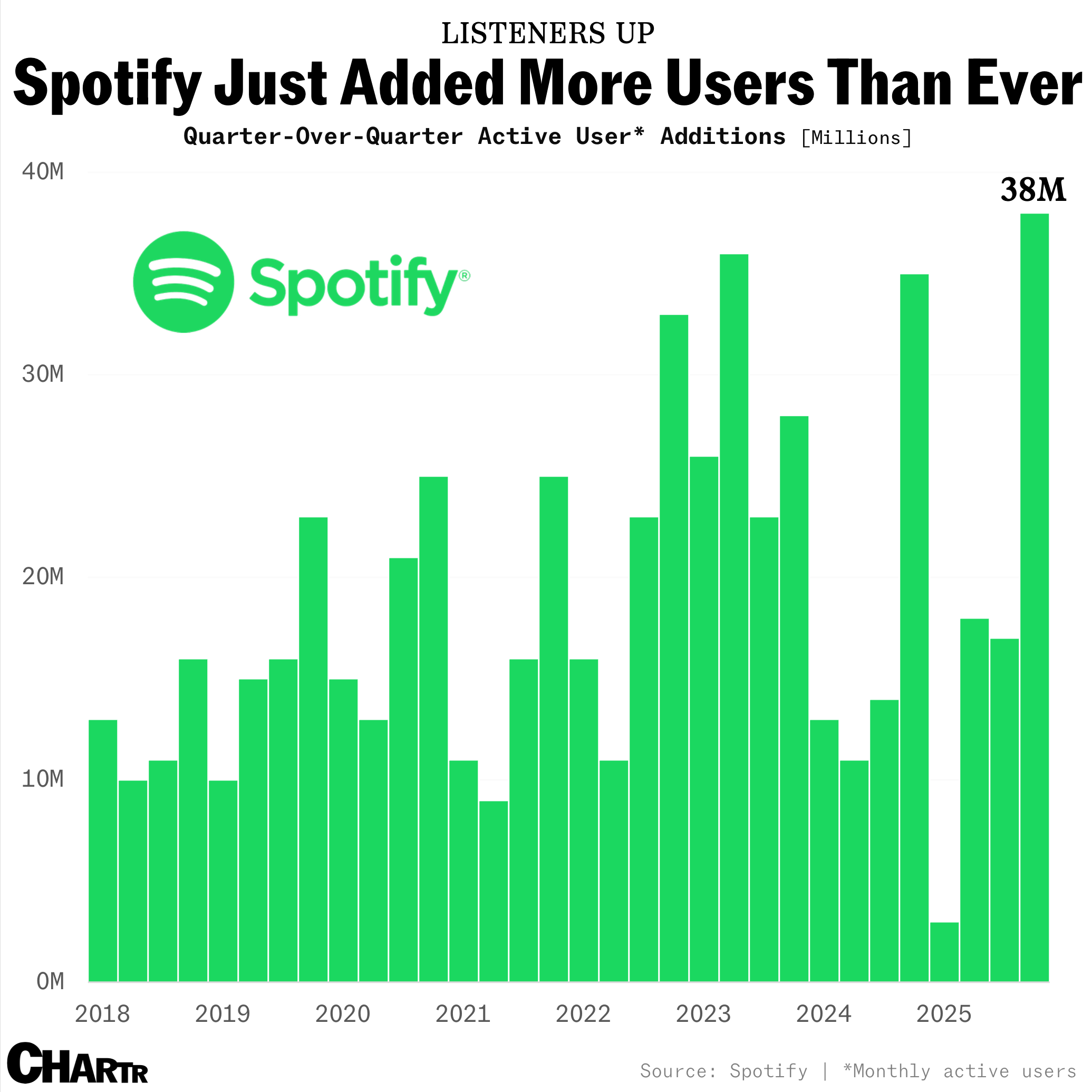
Spotify monthly active user chart
Sherwood News

More Markets

See all Markets
markets

Eos Energy Enterprises soars on joint venture with Cerberus for energy storage and Q1 revenue beat

Eos Energy Enterprises is surging in premarket trading after the company reported better-than-expected Q1 sales and unveiled a joint venture with a major alternative investment firm for battery energy storage projects.

The key Q1 numbers:

  • Revenue of $57 million (compared to analyst estimates of $54.27 million).

  • Adjusted earnings per share of $0.12 (estimate: a $0.20 loss), which was juiced by a noncash change in fair value based on the change in EOSE’s share price.

Concurrently with earnings, Eos and Cerberus Capital Management announced the formation of a joint venture called Frontier Power USA, which will be a stand-alone, purpose-built Independent Power Producer to be supplied through a 2-gigawatt-hour capacity reservation agreement with Eos.

“Frontier Power USA is expected to deploy this capacity across commercial and industrial applications, AI data centers, and utility-scale projects, drawing from a multi GWh project pipeline which is under active development,” per the press release.

To support the platforms launch, Cerberus has committed $100 million in equity, and, to underscore its confidence in Eos, extended its stock lockup agreement through the end of 2026. Eos plans to launch a rights offering to raise $150 million to support this JV.

“The market is telling us what it needs: long-duration storage that is safe, American-made, and financeable at scale,” said Joe Mastrangelo, CEO of Eos. “We have the technology, the manufacturing, the controls, and now, with Frontier Power USA, the planned capital to accelerate project deployment.”

Last month, Eos also announced a joint development agreement with Turbine-X Energy. The partnership focuses on deploying zinc-based battery storage solutions for AI hyperscale data centers, with a target capacity of up to 2 gigawatt-hours beginning in 2027.

For the full year in 2026, Eos expects to achieve revenue between $300 million and $400 million, in line with its previously provided guidance.

markets

EchoStar rises as FCC approves $40 billion wireless spectrum sale to SpaceX and AT&T

EchoStar is up more than 7% in premarket trading Wednesday after the FCC said on Tuesday that it had approved the telecommunications company’s roughly $40 billion spectrum sale to SpaceX and AT&T, saying the two deals would “accelerate Internet speeds, strengthen competition, and bolster rural service.”

According to the FCC’s two separate orders, AT&T is buying about 50 megahertz of EchoStar’s nationwide spectrum for roughly $23 billion to expand its 5G network, while SpaceX is buying about 65 megahertz of EchoStar’s spectrum for around $17 billion to support Starlink’s next-generation direct-to-device service.

The approval caps a yearlong FCC review of EchoStar’s wireless spectrum licenses, which drew intervention from President Trump, who encouraged the company and FCC Chair Brendan Carr to reach an “amicable resolution.”

Still, the approval comes with a major condition: the FCC requires EchoStar to set up a $2.4 billion escrow account to cover potential obligations tied to disputes over work under its spectrum licenses — a requirement EchoStar called “unprecedented,” adding that it’s “evaluating next steps.”

markets

Oklo whipsaws after posting slightly worse-than-anticipated Q1 loss

Nuclear energy company Oklo is whipsawing in postmarket trading after posting Q1 results.

Here are the key first-quarter numbers: 

  • Net income of -$33.1 million, or a $0.19 loss per share (compared to analyst estimates of -$29.5 million in income and a $0.19 loss per share).

Shares of America’s most valuable zero-revenue company were down over 2% just after the bell before rebounding to trade 3% higher, and then fell into the red again; its price-to-sales ratio remained unchanged throughout.

Oklo is a longtime retail darling. The reaction to these results can be a good read into traders’ appetite for speculative investments, which is probably more useful information than knowing precisely how much money it lost in a three-month period.

Not content with merely powering the AI boom at some point in the future, Oklo also plans on utilizing the technology to develop its reactors. Ahead of its earnings announcement on Tuesday, management teased new AI-integrated workflows for Oklo’s up-and-coming facilities:

“The project scope includes the development and application of technical guidance on model setup, benchmarking and validation strategies, and AI agents to accelerate existing workflows.” 

Last week, Oklo announced that it had cleared another regulatory hurdle for its Aurora Powerhouse reactor, currently under construction in Idaho. The nuclear reactor would, if completed, could produce up to 75 megawatts of electricity using Oklo’s small, fast-fission technology, enough to power tens of thousands of homes or cater to the high energy demands of AI data centers. 

Oklo and companies like NuScale and TerraPower have benefited from the Trump administration’s streamlined permitting process. And as AI data centers continue to push up demand, Oklo is up over 150% over the past year.

Latest Stories

Sherwood Media, LLC and Chartr Limited produce fresh and unique perspectives on topical financial news and are fully owned subsidiaries of Robinhood Markets, Inc., and any views expressed here do not necessarily reflect the views of any other Robinhood affiliate, including Robinhood Markets, Inc., Robinhood Financial LLC, Robinhood Securities, LLC, Robinhood Crypto, LLC, Robinhood Money, LLC, Robinhood U.K. Ltd, Robinhood Derivatives, LLC, Robinhood Gold, LLC, Robinhood Asset Management, LLC, Robinhood Credit, Inc., Robinhood Ventures DE, LLC and, where applicable, its managed investment vehicles.
