
Markets
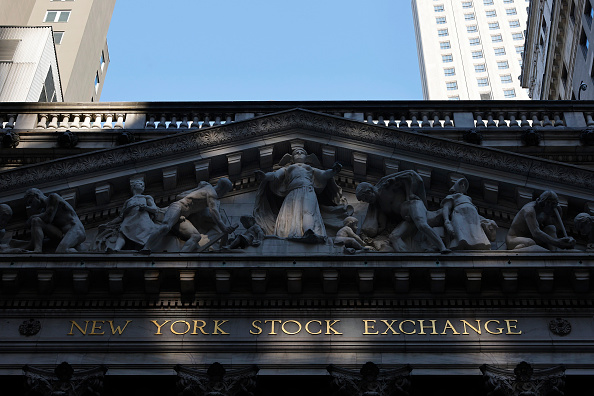
New York Stock Exchange Opens On Monday Morning
(Getty Images)

Earnings are absolutely off the charts this year

In case you were losing sleep about the ability of America’s largest and most powerful corporations to continue growing record profitability, you can rest easy.

Roughly halfway through first-quarter earnings season, Wall Street analysts have ratcheted up their expectations for earnings over the next twelve months. That’s been the reaction to results now for well over the last year. (See below.)

This is maybe the simplest way to quickly decide if earnings season has been good, bad or meh. If, after earnings season starts, the angle of this line moves higher, that means analysts are generally pleased with what they’re seeing in numbers and hearing from executives on conference calls. That seems to be what we’ve seen since the current crop of results starting rolling in earlier in April.

For the record, expectations for earnings rise most of the time, the key thing to watch is how fast they’re going up. This reflects the fact that earnings generally rise, and earnings generally rise, because prices generally rise. (Higher prices typically translates into higher revenues and profits.)

If expectations for earnings fall sharply, it’s usually because something pretty bad has happened, like the financial crisis, the Great Recession or more recently, the outbreak of Covid.


More Markets

See all Markets
markets

Palantir continues to dive as retail favorites, momentum stocks get hit

Palantir’s market pounding continues, as the intelligence, defense, and commercial AI software company slumps along with other retail favorites, bitcoin, and high-beta momentum trades such as space plays AST SpaceMobile and Rocket Lab, and quantum computing trades D-Wave Quantum and Rigetti Computing through the first half of Thursday’s session.

Palantir partisans could credibly argue that Alex Karp’s company shouldn’t be lumped in with that sort of crowd, some of which are a long way from profits, when Palantir has posted outstanding financial performance in recent quarters. But the market doesn’t seem to be listening — or at least, has stopped hearing reassurance after the stock’s massive run-up.

Thursday’s drop of more than 5% — shortly before 12 p.m. in New York — brings its cumulative losses to more than 35% since its November 3, 2025, all-time closing high. And that’s done considerable amounts of damage to the technical backdrop for the shares.

Late last month, Palantir traded far below its 200-day moving average, a key level of technical support that had held since May 2023, when the shares first started to gather steam. A break below the 200-day moving average underscores a serious loss of momentum for a stock, and can prompt some traders to reconsider their views on whether a stock that has been a winner has truly lost its mojo.

markets

How the character of the AI trade has changed — for the worse — in 2026

A smattering of observations on how the character of the AI trade has changed this year — with, obviously, some of these trends not having waited for a full turn of the Earth around the sun to start to establishing themselves:

  • All the bullish oxygen is being sucked out of the room and squarely into the memory chip shortage, which is offering bumper profits for a handful of firms. On a related note, semicap equipment stocks have been an upstream beneficiary of this dynamic. The underlying message is that near-term scarcity is being rewarded by the market.

  • That the big capex spenders will generate a high return on investment from their outlays is not something traders are willing to take for granted. Big budgets are not necessarily getting applauded; even companies that seemingly earn the benefit of the doubt by posting accelerating revenue growth, à la Meta, aren’t able to maintain those gains for long.

  • The big “consumers” of memory chips are getting squeezed. This includes the hyperscalers, obviously, but even more so the likes of Qualcomm, which has to wait behind these giants in line for supplies, which played a role in the company’s underwhelming outlook.

  • For public markets, the theme is more of a net negative than a positive. Firms seen as the most likely to be disrupted by AI (basically, the entire software industry) are getting indiscriminately clobbered, regardless of how good their quarterly results and guidance are.

  • The facilitators of disruption, in many cases, have not yet arrived on public markets but plan to do so this year. That’s SpaceX/xAI, OpenAI, and Anthropic. So if the AI theme has seemed a little “negative sum” in this year, that might be about the room that investment firms know they’re going to need in their portfolios to add these stocks once they’re able to (or, in some cases, ahead of time).

  • And this isn’t really a 2026 dynamic, strictly speaking, but the two biggest chip companies have been dead money for months. Since the end of Q3, Nvidia and Broadcom are both negative, with the S&P 500 up about 2% over this span.

markets

Memory chip makers bounce back after report of customers turning to China for supplies

High-flying memory chip stocks like Sandisk and Micron bounced back early Thursday after dropping in pre-market trading following a Nikkei report that some PC makers are considering turning to Chinese companies — such as ChangXin Memory Technologies — for supplies amid a historic chip price spike sent them down in the premarket session.

markets

Nio projects its first quarterly profit, sending shares surging

Chinese EV maker Nio on Thursday said it expects to achieve its first-ever quarterly profit in its fourth quarter. Its US-traded ADRs rose more than 6% in premarket trading.

Based on a preliminary assessment, Nio projects Q4 adjusted profit from operations of between $100 million and $172 million. Wall Street analysts polled by FactSet estimated a Q4 adjusted operating loss of $19 million.

Nio attributed the preliminary results to sustained sales volume growth, vehicle margin optimization, and cost reductions. Nio delivered 124,807 vehicles in its fourth quarter, which ended in December, up 72% year over year.

Latest Stories

Sherwood Media, LLC produces fresh and unique perspectives on topical financial news and is a fully owned subsidiary of Robinhood Markets, Inc., and any views expressed here do not necessarily reflect the views of any other Robinhood affiliate, including Robinhood Markets, Inc., Robinhood Financial LLC, Robinhood Securities, LLC, Robinhood Crypto, LLC, or Robinhood Money, LLC.