Markets
Vintage character design of a calendar
Getty Images
Sell me maybe

Stocks are sinking today — it’s surely the GDP numbers and not the fact that it’s the last day of April

It’s definitely not investors getting a jump start on “sell in May and go away.” Right?

David Crowther

After weeks of good news being bad and bad news being good for the stock market, this morning appears to be one of those rare days when market participants of all levels of sophistication get to say the rarest of phrases: I know why the market is doing what it’s doing.

Indeed, the cause of today’s market malaise, with the SPDR S&P 500 Trust Index still in the red despite staging a mini midmorning rally, seems easy to diagnose. As my colleague Luke Kawa put it:

“US stocks are sliding in early trading after the Bureau of Economic Analysis reported that the advance estimate of first-quarter GDP showed a 0.3% contraction in the economy compared to Q4.”

But, to quote Michael Scott, “I’m not super-stitious but I am a little stitious.” And today’s downturn in US stock markets just happens to come on the last trading day of April, giving ammunition to the small group of investors who espouse the old stock market adage that you should “sell in May and go away.”

As someone who typically puts as much faith in stock market voodoo as I put in my own ability to time the market (none), I’m hesitant to write about seasonal patterns. Though it might only be a very distant cousin of technical strategies like the “Inverse Head and Shoulders Pattern,” the “Broadening Bottom,” or the “Quasimodo Pattern,” the notion that what month it is matters is hard to swallow. But swallow it we must, because there is a substantial body of evidence confirming the fact that stock market returns tend to lag over May and the summer period that follows.

Per Fidelity’s research (emphasis ours):

“Since 1990, the S&P 500 has gained an average of about 2% from May through October. That compares with a roughly 7% average gain from November through April.”

It’s hard to tell at a glance, but even on a shorter, more modern time horizon, the monthly returns for the six-month period from the start of November to the end of April have averaged around 1%, while the May to October six-month swing has produced roughly half the returns, at 0.5%.
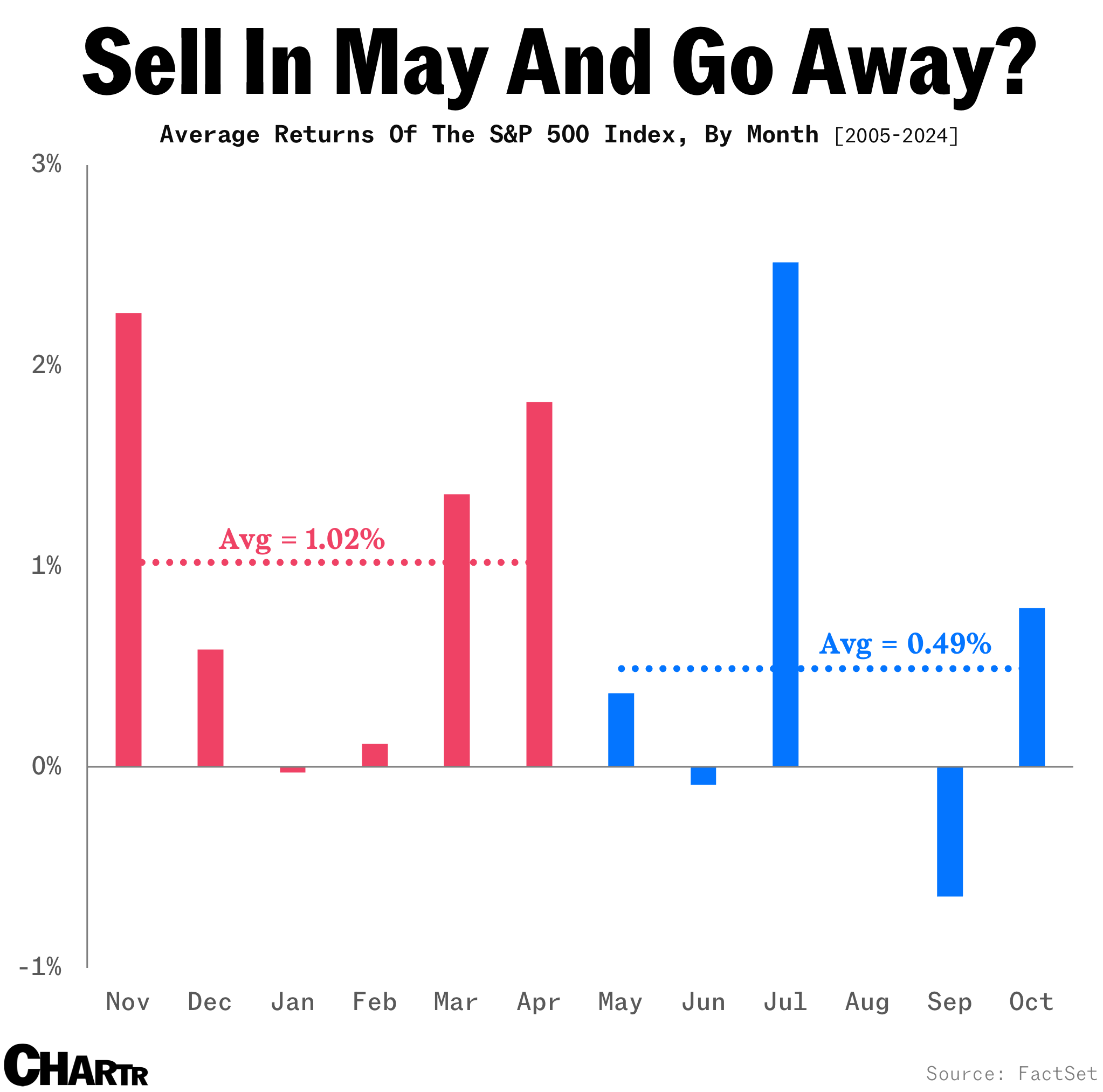
Monthly Returns SPX
Sherwood News

So, yeah, today’s downturn is almost certainly just the GDP numbers, tariff jitters, and the latest saga in the AI trade. But maybe — just maybe — there are a few folks out there hitting the sell button who are heading to a beach for the next six months. If that’s you, please get in touch.


More Markets

See all Markets

Gold and silver plunge, suffering their worst losses since the 1980s

Gold and silver suffered their worst losses in decades on Friday, with the iShares Silver Trust falling more than 30% at one point during afternoon trading before recovering slightly.

After recently crossing $5,000 per ounce for the first time, golds dip was relatively muted compared to silvers rout, but nevertheless eye-watering for a traditional safe haven asset. At one point, golds intraday dip exceeded 10%, its worst intraday drop since the 1980s and surpassing its declines seen during the 2008 financial crisis, per Bloomberg.

Silvers drop was its worst in percentage terms since 1980.

Gold, and particularly silver, have been pushed higher recently by a storm of retail trader enthusiasm for the metals, as well as more traditional drivers of precious metals such as geopolitical risks and concerns over a fall in the dollars value due to trade wars and possibly waning central bank independence.

Leveraged ETFs that hold gold and silver futures have become increasingly popular trading vehicles amid the parabolic moves in precious metals prices, and likely contributed to the magnitude of the unwind today.

Case in point: look at silver futures for delivery in March. That’s the dominant contract held by the ProShares Ultra Silver ETF, which offers exposure to 2x the daily move in the shiny metal. Volumes exploded (and the contract rebounded modestly) right around 1:25 p.m. ET, which is when silver futures settled and around the time the ETF performed its daily rebalancing (which in this case, involved massive selling).

Gaming stocks plunge following release of Google’s AI tool that can create playable, copyrighted worlds

Shares of major gaming companies are plunging on Friday as investors get a deeper look at the capabilities of Google’s new generative-AI prototype, Project Genie.

The tool allows users to “create and explore infinitely diverse worlds” with a text or image prompt. Users have already exposed its ability to realistically recreate knockoffs of copyrighted games from Nintendo and other gaming companies.

As users experiment with recreations of game worlds like Take-Two’s “Grand Theft Auto 6,” shares of major gaming companies are sinking. Unity Software, the maker of the popular Unity game engine, is down over 25%, while gaming platform Roblox is down about 9%.

Collision 2019 - Day One

D-Wave Quantum CEO on what’s next after the most eventful month in the company’s history

“If 2025 was the international year of quantum, 2026 is the international year of D-Wave Quantum,” said CEO Dr. Alan Baratz.

Luke Kawa1/30/26
markets

SoFi bests Wall Street’s Q4 expectations, shares rise

SoFi Technologies reported better-than-expected Q4 sales and earnings-per-share numbers Friday before market open, sending the shares higher in the premarket. 

The online lender reported: 

  • Adjusted Q4 earnings per share of $0.13 vs. the $0.12 consensus estimate collected by FactSet.

  • Adjusted revenue of $1.01 billion in Q4 vs. the Wall Street forecast for $977.4 million.

  • Q1 2026 adjusted net revenue guidance of approximately $1.04 billion vs. the $1.04 billion consensus expectation, according to FactSet.

SoFi shares rallied roughly 70% last year, as the company’s growing menu of financial products — including trading, wealth management, mortgages, credit cards, and cryptocurrency trading — showed signs of gaining traction beyond its traditional base of student borrowers. But the stock has stumbled in early 2026, falling nearly 7% in January through Thursday’s close, though most of that slump seems to have been reversed this morning.

Latest Stories

Sherwood Media, LLC produces fresh and unique perspectives on topical financial news and is a fully owned subsidiary of Robinhood Markets, Inc., and any views expressed here do not necessarily reflect the views of any other Robinhood affiliate, including Robinhood Markets, Inc., Robinhood Financial LLC, Robinhood Securities, LLC, Robinhood Crypto, LLC, or Robinhood Money, LLC.