
Markets
Vintage character design of a calendar
Getty Images
Sell me maybe

Stocks are sinking today — it’s surely the GDP numbers and not the fact that it’s the last day of April

It’s definitely not investors getting a jump start on “sell in May and go away.” Right?

David Crowther

After weeks of good news being bad and bad news being good for the stock market, this morning appears to be one of those rare days when market participants of all levels of sophistication get to say the rarest of phrases: I know why the market is doing what it’s doing.

Indeed, the cause of today’s market malaise, with the SPDR S&P 500 Trust Index still in the red despite staging a mini midmorning rally, seems easy to diagnose. As my colleague Luke Kawa put it:

“US stocks are sliding in early trading after the Bureau of Economic Analysis reported that the advance estimate of first-quarter GDP showed a 0.3% contraction in the economy compared to Q4.”

But, to quote Michael Scott, “I’m not super-stitious but I am a little stitious.” And today’s downturn in US stock markets just happens to come on the last trading day of April, giving ammunition to the small group of investors who espouse the old stock market adage that you should “sell in May and go away.”

As someone who typically puts as much faith in stock market voodoo as I put in my own ability to time the market (none), I’m hesitant to write about seasonal patterns. Though it might only be a very distant cousin of technical strategies like the “Inverse Head and Shoulders Pattern,” the “Broadening Bottom,” or the “Quasimodo Pattern,” the notion that what month it is matters is hard to swallow. But swallow it we must, because there is a substantial body of evidence confirming the fact that stock market returns tend to lag over May and the summer period that follows.

Per Fidelity’s research (emphasis ours):

“Since 1990, the S&P 500 has gained an average of about 2% from May through October. That compares with a roughly 7% average gain from November through April.”

It’s hard to tell at a glance, but even on a shorter, more modern time horizon, the monthly returns for the six-month period from the start of November to the end of April have averaged around 1%, while the May to October six-month swing has produced roughly half the returns, at 0.5%.
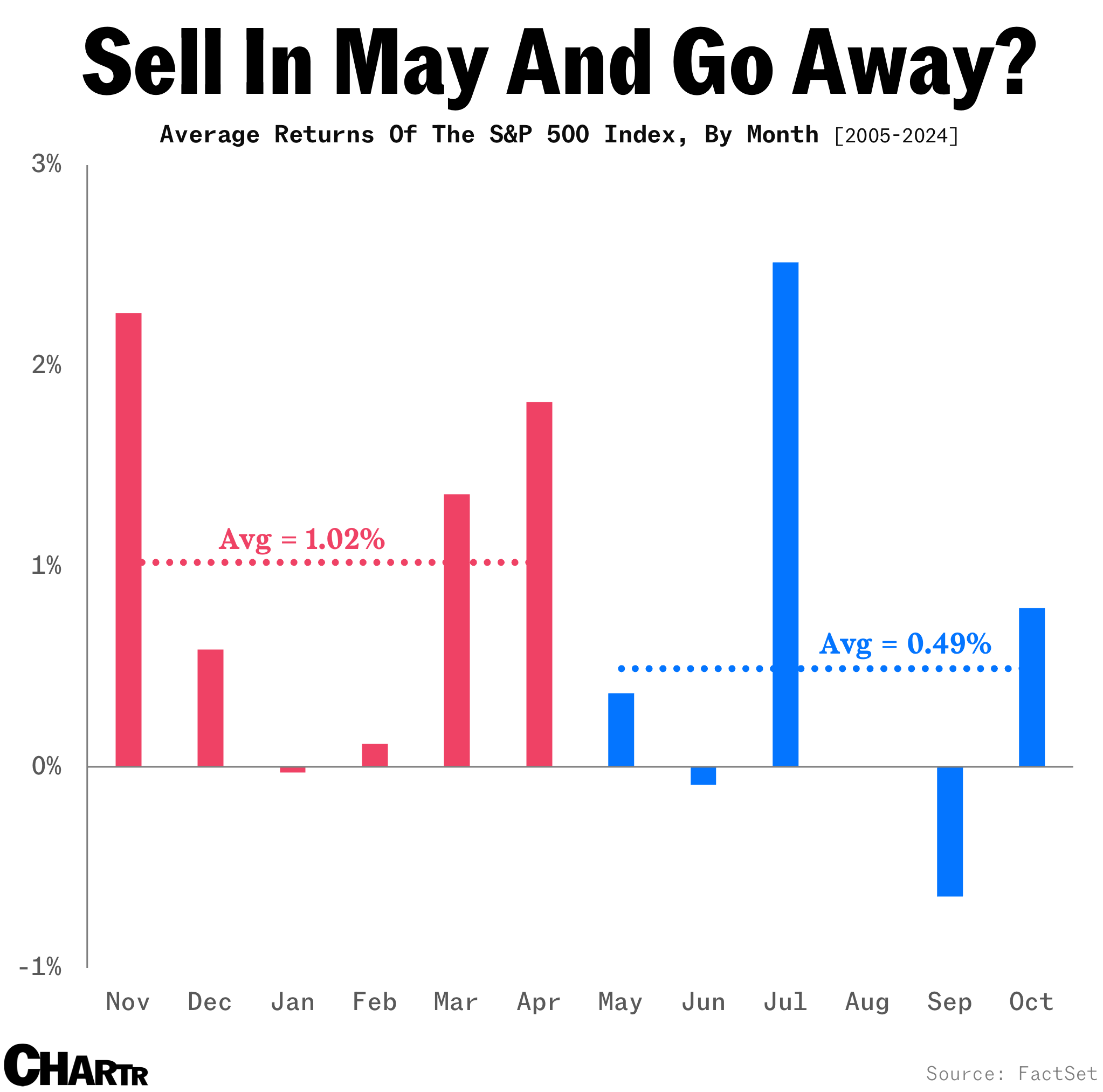
Monthly Returns SPX
Sherwood News

So, yeah, today’s downturn is almost certainly just the GDP numbers, tariff jitters, and the latest saga in the AI trade. But maybe — just maybe — there are a few folks out there hitting the sell button who are heading to a beach for the next six months. If that’s you, please get in touch.

More Markets

See all Markets
markets

SpaceX gets a wave of bullish ratings from Wall Street analysts

SpaceX received more than a dozen positive analyst calls on Tuesday — including from major Wall Street banks — as they initiate coverage on Elon Musk’s space and AI company.

SpaceX went public on June 12 at a $2.2 trillion valuation, the largest debut in history. While the company hasn’t yet posted a profit, it seems to have convinced Wall Street that it will get there and grow its valuation on the way.

Of the at least 17 analysts that gave a rating on Tuesday, all but one gave it a “buy” or “outperform” rating. MoffettNathanson was "neutral."

The ratings come as SpaceX joined the Nasdaq 100 index, a benchmark tech-heavy basket of companies that underpins millions of portfolios. The inclusion adds built-in demand for the stock from index funds and ETFs.

Still, SpaceX fell more than 5% on Tuesday amid a broader sell-off, and is currently effectively flat from its opening price of $150 a share.

markets

Nike sinks to lowest level since 2014 after warning of “challenged” sales environment in Q4 report

Did Nike do it?

Investors had a mixed reaction after the global sports apparel company reported its fourth quarter earnings on Tuesday after the bell. Shares initially rose 5% as Nike beat out Wall Street expectations amid a hefty tariff refund bonus. However, the stock then sank to its lowest level since August 2014 in postmarket trading.

Here are the Q4 numbers:

  • Revenue of $11.0 billion (estimate: $10.8 billion).

  • Adjusted earnings per share of $0.20 (estimate: $0.12).

Ahead of this report, Nike warned that results would be flattered by a one-time tariff refund (now estimated at roughly $0.52 per share for the bottom line). That gave the company an extra cushion in snapping its streak of seven quarters of year-over-year profit declines.

Over the past year, the company had been punished by tariffs on imported goods, stagnant consumer spending, and increasing competition from other footwear brands like New Balance, Adidas, and Hoka.

Outgoing CFO Matthew Friend deemed it an “increasingly challenging operating environment, where sell-through remains challenged.”

Latest Stories

Sherwood Media, LLC and Chartr Limited produce fresh and unique perspectives on topical financial news and are fully owned subsidiaries of Robinhood Markets, Inc., and any views expressed here do not necessarily reflect the views of any other Robinhood affiliate, including Robinhood Markets, Inc., Robinhood Financial LLC, Robinhood Securities, LLC, Robinhood Crypto, LLC, Robinhood Money, LLC, Robinhood U.K. Ltd, Robinhood Derivatives, LLC, Robinhood Gold, LLC, Robinhood Asset Management, LLC, Robinhood Credit, Inc., Robinhood Ventures DE, LLC and, where applicable, its managed investment vehicles.

