

Markets
markets
Luke Kawa

Strategists sound alarm over silver’s rally, recommend options trades for potential violent reversal

Silver’s ridiculous romp higher in 2025 and at the start of this year is showing some signs of fraying around the edges.

And with just how fierce the move higher has been, strategists are warning of the potential for intense downside as some of the key parts of the fundamental and technical theses for silver are starting to look less solid.

Michael Purves, CEO of Tallbacken Capital Advisors, who’s been bullish on the shiny metal, thinks it’s once again time to hedge long exposure.

On Thursday, he recommended selling $95 strike calls on the iShares Silver Trust that expire in February to purchase $75 strike puts.

Purves previously recommended that clients hedge their silver exposure on December 26 (its 2025 peak) before declaring that the coast was once again clear for longs on December 30.

“It might be surprising to know that speculative long silver futures positions are at 20 month lows, or that Open Interest is at five year lows,” he wrote. “Once again, hedging long positions is in order — particularly given the distorted put-call skew which allows [investors] to sell calls to finance long put positions.”

Viresh Kanabar, an investment strategist at Macro Hive, followed this up on Friday by flagging one of several key changes in the market structure for silver. The physical market tightness, cited by bulls as an important driver behind silver’s skyward ascent, is showing signs of reversing.

“1m forwards on physical silver have flipped back to contango,” he wrote. “This lines up with physical ETF outflows and evidence that high prices are weighing on industrial demand.”
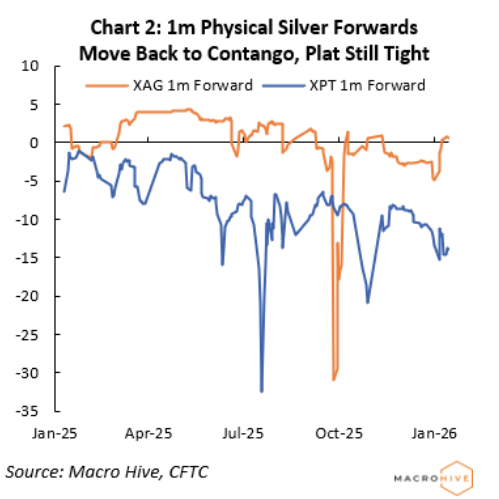
Silver contango

“In short, we are not bullish on silver at these levels, instead, see increasing signs of risks skewing to the downside,” Kanabar added.

David Cervantes, founder of Pinebrook Capital Management, told clients on Thursday that he’s taken a short position in silver by owning put options on SLV with three months to expiry, noting that its outperformance of the stock market over the past 100 and 252 days has reached unprecedented levels.

“THIS IS HIGHLY SPECULATIVE AND A SMALL GAMBLE-SIZED WAGER WILL BE MADE OVER WHICH SLEEP WILL NOT BE LOST,” he emphasized.

More Markets

See all Markets
markets

Investors are itching to buy the dip in memory stocks

The intense drubbing in South Korean stocks, with the benchmark KOSPI falling nearly 20% in its first two trading days of the week following a Monday holiday, represented a serious threat to the hottest AI trade: memory stocks.

South Korea’s market is dominated by two high-bandwidth memory giants: SK Hynix and Samsung.

After Tuesday’s tumble, US investors seemingly said enough is enough: it’s a buy the dip opportunity.

US memory stocks like Micron, Sandisk, Western Digital, and Seagate Technology Holdings are posting massive gains on the day. The advance comes amid positive commentary on demand for memory chips at a Morgan Stanley conference.

Even more interestingly, the iShares MSCI South Korea ETF is up big today despite the KOSPI falling 12% overnight, its largest drop on record. The ETF’s outperformance of the South Korean equity gauge is the largest since 2008, as the financial crisis raged.

The daily performance of these two can differ materially since they trade at different times, and don’t track precisely the same things. US investors are making the bet that a potential break in this momentum trade and the potential for an unwind of retail leverage in South Korean markets be damned, big drops in memory stocks are meant to be bought.

markets

AST SpaceMobile surges on earnings, momentum bounce

Satellite-services-from-space play AST SpaceMobile surged Wednesday after receiving price-target hikes from analysts at Deutsche Bank and UBS amid a broader bounce in retail trading.

Shortly after 1 p.m. ET, the shares were on track for their best daily gain since late January, putting them up 30% for the week — AST reported mixed earnings after the close Monday — and more than 40% for the year.

The stock has been a favorite of smaller traders in recent years who’ve ridden AST’s 250% gain in 2024 and 244% gain in 2025. And the fact that the stock sprung back to life this week may mean that after a couple of dazed days following the outbreak of war between the US (and Israel) against Iran, retail speculators are again dip-buying once again.

That’s consistent with signals coming from the performance of Goldman Sachs’ themed baskets of stocks Wednesday, where some of the biggest gainers are “Meme Stocks” — which includes AST SpaceMobile — “Non-profitable Tech” and “Bitcoin Sensitive Equities.”

markets

GitLab shares dive as death-of-human-coding theme strengthens

Shares of software development service GitLab tumbled Wednesday after lackluster guidance undermined an otherwise solid set of Q4 results.

The hard numbers, however, may be less important for the shares than the hardening narrative entombing the company, whose stock price is down roughly 60% over the last year, at last glance.

In short, the problem is that GitLab sells coding and software development services long used by human coders and software developers. And investors think rapid advances in AI coding, through programs like Claude Code, mean there will be far fewer flesh-and-blood programmers to use GitLab in the future.

To wit, this report from The Information notes that OpenAI is developing an alternative to Microsoft’s GitHub — not to be confused with GitLab, an independent company, though both offer similar services such as code repositories and collaborative software development tools.

For sure, it’s not clear that human coders are destined for the dustbin of history. But it does seem fairly obvious that far fewer will be needed.

As I’ve written recently, that makes the AI boom somewhat distinct from other recent tech frenzies, in which programmers were typically insulated from the job losses their work often unleashes.

In short, the problem is that GitLab sells coding and software development services long used by human coders and software developers. And investors think rapid advances in AI coding, through programs like Claude Code, mean there will be far fewer flesh-and-blood programmers to use GitLab in the future.

To wit, this report from The Information notes that OpenAI is developing an alternative to Microsoft’s GitHub — not to be confused with GitLab, an independent company, though both offer similar services such as code repositories and collaborative software development tools.

For sure, it’s not clear that human coders are destined for the dustbin of history. But it does seem fairly obvious that far fewer will be needed.

As I’ve written recently, that makes the AI boom somewhat distinct from other recent tech frenzies, in which programmers were typically insulated from the job losses their work often unleashes.

markets

Ross Stores climbs after posting stronger-than-expected Q4 sales

Shares of off-price retailer Ross are up more than 6% on Wednesday morning, following the release of the company’s fourth-quarter earnings report after-hours on Tuesday.

Ross posted adjusted earnings of $2 per share in its Q4, ended January 31, beating Wall Street’s expectations of $1.90 per share. Total sales climbed 12% year over year to $6.6 billion, ahead of the $6.4 billion consensus.

CEO Jim Conroy credited some of the company’s success on growth in 18- to 34-year-old customers.

Looking ahead to the current quarter, Ross expects earnings of between $1.60 and $1.67 per share. Analysts polled by FactSet expect $1.68.

Latest Stories

Sherwood Media, LLC produces fresh and unique perspectives on topical financial news and is a fully owned subsidiary of Robinhood Markets, Inc., and any views expressed here do not necessarily reflect the views of any other Robinhood affiliate, including Robinhood Markets, Inc., Robinhood Financial LLC, Robinhood Securities, LLC, Robinhood Crypto, LLC, or Robinhood Money, LLC.