
Markets
US-POLITICS-TRUMP
President Donald Trump steps off Air Force One in Maryland (Brendan Smialowski/Getty Images)

Tariff talk rattles global markets as Q1 draws to a close, Goldman cuts S&P 500 price target

Markets in Europe and China were modestly red, while Japan’s Nikkei 225 dropped 4%.

The final trading session of Q1 2025 is shaping up to be a microcosm of the three-month period that it will close out, with markets around the world turning red as investors second-guess US trade policy.

Speaking about tariffs aboard Air Force One, President Trump told reporters, “You’d start with all countries, so let’s see what happens” — a comment that’s spooked investors when combined with reports that advisers have been considering a blanket 20% tariff on all US trading partners, ahead of Wednesday’s “Liberation Day.”

Japan’s Nikkei 225 dropped sharply in early trading and never dug itself out of its hole, ending today’s session down 4%, officially entering correction territory. Europe’s flagship index, the STOXX 600, is down 1.6%, and US markets are following it into the red, with the SPDR S&P 500 Trust currently down 1.4%. Though tariff-sensitive stocks like General Motors are down modestly, the price action in early trading suggests that high-beta names like Palantir and Super Micro Computer — many of which are associated with the AI trade — may be hit hardest.

Growth scare

After a flurry of soft economic data, US stocks closed out last week with a 2% drop as investors reevaluate their assumptions about the economy. Cracks in certain areas, like the credit market, signal that Wall Street is officially in “growth scare” mode. In a note published yesterday evening, Goldman Sachs officially slashed its S&P 500 forecasts for the second time this month, citing higher tariffs and growing recession risks. The bank now expects the index to dip to 5,300 over the next three months, before rebounding to 5,700 by year-end and 5,900 in 12 months.

GS Forecasts
Sherwood News

The new year-end target marks a sharp downgrade from the earlier 6,200 and stands just 2% above where the index closed on Friday, putting it among the lowest forecasts on Wall Street, per Bloomberg. Goldman now assigns a 35% chance of a US recession over the next 12 months — up from the previous 20% — warning that if history repeats, stocks could fall another 17% from current levels, down to ~4,600. Event contract platforms like Kalshi now predict a 42% chance of a US recession this year, up from ~18% in mid-January.

Tariff fever

In the summer of 2022, fear of inflation peaked, with Google Trends data revealing that searches for the term reached their highest volume in August — just two months after US inflation itself topped out, with the CPI Index clocking a 9.1% year-on-year increase in June.

At the time, it was hard to imagine an economic term becoming more prevalent than that in our everyday lives. But the endless tariff talk since, as consumers buzz about Trump’s favorite trade policy instrument, has seen searches for “tariffs” skyrocket since the start of the year.
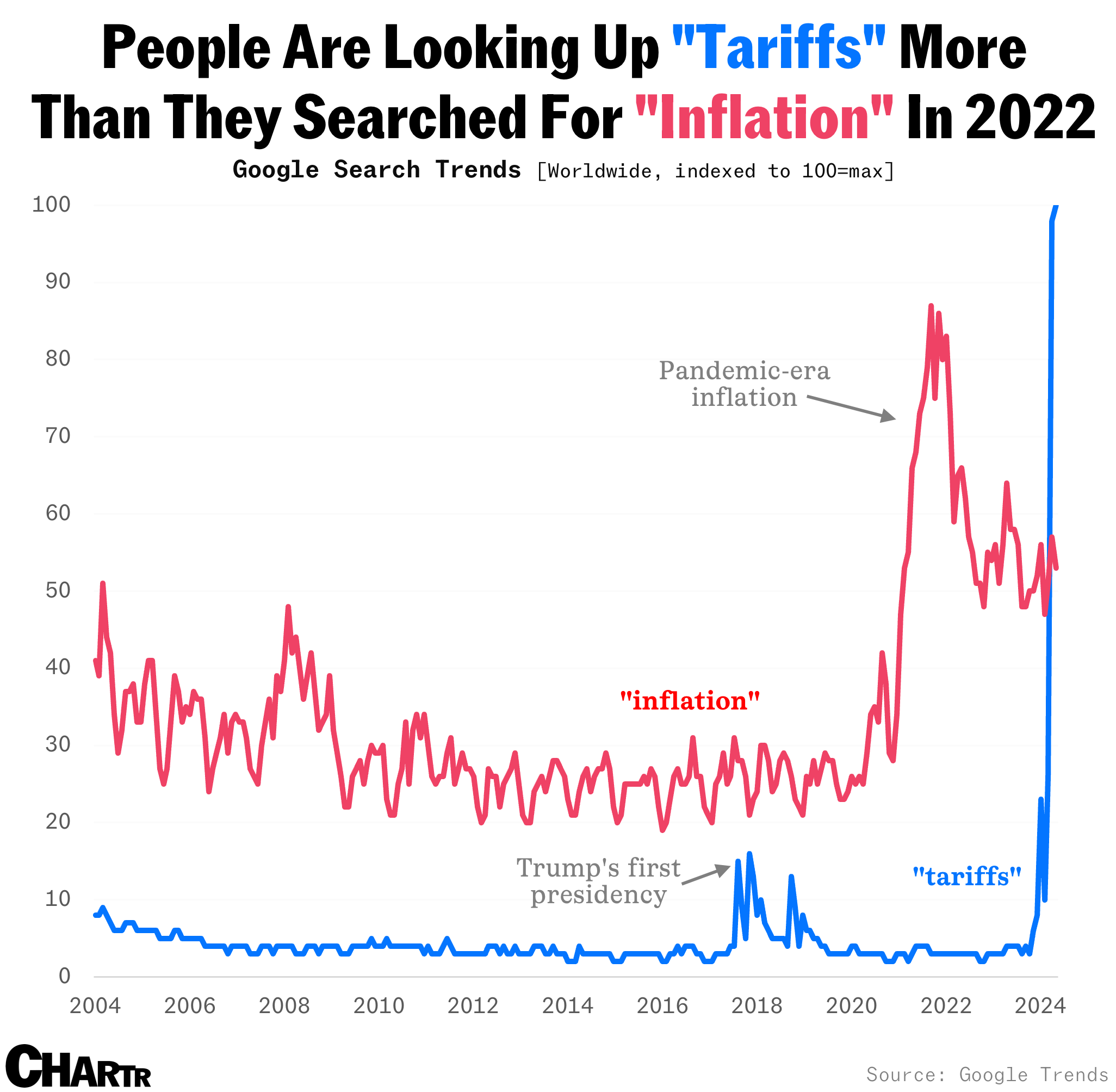
Tariffs vs. inflation
Sherwood News

Company leaders are also obsessed with discussing them: for the latest quarter, the terms “tariff” and “tariffs” were featured in S&P 500 companies’ earning calls more than any other since early 2018. Interestingly, however, the number of S&P 500 companies citing the word “recession” was the lowest in over five years, per FactSet data.

So long, Q1

Though quarters are as arbitrary a measurement as any other, the end of March brings a chance to reflect on the market’s winners and losers so far.

Winners: Topping the S&P 500 Index this quarter, barring any major moves in afternoon trading, is CVS Health, which has gained a whopping 50%. Other defensive names like tobacco giant Philip Morris and AT&T are also near the top of the leaderboard, as are a number of energy stocks, which is the best-performing sector year-to-date.

Losers: We won’t labor the point on Tesla. It’s having a terrible, horrible, no good, very bad year. But it’s actually not the worst-performing S&P 500 stock; that dubious honor falls to Deckers Outdoor, owner of shoe brands like Hoka and Ugg, which has fallen 45% as growth slows at its key brands.

More Markets

See all Markets
markets

Wendy’s spikes on heightened attention from Reddit’s retail traders

From flipping burgers to being flipped by retail traders:

It seems Wendy’s may now be a meme stock?

Shares are up over 30% in early trading, with the ticker being the most mentioned on the WallStreetBets subreddit over the past 12 hours, per SwaggyStocks.

As of 9:03 a.m. ET, more money had changed hands trading Wendy’s stock in the premarket than Microsoft, Palantir, Apple, Amazon, or Meta.

(I’m no doctor, but I think pairing this with a short-lived meme stock of 2025, Krispy Kreme, could result in negative health outcomes.)

User u/ElegantCombination43 recently tried to stir up support by posting in r/wallstreetbets that redditors “need to save Wendy’s before it’s too late,” adding that “we’ll all be out of a job” if it goes bankrupt.

On Tuesday morning, the fast food chain announced a C-Suite shuffle, hiring Steve Cirulis from Potbelly to serve as chief financial officer and chief strategy officer.

Wendy’s could certainly use a shot in the arm to bolster its operations: trailing 12-month sales and adjusted earnings per share for Wendy’s are flat and lower, respectively, since the end of 2023.

Anyhow, Wendy’s fries are superb and second to none. Don’t @ me.

markets

Google invests $75 million in film studio A24, forms AI partnership

Google is investing roughly $75 million in independent film studio A24 as part of an AI partnership, according the Wall Street Journal. The investment marks Google’s first direct stake in a film studio.

Under the agreement, A24 will work with Google DeepMind to develop and test AI tools for filmmaking and production workflows, the Journal reports.

The deal comes as A24 continues to expand its business beyond indie films into television, music, and live events. Since its 2013 launch, the studio has produced Oscar-winning films such as Everything Everywhere All at Once. Its revenue has more than doubled over the past two years, according to the Journal, and the company was last valued at $3.5 billion in a Thrive Capital-led funding round in 2024.

Google’s investment comes as major technology companies increasingly deepen ties with media companies as generative AI tools become more integrated into creative industries. For Google, the partnership also expands DeepMind’s reach into entertainment and film production.

The firm and TV industry is pushing to develop AI tools that can be integrated into the time-consuming and expensive production process. In a sign of the potential value of such tools, in March, Netflix announced it would acquire Ben Affleck's startup InterPositive, which is building AI film-making tools, for $600 million.

markets

Getty Images surges following OpenAI partnership

Getty Images is surging in early trading after the company announced a multi-year licensing and product partnership with OpenAI.

Under the agreement, OpenAI will license Getty’s library of images, videos, and metadata for use in training and improving its AI models, while Getty will integrate OpenAI’s generative AI tools into its own products and services.

The deal comes as Getty faces growing pressure from generative AI tools that can create stock image-like images in seconds, threatening parts of its traditional licensing business. Getty posted revenue of $226.6 million in Q1, down 2.5% year over year on a currency-neutral basis.

Getty was one of the earliest major content companies to challenge AI firms in court, suing Stability AI in 2023 for allegedly scraping millions of copyrighted images without permission to train image-generation models.

The OpenAI deal follows Getty’s 2025 licensing agreement with Perplexity, which gave the AI search company access to Getty’s library and required image credits with links to original sources.

Before the announcement, Getty shares had been trading below $1 for months. The stock surged by 124% in early trading, erasing its year-to-date losses as investors are waiting to see if Getty can turn its licensed content library into a more valuable AI asset.

Latest Stories

Sherwood Media, LLC and Chartr Limited produce fresh and unique perspectives on topical financial news and are fully owned subsidiaries of Robinhood Markets, Inc., and any views expressed here do not necessarily reflect the views of any other Robinhood affiliate, including Robinhood Markets, Inc., Robinhood Financial LLC, Robinhood Securities, LLC, Robinhood Crypto, LLC, Robinhood Money, LLC, Robinhood U.K. Ltd, Robinhood Derivatives, LLC, Robinhood Gold, LLC, Robinhood Asset Management, LLC, Robinhood Credit, Inc., Robinhood Ventures DE, LLC and, where applicable, its managed investment vehicles.

