
Markets
US-TECHNOLOGY-AI-MICROSOFT-COMPUTERS
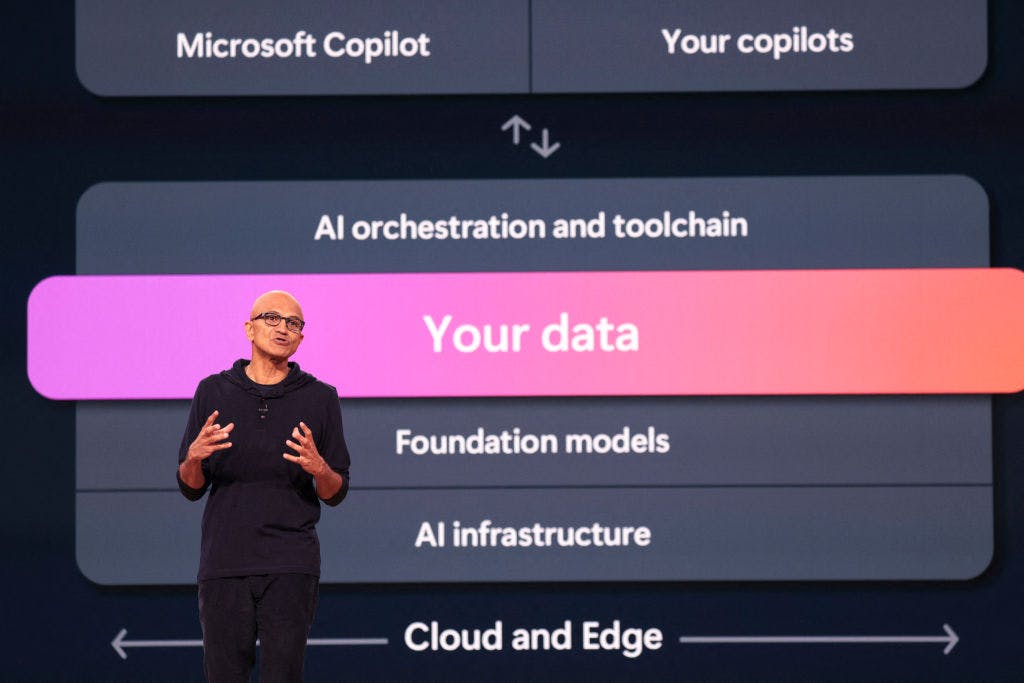
Microsoft CEO Satya Nadella (Jason Redmond/Getty Images)

TD Cowen warns that Microsoft might already have too many data centers

Despite CEO Satya Nadella making comments to the contrary last fall, analysts say the tech giant may now be in an oversupply position.

Microsoft’s boom in AI data center spending may have gotten out over its skis, according to a TD Cowen report published Friday that’s causing aftershocks across Wall Street and all the way over in Europe.

“Our recent channel checks indicate that Microsoft has terminated select leases with at least two private data center operators across multiple US markets to the tune of ‘a couple of hundred MW,’” wrote analysts led by Michael Elias, also saying that some of its real estate management tactics mirror measures that Meta took while curtailing its metaverse-related capex binge. Separately, they flagged that Microsoft may be reallocating some of its international spending budget to the US.

“Our initial reaction is that this is tied to Microsoft potentially being in an oversupply position,” they concluded.

European stocks with a link to the AI data center trade are taking one on the chin on Monday.

Chatter around this report, as well as the monthly options expiry, likely contributed to the magnitude of the losses across chip stocks on Friday, with Nvidia, Micron, Intel, and Microchip Technology all down 4% to 5%.

Of note: these are communication infrastructure analysts; Elias & Co. don’t cover Microsoft, but rather the likes of telecom infrastructure companies like American Tower, Crown Castle, and Equinix.

Last October, Microsoft CEO Satya Nadella said that supply constraints weighed on the company’s revenue generation from AI services “because data centers don’t get built overnight.” That message on the need to scale up was affirmed by the company’s massive capital outlay plans.

A Microsoft spokesperson reiterated Microsoft’s plans to spend over $80 billion on infrastructure this year, though they noted that the tech giant “may strategically pace or adjust” such spending.

The continued willingness of megacap tech companies to spend hundreds of billions on capex has been a massive boon for S&P 500 profit generation, and is probably one of the most critical factors to monitor in terms of judging whether the AI boom has gotten a little long in the tooth.

More Markets

See all Markets
markets

IonQ and D-Wave Quantum spike as Jefferies initiates coverage with “buy” ratings

Shares of IonQ and D-Wave Quantum are soaring on Tuesday after Jefferies initated coverage on the stocks with buy ratings and price targets of $100 and $45, respectively.

Rigetti Computing, which Jefferies started with a hold rating and $30 price target, is modestly lower. These three quantum computing companies are all down between 40% and 60% from their October all-time highs.

All 13 analysts who cover D-Wave have a buy (or equivalent) rating, while 75% of the dozen on Wall Street who have a rating on IonQ recommend the stock.

While the speculative AI-linked stocks continue to largely get crushed, this pocket of the market also favored by retail traders is showing some signs of life.

Chip Stocks Bubble

Chip stocks are in a bubble, at least by this definition, says analyst

The definition of a “bubble” is notoriously difficult to pin down. But these analysts applied a Harvard academic’s rubric and found the shoe fits for some popular tech stocks.

markets

Frontier sinks as longtime CEO, who regularly feuded with United, suddenly departs

Shares of ultra-budget airline Frontier are down more than 10% on Tuesday morning following the carrier’s announcement that it would replace its longtime CEO, Barry Biffle. Frontier President James Dempsey will fill in as interim CEO.

Biffle, who has been Frontier’s CEO since early 2016, will remain at the airline in an “advisory capacity” until December 31. The move is “not the result of any disagreement with the Company on any matter relating to the Company’s operations, policies or practices,” per a company filing.

Under Biffle, Frontier attempted to acquire rival Spirit twice since 2022 — both unsuccessful. Last week, the carrier’s shares dropped after Spirit’s pilots ratified a lower-paying contract in an effort to keep it afloat through its latest bankruptcy.

Biffle was a staunch defender of the ultra-budget model, which has been falling out of fashion in the US market in recent years. He’s regularly feuded with United Airlines CEO Scott Kirby over comments about budget airlines.

Latest Stories

Sherwood Media, LLC produces fresh and unique perspectives on topical financial news and is a fully owned subsidiary of Robinhood Markets, Inc., and any views expressed here do not necessarily reflect the views of any other Robinhood affiliate, including Robinhood Markets, Inc., Robinhood Financial LLC, Robinhood Securities, LLC, Robinhood Crypto, LLC, or Robinhood Money, LLC.
